
To train staff to answer busy calls, teach one job for the rush: capture the caller's name, number and need in under 60 seconds, then promise a callback. Training improves speed but cannot add capacity. One person fielding 12 four-minute calls an hour still misses about 44% of them, so shorten the call and add a second answerer or an overflow option.
TL;DR:
- Calls blocked at peak depend on call length and headcount. The Erlang B formula shows one answerer missing 29% of calls at 6 four-minute calls an hour.
- Train a 60-second capture script (number, name, need, location, callback window) and drop troubleshooting from the first call.
- Cutting average call length from 4 minutes to 2 does as much for a single answerer as adding a second person does at the lighter load.
- Plan on roughly two hours of script drilling, then four weeks of reviewing about 10 recorded calls a week.
- When peak volume exceeds what two people can cover, add overflow coverage instead of more training.
Table of Contents
- Train Staff to Answer Busy Calls: Fix the Capacity Math Before the Script
- How to Get Through a Busy Phone Line, and What Callers Do When They Can't
- The 5 Customer Service Skills That Matter on a Busy Line
- The 5 P's of Telephone Etiquette, Cut to a Ringing-Queue Version
- The 60-Second Capture Script, Plus a Printable Cheat Sheet
- How Long Is the Training? Two Hours, Then Four Weeks of Review
- When Training Hits Its Ceiling: Overflow Rules and Handoffs
- Get Peak-Hour Calls Captured Without Hiring Another Receptionist
- Frequently Asked Questions
- Sources
Train Staff to Answer Busy Calls: Fix the Capacity Math Before the Script
Most training plans start with tone and greetings. Start with arithmetic instead. The number of calls that find nobody free depends on how many calls arrive and how long each one lasts, and friendliness does not change that.
Two ideas from queueing theory apply here. Little's law says the average number of calls in progress equals the arrival rate times the average call length. Agner Krarup Erlang, a Danish engineer who studied telephone traffic, turned that load into a blocking probability. His Erlang B formula gives the share of calls that hit a busy line when no one queues. For a small office, "blocked" means voicemail, a busy signal or a ring-out.
If you are still working out why calls go unanswered in the first place, the main guide to unanswered phone calls covers the causes. This article covers only the training side.
| Peak-hour scenario | Load (Erlangs) | 1 person answering | 2 people answering |
|---|---|---|---|
| 6 calls/hour, 4 minutes each | 0.40 | 29% blocked | 5% blocked |
| 12 calls/hour, 4 minutes each | 0.80 | 44% blocked | 15% blocked |
| 12 calls/hour, 2-minute capture-only calls | 0.40 | 29% blocked | 5% blocked |
These figures come from the Erlang B formula and assume calls arrive at random. Real peaks clump (everyone calls after a storm or at 7:45 a.m.), so treat the table as a best case.
Halve the average call from 4 minutes to 2 and a lone answerer at 12 calls an hour goes from missing 44% of callers to missing 29%.
Here the obvious answer is wrong. Training everyone to be faster and friendlier barely moves the number. Training everyone to keep the first call short does.
How to Get Through a Busy Phone Line, and What Callers Do When They Can't
If you are the caller, the fastest route through a busy line is to call at an off-peak hour, usually mid-morning or mid-afternoon, since most small offices clog right after opening and right before close. If the business lists a mobile number, a text often gets a reply faster than a third redial. Check the listing for a booking form too.
If you are the owner, think about the same experience from your customers' side. A busy signal, a full voicemail box and a ring-out all count as a missed call, and most callers move on to the next name in the search results instead of leaving a message. Set your phones to forward on busy and on no-answer to a second person or a second number. Train whoever picks up there to run the same short script as the first answerer.
The 5 Customer Service Skills That Matter on a Busy Line
Generic lists of customer service skills include patience, problem solving and product knowledge. On a busy line you need a narrower version of each.
- Active listening. The answerer repeats the number and the request back once. This catches the wrong digit before the caller hangs up.
- Speaking clearly while rushed. Drill the greeting until it takes five seconds and sounds the same on the fortieth call of the day.
- One-sentence empathy. "That sounds stressful, I'll get this to the right person right now" does the job. Long sympathy burns minutes you are short on.
- Enough job knowledge to triage. Staff need to tell an emergency (active leak, no heat in winter) from a quote request. They do not need to diagnose anything.
- Ending a call on purpose. Closing politely when another line lights up is the skill most training skips. Teach the phrase: "I have everything I need, you'll hear back by 2 p.m."
We would skip upselling and small talk during peak hours. Both lengthen calls, and length is what blocks the next caller.
The 5 P's of Telephone Etiquette, Cut to a Ringing-Queue Version
Trainers vary on the exact words, but the usual list is Prompt, Polite, Prepared, Professional and Positive. Here is how we would teach each one when three lines are lit.
- Prompt. Pick up by the third ring, and if you can't, make sure the call rolls to someone who can. Speed matters more here than polish.
- Polite. A short "thanks for holding" beats a long apology, and it never asks the caller to wait without a time frame.
- Prepared. The pen, the job form and the callback list are within reach before the phone rings, not after.
- Professional. Use the business name in the greeting and keep background noise down. A caller deciding whether to trust you has only your voice to go on.
- Positive. Say what will happen ("Dave will call you by noon") instead of what can't ("he's not available").
The 60-Second Capture Script, Plus a Printable Cheat Sheet
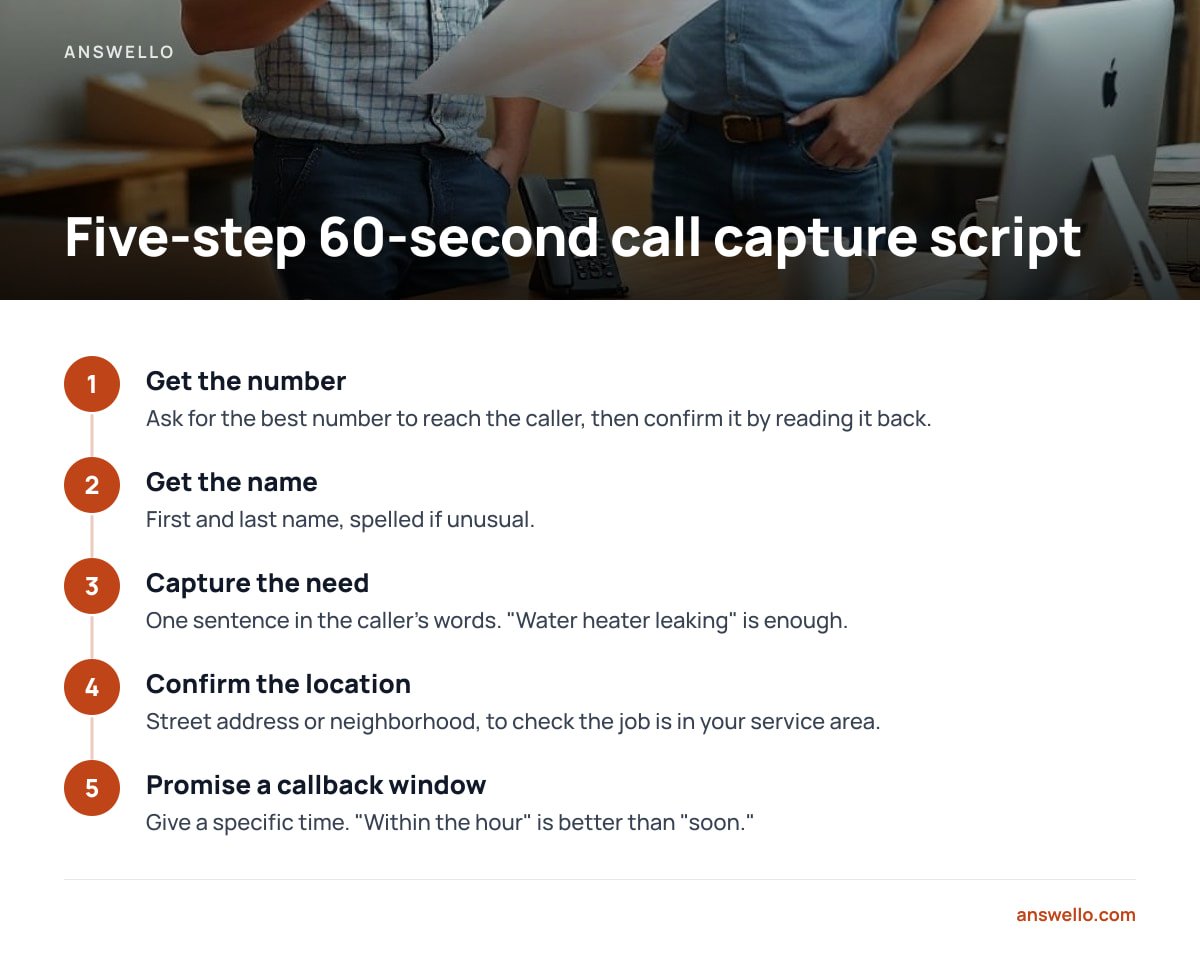
During a rush, the first call is not the place to solve anything. Its job is to get the lead into your hands. Train staff to ask these five things in this order.
- Number. "What's the best number to reach you?" Confirm it by reading it back.
- Name. First and last, spelled if unusual.
- Need. One sentence, in the caller's words. "Water heater leaking" is enough.
- Location. Street address or neighborhood, so you know whether the job is in your service area.
- Callback window. Give a specific time. "Within the hour" is better than "soon."
Pro Tip: Have staff run the script against a stopwatch, and put the phone number first, ahead of the name. Callers hang up mid-script more often than you expect, and a name with no number is worthless while a number alone is still a lead. If the script takes more than 60 seconds out loud, cut a question until it doesn't.
If you went looking for a PDF, the cheat sheet is the five steps above on one page, with the callback promise written at the bottom so nobody improvises it. Print it and tape it by every phone. Forum threads on this topic, Reddit included, are useful for phrasing people actually say aloud, but check any advice against your own call volume before you adopt it.
How Long Is the Training? Two Hours, Then Four Weeks of Review

For large call centers, onboarding can last weeks. The U.S. Bureau of Labor Statistics classifies customer service representative work as short-term on-the-job training, so the skill is learned mostly by doing calls, not by sitting in a classroom.
A small trades office needs far less. We would run it like this:
- Hour one. Walk through the script and the emergency-versus-routine rules, and role-play five calls each.
- Hour two. Practice the hard moments: a second line ringing, an angry caller, a caller who wants a price right now.
- Weeks one to four. Listen to about 10 recorded calls a week and pick one thing to fix per person.
The ten-call habit does most of the work. People improve when someone listens, and they stop improving when nobody does.
When Training Hits Its Ceiling: Overflow Rules and Handoffs
Look back at the table. At 12 four-minute calls an hour, two well-trained people still miss 15%. If your peak looks like that, you need a different tool, not another training session.
Your options in order of cost are forward-on-busy to a second person's mobile, a human answering service, or an AI answering system. We would pick the cheapest one that catches the calls you lose at peak, and decide what the overflow does before you sign anything. Read how to set call routing and hand off to a human so your emergencies still reach a person fast. Check the privacy risks of AI phone answering, especially around call recording, before you turn anything on. If you go with a staffed service, the contract terms worth negotiating are the ones that bite later.
Get Peak-Hour Calls Captured Without Hiring Another Receptionist
Answello is a one-time-purchase AI phone-answering system that picks up the calls your crew misses, works out who is calling and what they need, and texts you the name, number and request with a transcript. It runs the 60-second capture script on every call at once, so a 4 p.m. rush stops costing you 44% of your callers. The self-install package is $399 one time. The fully configured package with a custom script is $895 one time. Multiple brands or numbers sit under a single payment. Recordings and transcripts go into a dashboard where you can review them the way you would review staff calls.
The optional looked-after plan tunes the script as you review calls. It costs $119 a month, you can cancel anytime, and the system works without it. It captures and summarizes, but it will not diagnose a leaking pipe or quote a job, so keep your staff trained for the callbacks, and test the setup with your own peak-hour calls before you rely on it.
Frequently Asked Questions
How do you get through a busy phone line?
Call at an off-peak hour, usually mid-morning or mid-afternoon, and text the business if it lists a mobile number. As an owner, forward calls on busy and on no-answer to a second number so callers never reach a dead end.
What are the top 5 skills for customer service on the phone?
Active listening, clear speech under pressure, one-sentence empathy, enough job knowledge to triage urgent from routine, and the ability to end a call politely. On busy days these matter more than a long list of soft skills, because every extra minute blocks the next caller.
What are the 5 P's of telephone etiquette?
Most trainers use Prompt, Polite, Prepared, Professional and Positive, though some lists swap in Patient or Pleasant. On a busy line, apply them as: pick up fast, thank callers briefly, keep a pen and form ready, state the business name, and say what will happen next.
How long is the training for a call center?
Large call centers commonly run onboarding for several weeks, and the U.S. Bureau of Labor Statistics lists customer service representative work as short-term on-the-job training. A small trades office can do the job with about two hours of script practice and four weeks of reviewing roughly 10 recorded calls a week.
Why does one trained person still miss calls during a rush?
One person can only catch so many calls. By the Erlang B formula, one answerer handling 12 four-minute calls an hour misses about 44%, and halving the call length to 2 minutes cuts that to about 29%. Past a certain volume you need a second answerer or overflow coverage.
Sources
- Erlang (unit) | Wikipedia
- Little's law | Wikipedia
- Customer Service Representatives, Occupational Outlook Handbook | U.S. Bureau of Labor Statistics
Leave a Reply