
The average call minutes a small business answering service handles run roughly 100 to 400 per month for a typical one-to-three-truck trades business, though no published survey gives a reliable national figure. Only the calls you miss reach the service, so count those, multiply by about 2.5 minutes each, and add 15 to 25 percent for rounding, spam and transfers. That calculation beats any industry average.
TL;DR:
- Most one-to-three-truck trades businesses use about 100 to 400 billed minutes a month. A solo operator can sit near 70, and a busy multi-brand shop can pass 600.
- Total call volume is the wrong input. Only the calls you miss or forward become billable minutes.
- Use this formula: missed calls x average billed length (1.5 to 3 minutes) x 1.15 to 1.25 for rounding, spam and transfers.
- Callers who used to hang up on voicemail stay on the line once a live answer picks up, so add about 25 percent to your current missed-call count.
- Size a per-minute plan at 1.5 times your estimate and get the overage rate in writing.
Table of Contents
- Average Call Minutes for a Small Business Answering Service: The Working Range
- Why No Trustworthy National Average Exists
- The Three-Number Formula for Your Monthly Minutes
- Four Sample Businesses, Run Through the Math
- Where Extra Minutes Come From: Rounding, Spam and Chatty Callers
- How to Pull Your Own Numbers in One Afternoon
- What I Would Pick: Sizing a Per-Minute Plan
- Stop Counting Minutes: A One-Time-Purchase Answering System
- Frequently Asked Questions
- Sources
Average Call Minutes for a Small Business Answering Service: The Working Range
Based on the formula below, a solo operator with one phone number lands near 50 to 120 billed minutes a month. A two- or three-truck shop usually falls between 200 and 400. A multi-brand business running several numbers can reach 500 to 800. These are planning ranges built from call counts and call lengths, not survey results, and the next section explains why.
If you are deciding between paying per minute and a flat monthly fee, the trade-offs are laid out in Flat Rate Phone Answering Service: Real Costs, Real Trade-offs. This article only covers how many minutes you will use.
Why No Trustworthy National Average Exists
The U.S. SBA Office of Advocacy generally treats any independent business with fewer than 500 employees as small. A 400-person manufacturer and a one-man roofing outfit share that label, and their phone habits have nothing in common. Any "average small business" minute count mixes the two.
Providers publish plan tiers, usually in blocks like 50, 100 or 200 minutes. Those tiers are pricing decisions that show how a vendor wants to sell, not how much a real shop talks. Treat them as a menu, not a benchmark.
The Three-Number Formula for Your Monthly Minutes
Your usage comes from three inputs:
- Forwarded calls. Count only the calls you miss or send to the service. If you answer 70 percent of your calls yourself, only the other 30 percent can ever become minutes.
- Average billed length. A message-taking call usually runs 1.5 to 3 minutes. Calls where the service also qualifies the job, asks about address and urgency, or books an appointment run toward the long end.
- Overhead. Add 15 to 25 percent for rounding up, spam calls, transfers and callbacks.
Multiply them: missed calls x billed length x 1.15 to 1.25.
Sixty missed calls at 2.5 minutes each is 150 minutes. After a 20 percent overhead allowance, you should expect to be billed for about 180.
Four Sample Businesses, Run Through the Math

The profiles below use a flat 2 to 2.5 minutes per call and a 20 to 25 percent overhead allowance. Swap in your own figures.
| Profile | Missed calls/month | Avg. minutes | Overhead | Billed minutes |
|---|---|---|---|---|
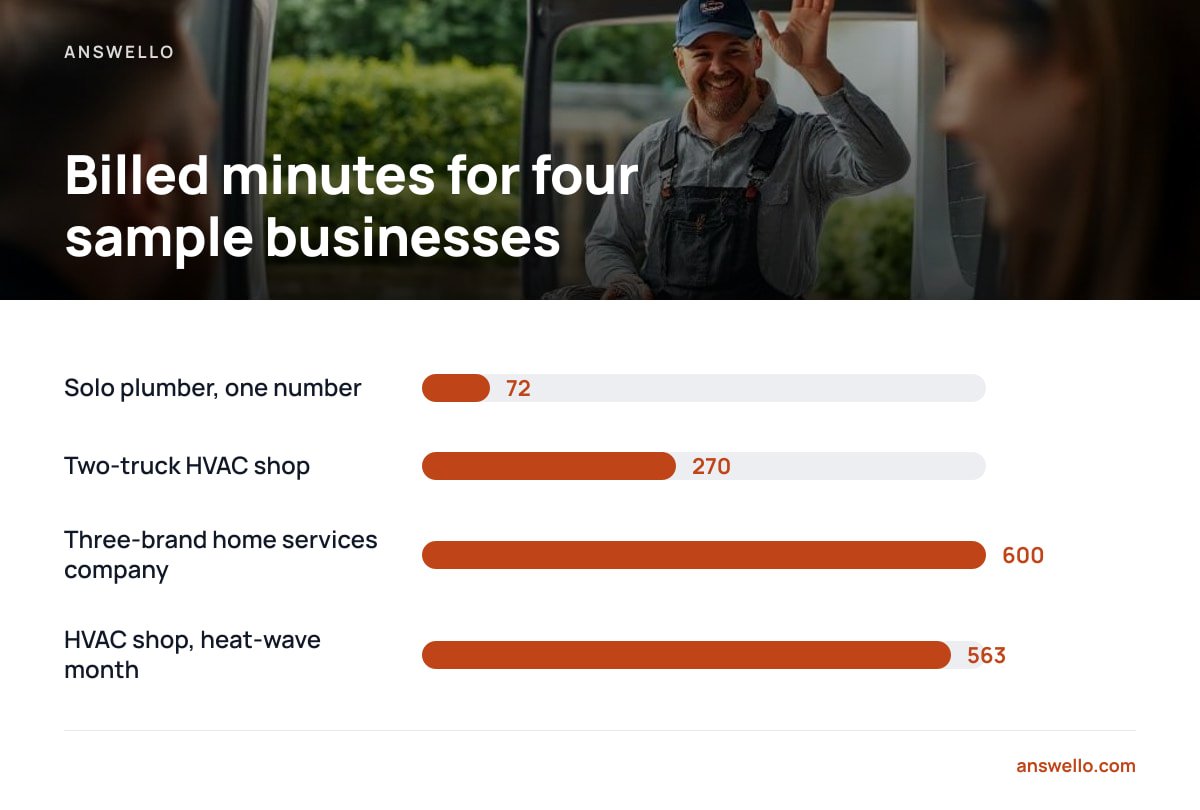
| Solo plumber, one number | 30 | 2 | 20% | 72 |
| Two-truck HVAC shop | 90 | 2.5 | 20% | 270 |
| Three-brand home services company | 200 | 2.5 | 20% | 600 |
| Same HVAC shop in a heat-wave month | 180 | 2.5 | 25% | 563 |
The last row trips people up. A shop that normally uses 270 minutes can double its calls in a single bad-weather month, and a 300-minute plan turns into an overage bill. Size for your peak month, not your average one.
Where Extra Minutes Come From: Rounding, Spam and Chatty Callers
Overhead is where estimates fail, so it helps to know the sources:
- Rounding increments. Some services bill each call in full-minute blocks, so a 20-second call costs a minute. Others bill per 6 or 30 seconds. On short calls the difference can be 30 percent or more, so put it in the contract. See Answering Service Contract Terms to Negotiate Before You Sign.
- Spam and robocalls. A service that answers every ring answers the junk too. The FCC's STIR/SHAKEN call authentication framework has carriers sign caller ID information so spoofed numbers can be flagged, but a robocaller using a real number still rings through. Ask whether the service screens before it starts the meter.
- Chatty callers. One 12-minute call about a leaky water heater costs as much as five normal ones, and services that bill by the minute rarely cut these short.
- Transfers and callbacks. If a human agent patches the caller through to you and stays on the line, both legs may count. Routing rules decide how often that happens, as covered in AI Receptionist Call Routing Setup: When to Hand Off to a Human.
How to Pull Your Own Numbers in One Afternoon
You do not need a spreadsheet model, just 90 days of call history and about an hour.
- Download call detail records from your carrier or phone app for the last three months.
- Filter to inbound calls that went unanswered or hit voicemail. That is your forwarded-call count.
- Divide by three for a monthly figure, then find your single busiest month and note it separately.
- Use 2.5 minutes as your length unless you already have transcripts showing something different.
- Apply the overhead multiplier, then compare the result to the plan tiers you are considering.
If you record calls to check lengths later, consent rules differ by state. The Reporters Committee for Freedom of the Press recording guide summarizes one-party and all-party consent laws across the U.S.
Pro Tip: Raise your missed-call count by about 25 percent before you multiply. Plenty of callers hang up on voicemail without leaving a message, so your carrier log shows a 10-second missed call. Once a live voice answers, those same people stay on the line and describe the job. Your minutes will rise after you start answering, even though your call volume has not changed. That 25 percent is my rule of thumb, not a measured figure, so check it against your first month.
What I Would Pick: Sizing a Per-Minute Plan
If you stay with a per-minute service, buy a tier at about 1.5 times your calculated figure. A shop that estimates 270 minutes should shop 400-minute plans. A plan that is 30 percent too big costs a few dollars. One that is 30 percent too small costs overage rates, typically the most expensive minutes on the invoice.
Get three things in writing: the rounding increment, the overage rate per minute, and whether unused minutes roll over. Then track handle time and answer rate monthly, using the metrics in After Hours Answering Service Performance Metrics That Matter. If minutes per call creep above 3, the script is probably asking too many questions.
I prefer to avoid the meter entirely when the business is small and the calls are routine. Minute-counting is a tax on being busy, and the busiest months are when you can least afford a surprise.
Stop Counting Minutes: A One-Time-Purchase Answering System
A per-minute bill grows when your phone rings more, and your phone rings more when business is good. Answello sells an AI phone-answering system you buy once. It picks up the calls you miss, identifies the caller and what they need, and texts you the name, number, request and a transcript, so you can see exactly what each call cost you in time. The self-install package is $399 one-time. The fully configured package with a custom script is $895 one-time. Several brands or numbers can run under a single payment.
An optional maintenance and tuning plan costs $119 a month, is cancelable anytime, and you can skip it. The purchase price covers the system, not your own phone carrier's charges or forwarding fees, so check your carrier's rates and our spec sheet before you buy. An AI answerer also handles routine calls better than angry or complicated ones, so keep a route to your cell for emergencies.
Frequently Asked Questions
How many minutes does a small business use per month on an answering service?
Most one-to-three-truck trades businesses land between 100 and 400 billed minutes a month, based on the formula of missed calls times billed length times overhead. A solo operator can be near 70, and a multi-brand company can pass 600. No authoritative national survey exists, so calculate your own figure.
What is a normal length for an answered call?
A message-taking call typically runs 1.5 to 3 minutes. If the service also asks qualifying questions, collects an address or books a time, expect the upper end or slightly beyond. Use 2.5 minutes for planning until you have real transcripts.
Do I pay for all my calls or only the ones I miss?
You pay only for calls that reach the service, which are the ones you miss or forward. If you answer most calls yourself, your billed minutes will be a small fraction of your total call volume. Check how the service counts forwarded calls that you pick up halfway through.
Why did my minutes go up after I started using an answering service?
Callers who used to hang up on voicemail now stay on the line and explain the job. Your call volume has not changed, but more calls turn into conversations. Add about 25 percent to your missed-call count when you plan.
Should I buy a bigger plan than I calculated?
Yes, size per-minute plans at about 1.5 times your estimate. Overage minutes usually cost more than plan minutes, and seasonal spikes can double your call volume in a single month. Get the overage rate and rounding increment in writing.
Sources
- Office of Advocacy: Small Business Resources | U.S. Small Business Administration, Office of Advocacy
- Call Authentication (STIR/SHAKEN) | Federal Communications Commission
- Reporter's Recording Guide | Reporters Committee for Freedom of the Press
Leave a Reply