

A2P 10DLC registration for missed call texting means registering your business and your texting use case with US carriers, through The Campaign Registry, before software sends automatic texts from a local 10-digit number. A missed call auto-reply counts as application-to-person traffic even though it answers an inbound call, so skipping registration gets your messages filtered. Plan on submitting a brand, a campaign, and sample messages, then waiting days, not minutes.
TL;DR:
- A missed call text back is automated, so US carriers treat it as A2P traffic even though the caller dialed first.
- You register twice: a brand (your business identity), then a campaign (what you text and why). Expect a few business days to a few weeks.
- Most rejections come from mismatched business details, a thin website, public link shorteners, or sample messages with no business name or opt-out language.
- Toll-free verification and personal-phone apps are real alternatives, but each has a trade-off you should know before choosing.
- Texts that go to you, the owner, are a much lighter compliance load than texts that go to callers.
Table of Contents
- A2P 10DLC Registration for Missed Call Texting: Why a "Reply" Still Counts
- Is A2P Necessary? Four Ways to Send, and the One I'd Pick
- The Registration Steps, in the Order That Avoids Rejection
- How Long 10DLC Verification Takes, and What It Costs
- Why Campaigns Get Rejected, and What to Do When Texts Don't Deliver
- Android and Personal-Phone Apps: Skipping Registration Has a Price
- Running Several Brands or Numbers? Registration Multiplies
- Get Missed Calls Answered Without Running a Texting Campaign
- Frequently Asked Questions
- Sources
A2P 10DLC Registration for Missed Call Texting: Why a "Reply" Still Counts
Most owners assume a missed call text back is exempt because the caller reached out first. It isn't. Carriers don't care who dialed first. They care that software, not a person typing on a phone, sent the message from a local 10-digit number. That makes it application-to-person (A2P) traffic, and The Campaign Registry, the database US carriers use to track who is sending what, expects it to be registered.
Quick definitions, since people search for these separately:
- A2P. Application-to-person messaging. A system, such as a missed call tool, sends a text to a human.
- 10DLC. 10-digit long code. An ordinary local-looking phone number, as opposed to a toll-free number or a five- or six-digit short code.
- 10DLC SMS. Any text sent by software from one of those ordinary numbers. Registration ties the number to a verified business and a described purpose.
Twilio's A2P 10DLC documentation lays out the same two-part model of brand and campaign, and it is how most providers pass your registration to the carriers. This all applies to US numbers texting US mobile phones. Outside the US, 10DLC doesn't exist, though other countries have their own consent and sender rules.
If you're still choosing a tool, our comparison of the best missed call text back apps for small business covers that. This page covers only how to get the messages delivered.
Is A2P Necessary? Four Ways to Send, and the One I'd Pick
Yes, if software sends texts from a regular local number. It's not necessary if you pick a different route, and each route has a cost.
| Route | What you register | Best for | The catch |
|---|---|---|---|
| Local 10DLC number | Brand and campaign | Keeping the number printed on your truck and website | Days of waiting, small fees, rules to follow |
| Toll-free number | Toll-free verification (a separate process) | Starting from zero and wanting to send soon | Customers see an unfamiliar number, and verification still takes time |
| Short code | Carrier-approved application | High-volume marketing | Slow and expensive; overkill for missed calls |
| Personal phone app | Nothing formal | A solo owner with a handful of missed calls a week | Not built for automation; breaks when you change phones |
My pick: if the number is already on your van, your invoices, and your Google listing, register it for 10DLC. Customers call that number back, and a reply from a number they don't recognize gets ignored. Pick toll-free only if you have no established number to protect.
The Registration Steps, in the Order That Avoids Rejection
Your provider will walk you through a form. The work is in preparing the answers before you start.
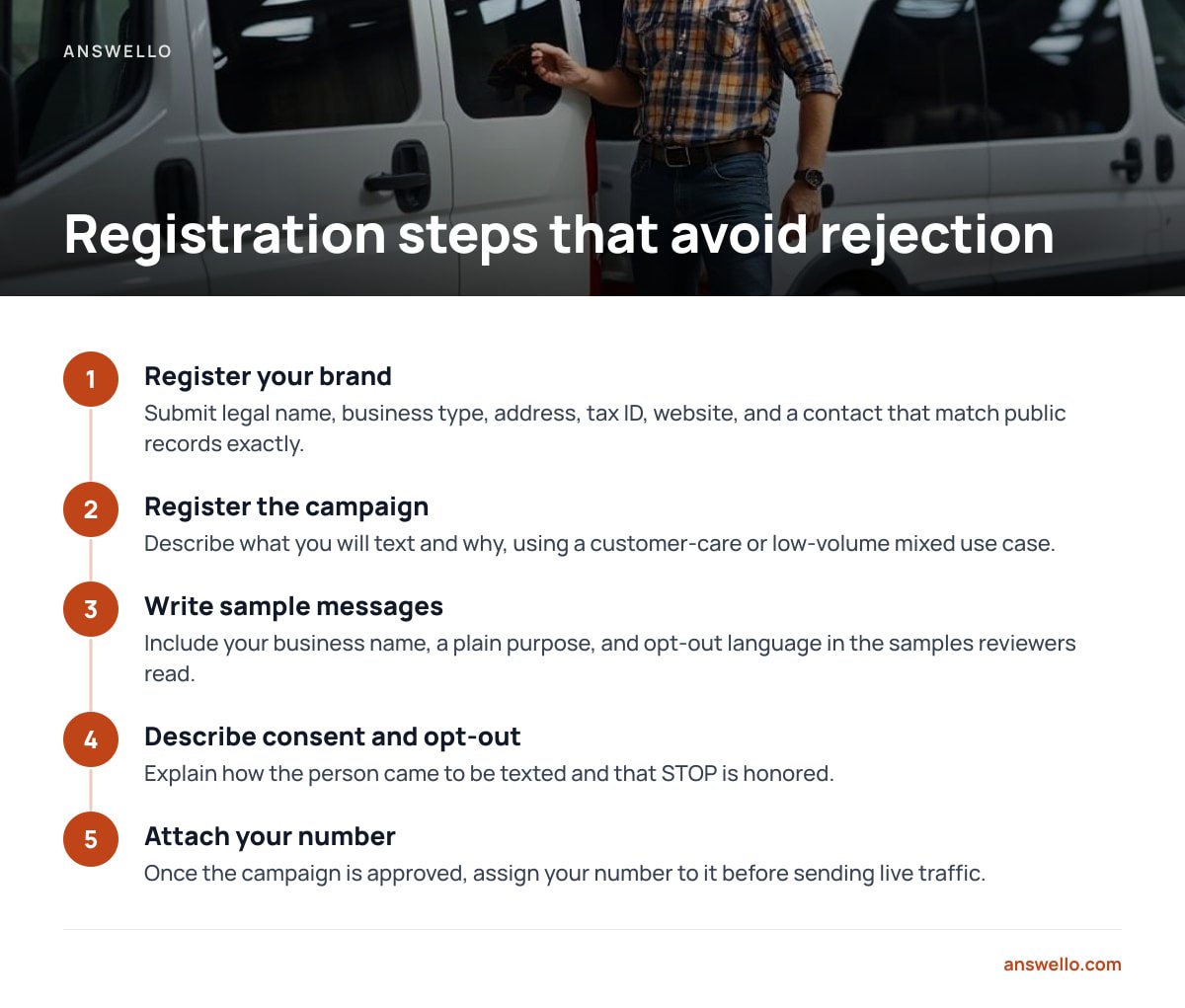
Step 1: Register your brand
The brand is your business identity: legal name, business type, address, tax ID (an EIN in the US), website, and a contact. These must match your public records exactly. "Smith & Sons Plumbing LLC" and "Smith Plumbing" are not the same thing to a vetting system. If you have no EIN, many providers offer a sole proprietor option, which usually comes with strict volume caps and one number.
Step 2: Register the campaign
The campaign describes what you will text and why. For missed call texting you want a customer-care or low-volume mixed use case, not marketing. Describe it honestly: "One automatic reply to a person who called our business line and didn't reach us, asking what they need."
Step 3: Write sample messages that pass
Reviewers read your samples closely. Include your business name, a plain purpose, and opt-out language. For example: "Hi, this is Ridgeline Plumbing. Sorry we missed your call. What do you need help with? Reply STOP to opt out."
Step 4: Describe consent and opt-out truthfully
Explain how the person came to be texted and that STOP is honored. CTIA's Messaging Principles and Best Practices is the industry reference on consent and opt-out. Texting rules are also a legal matter. The FCC's guidance on the Telephone Consumer Protection Act is a starting point, and a short call with a lawyer is cheap insurance if you plan to text anything beyond a one-time reply.
Step 5: Attach your number
Once the campaign is approved, assign your number to it. Until then, don't send live traffic from that number.
How Long 10DLC Verification Takes, and What It Costs
There's no single answer, because the timeline depends on your provider and on whether your first submission is clean. Typical ranges, based on provider documentation and common experience:
| Stage | Typical wait | Typical one-time fee* |
|---|---|---|
| Brand registration | Minutes to a couple of days | A few dollars |
| Campaign vetting | Several business days; up to a few weeks if sent back for fixes | Around $15 |
| Linking your number | Minutes | Usually none |
| Ongoing campaign fee | Monthly, while active | A few dollars per month |
*These are pass-through carrier-side fees. Providers add their own, so check your provider's current pricing page before you start.
A rejected campaign costs you more in calendar time than in dollars. Each resubmission restarts the review queue, so one clean submission beats three fast ones.
My advice: plan for two weeks, and be pleasantly surprised if it takes four days. Don't schedule a launch around approval.
Why Campaigns Get Rejected, and What to Do When Texts Don't Deliver
The same handful of mistakes causes most rejections.
- Mismatched identity. Legal name, EIN, and address must agree with your records. A typo here fails brand vetting.
- A thin website. Reviewers visit your site. Put your business name, services, contact details, and a privacy policy on it. A single-page placeholder invites questions.
- Public link shorteners. Shorteners are commonly flagged because spammers use them. Use your own domain or leave links out.
- Vague or marketing-flavored samples. A "10% off this week!" line turns a customer-care campaign into marketing, which gets reviewed differently.
- Missing business name or STOP language. The recipient should know who is texting and how to stop it.
Pro Tip: Write your campaign description and sample messages first, then edit your website to match them. Reviewers compare the two. If your site says you do roofing and your campaign says "home services," you've created a mismatch for no reason. Wording the campaign to match what's already on your site is faster than rebuilding the site.
If messages still fail after approval, check the error codes in your provider's logs. Twilio, for instance, documents error 30034 as a message sent from an unregistered number.
Error 30034 means the number was never registered, or never attached to an approved campaign. The carrier didn't lose your text. It refused it.
Other common causes are a campaign still in review, a number not linked to the campaign, or carrier filtering from content that looks like spam (error 30007 in Twilio's list).
Android and Personal-Phone Apps: Skipping Registration Has a Price
People searching for this often ask about Android, because several Android apps send an automatic text from your own SIM when you miss a call. Since those messages leave your personal number, they behave like ordinary person-to-person texts, and they don't go through 10DLC registration.
That is why they're tempting, and it's fine for a solo operator who misses a few calls a week. The trade-offs:
- No business-grade controls. There's no campaign record, no consent paper trail, and no shared inbox.
- Carrier pattern detection. Carriers can still flag a personal number that fires off automatic messages in a pattern, with no registration record to point to.
- Fragility. A phone upgrade, an OS permission change, or a battery-saver setting can silently stop it.
- Your personal number is the sender. If a customer replies at 10 p.m., it lands on your phone.
If you want to understand the mechanics first, see what a text back app actually does and the limits of any automatic text reply.
Running Several Brands or Numbers? Registration Multiplies

If you operate more than one brand, each customer-facing identity needs to match what a caller sees. Carriers vet against a legal entity, so brands under one EIN may share a brand registration, but each campaign's samples and website should show the name the caller actually hears. Separate legal entities need separate brands. A rough count: three brands means three descriptions to write, three sets of samples, and three review waits, often run in parallel.
Subscription tools make this worse, because each added site or number typically adds a monthly line item on top of the registration work. For a three-brand trades business, that adds up quickly.
Get Missed Calls Answered Without Running a Texting Campaign
Answello is built around a different flow than the caller-facing text blast. The AI answers the call you missed, finds out who is calling and what they need, then texts you, the owner, the caller's name, number, request, and a transcript. Because the main text goes to you rather than to a stranger, there's no consent puzzle to solve for the core job. You can read every call and recording in the dashboard. One payment covers multiple brands and numbers. The DIY install is $399 once, or $895 once for the fully configured package with a custom script. The optional "looked after" tuning plan is $119 a month, and you can cancel anytime. For trades-specific detail, see AI call answering for tradespeople.
The caveat is that this is not a way around registration if you also want automatic texts sent to callers from your numbers. That is still A2P traffic, and the steps above still apply. Check the spec sheet, ours included, for exactly how any message is sent and from which number.
Frequently Asked Questions
How long does 10DLC verification take?
Brand registration often clears in minutes to a couple of days, while campaign vetting commonly takes several business days and can stretch to a few weeks if it's sent back for fixes. The exact timeline depends on your provider and how clean your submission is. Plan for about two weeks and treat anything faster as a bonus.
What does A2P messaging mean?
A2P means application-to-person messaging, where software, such as an auto-reply tool, sends a text to a human recipient. It's distinct from person-to-person (P2P) texting, where someone types on a phone. US carriers regulate A2P traffic on local numbers through registration.
Is A2P necessary?
It's necessary if software sends texts from a regular local US number to US mobile phones. You can avoid it by using a verified toll-free number or a personal-phone app, but each has its own trade-offs. For a number you've already advertised, registering is usually the better path.
What is a 10DLC SMS?
A 10DLC SMS is a text sent by software from an ordinary 10-digit long code, meaning a regular local-looking phone number. The "10DLC" system lets carriers verify the business behind the number and the purpose of its messages. A missed call auto-reply sent from your business line is a 10DLC SMS.
Why is my missed call text not sending after I registered?
Check whether the campaign was actually approved and whether your number is linked to it. Then look at your provider's error codes, such as 30034 for an unregistered number or 30007 for carrier filtering in Twilio's list. Content that looks promotional can also trigger filtering.
Sources
- A2P 10DLC overview | Twilio Docs
- The Campaign Registry | The Campaign Registry (TCR)
- Messaging Principles and Best Practices | CTIA
- Stop Unwanted Robocalls and Texts | Federal Communications Commission
- Error 30034: Message from an unregistered number | Twilio Docs
Leave a Reply