
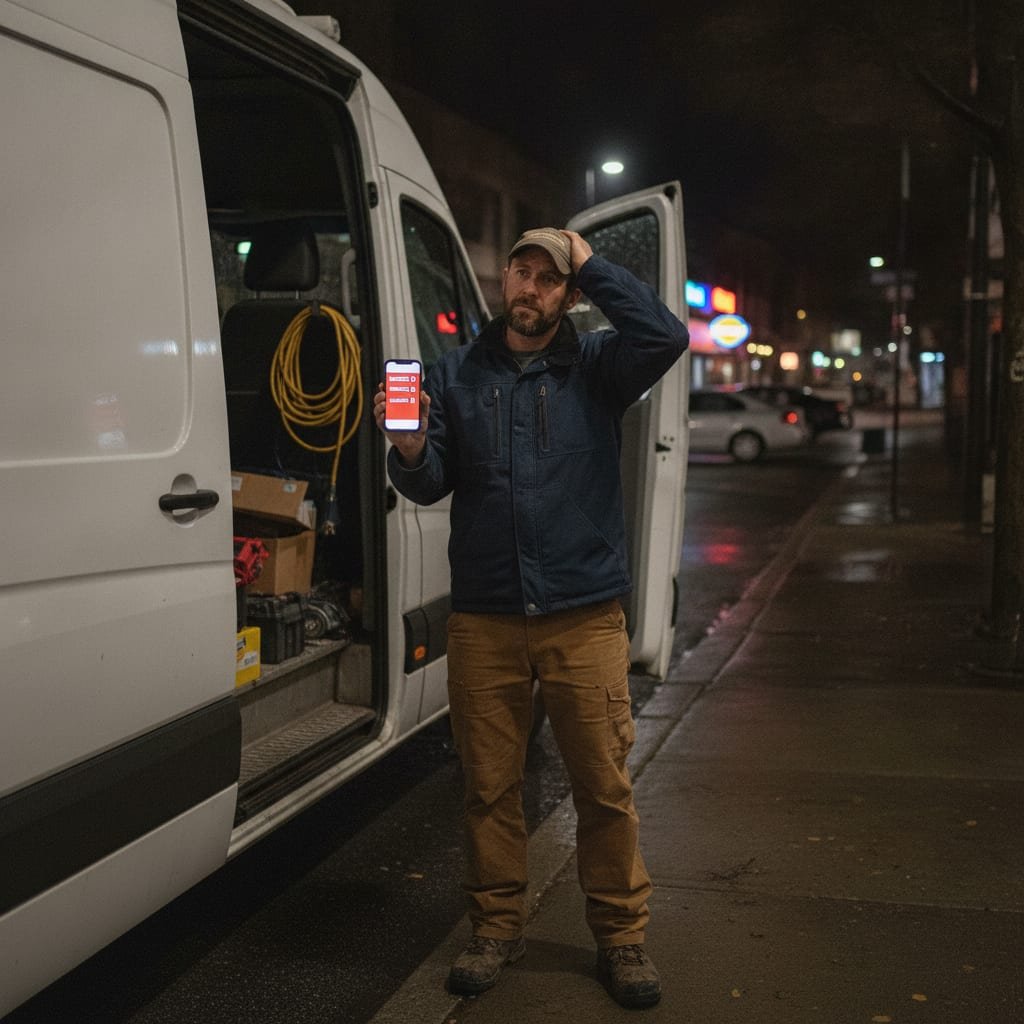
An after hours virtual receptionist is a live agent or AI system that answers your business calls outside normal working hours, when your team has gone home but customers keep calling. The distinction that actually matters isn't live-versus-recorded — it's what happens after the call: whether the message reaches you in a form you can act on immediately, or sits in a voicemail box you check at 8 a.m. tomorrow, by which time the caller has already dialed a competitor.
TL;DR:
- After-hours coverage splits into three models — live human answering, AI voice/text systems, and hybrid — and each has a different cost structure and failure point.
- Live answering services typically charge a monthly base fee plus $1–$2 per minute, which adds up fast once after-hours call volume grows.
- AI receptionist subscriptions usually run $50–$500+ a month depending on volume; Answello sells the same core function as a one-time purchase starting at $399.
- Yes, virtual receptionists — human or AI — take messages; the real question is how fast you get them and in what format.
- Becoming a virtual receptionist needs no license or certification; BLS data puts median receptionist pay around $34,000 a year, and most after-hours jobs are contract or remote.
Table of Contents
- After Hours Virtual Receptionist vs. AI: The Real Difference
- What It Actually Costs: Virtual Receptionist Pricing Broken Down
- Human, AI, or Hybrid: Which After-Hours Service Actually Wins
- Can a Virtual Receptionist Take Messages? Yes — Here's What Changes
- Becoming an After-Hours Virtual Receptionist: Jobs, Pay, and Reality
- Virtual Receptionist for Small Business: When After-Hours Coverage Actually Pays Off
- Get Every After-Hours Call Answered Without Another Monthly Bill
- Frequently Asked Questions
- Sources
After Hours Virtual Receptionist vs. AI: The Real Difference
Most pages on this topic treat "virtual receptionist" as one product with two delivery methods — a human on a headset or a voice synthesized by software. That's the wrong axis. The distinction that actually changes your outcome is what the system does with the information it collects after the call ends. A human answering service takes a message and either emails it, texts it, or logs it in a portal you have to check. An AI system can do the same thing, but the good ones parse the call in real time — caller name, phone number, what they want — and push that straight to your phone as a text, often before the caller has hung up.
This matters because after-hours calls to a small trades business are rarely social. They're a burst pipe at 9 p.m., a locked-out tenant at midnight, a customer calling three plumbers in a row until one picks up. The business that texts the owner "John Reyes, 555-0142, water heater leaking, wants a callback tonight" within ninety seconds of the call ending is going to win that job more often than the one where the message sits in a shared inbox until 7 a.m.
If you want the fuller breakdown of how answering services are structured and priced across the industry, see After Hours Call Answering Service: Costs, Options, Trade-offs.
What It Actually Costs: Virtual Receptionist Pricing Broken Down
How much does a virtual receptionist cost? It depends almost entirely on the billing model, not the brand. Live services bill by the minute or by the call, on top of a monthly base fee that buys you a set number of minutes. AI subscription services bill by seat, by call volume tier, or by minute, similarly stacked on a base fee. A one-time-purchase system charges once for the hardware/software setup and, in some cases, an optional ongoing tuning plan.
| Model | Typical Cost | Billing Trigger | Best For |
|---|---|---|---|
| Live 24/7 answering service | $300–$1,200/month base, plus $1–$2/minute overage | Per-minute or per-call | High after-hours volume, budget for recurring cost |
| AI subscription receptionist | $50–$500+/month | Per-minute, per-call, or per-seat | Businesses comfortable with ongoing SaaS billing |
| One-time AI answering (e.g., Answello) | $399 self-install, $895 done-for-you, optional $119/month care plan | One-time purchase | Trades and multi-brand businesses avoiding recurring fees |
A live answering service billing $1.50 a minute adds up to $900 a month at just ten hours of after-hours calls — before the base fee is even added.
That math is why so many small trades businesses either underuse a live service (because they're rationing minutes) or quietly cancel it after a few months. Virtual receptionist pricing built around per-minute overages punishes exactly the busy season you bought the service for.
Human, AI, or Hybrid: Which After-Hours Service Actually Wins
There isn't one best virtual receptionist service — there's a best fit for your call pattern, and most buyers guess wrong on this the first time.
Live human receptionists
A trained person on the line still wins for calls that need judgment: a patient describing symptoms to a medical office, a tenant disputing a lease term, a customer who's upset and needs to be talked down before any information gets exchanged. Humans read tone and improvise in ways scripted systems can't yet match reliably.
AI voice and text receptionists
For the bulk of after-hours calls to a service trade — "can someone come look at my furnace," "do you do commercial jobs," "what's your rate for an emergency call" — the call follows a predictable script. AI answers consistently, never gets tired at 2 a.m., and costs a fraction of a staffed line for the same coverage. The trade-off is that it handles the unusual call worse than a person would.
Hybrid setups
Some businesses route straightforward calls to AI and escalate anything ambiguous to a live answering service or directly to the owner's cell. It's the most capable setup and also the most expensive, since you're paying for two systems instead of one.
If most of your after-hours calls are routine requests for service, AI wins on cost without losing much on outcome. If your calls regularly involve conflict, medical detail, or legal nuance, pay for a human. For a deeper look at what AI systems specifically do differently, read AI Answering Service: What It Actually Does and Costs.
Can a Virtual Receptionist Take Messages? Yes — Here's What Changes
Every virtual receptionist, live or AI, takes a message in some form — that's the baseline function, not a differentiator. What separates a good service from a mediocre one is speed, structure, and where the message lands. A voicemail transcription emailed to a general inbox is technically "taking a message." So is a structured text sent to the owner's personal phone within a minute, with the caller's name, number, and stated need already pulled out. One of these gets acted on tonight. The other gets read tomorrow with the rest of the inbox.
Answello's approach is the second kind: the AI answers the missed call, identifies who's calling and what they want, and texts the owner a summary and a full transcript, so there's no portal to log into and no voicemail to replay.
Pro Tip: Before signing with any answering service — live or AI — ask them to send you a sample transcript from a call with real background noise, like a running truck engine or a jobsite. Demo calls happen in quiet offices. Real trade calls don't, and that's where transcription quality actually falls apart.
The Telephone Consumer Protection Act requires prior consent before an automated system sends a text to a customer — a rule that applies whether the follow-up message comes from a live agent's software or an AI system.
If a service or system texts customers back automatically (rather than just texting you, the owner), check how it handles consent under that rule before you turn the feature on.
Becoming an After-Hours Virtual Receptionist: Jobs, Pay, and Reality
If you're searching for after hours virtual receptionist jobs rather than looking to hire one, the barrier to entry is low and the pay reflects that. No license or certification is required in most jurisdictions. Employers — answering-service companies, medical practices, law firms — typically want reliable internet, a quiet space, comfort with call-handling software, and availability during overnight or weekend shifts, since that's when demand for after hours phone answering service jobs is highest and hardest to staff.
The U.S. Bureau of Labor Statistics tracks receptionists and information clerks as a broad occupational category, with median annual pay in the low $30,000s as of its most recent Occupational Outlook Handbook data — after-hours and remote roles can pay somewhat above or below that depending on shift and employer. Most postings show up directly on answering-service company career pages rather than general job boards, since the work is specialized enough that generic listings underperform.
Virtual Receptionist for Small Business: When After-Hours Coverage Actually Pays Off
The honest trade-off nobody selling you a service wants to state plainly: after-hours coverage costs money whether it's a human or an AI system, and for a business that gets two or three calls a week after 6 p.m., the math rarely justifies a recurring monthly bill. The calculation changes fast for a trades business — plumbing, HVAC, electrical, locksmith — where after-hours calls are often emergencies with high willingness to pay, and where a missed call doesn't mean a delayed sale, it means the customer calls the next name on the list.
The best answering service for small business use isn't necessarily the most feature-rich one. It's the cheapest system that reliably captures the caller's name, number, and request, and gets that information to you fast enough to call back before the customer moves on. For businesses running more than one brand or phone number — a common setup among multi-service trades operators — that also means checking whether the service can handle multiple numbers under one account instead of billing you separately for each. See AI Phone Answering System for Plumbers: What It Actually Costs for a breakdown specific to one of the highest-volume after-hours trades. For a plainer walkthrough of what these systems do end to end, Can AI Answer Phone Calls and Text a Summary: What Actually Matters covers the mechanics without the sales pitch.
Get Every After-Hours Call Answered Without Another Monthly Bill
Answello answers the calls you miss, texts you the caller's name, number, and what they need, and logs the full transcript — without billing you per minute or per seat. The self-install package is $399 one-time; the done-for-you version with a custom script is $895 one-time; an optional $119/month care plan exists for businesses that want ongoing tuning, and you can cancel that plan anytime without losing the core system. It covers multiple brands or numbers under a single purchase, which matters if you run more than one business line. The honest limit: it's built for capturing and routing missed calls, not for handling complex, judgment-heavy conversations — check the spec sheet if your after-hours calls skew toward that kind of complexity.
Frequently Asked Questions
How much does a virtual receptionist cost?
Live answering services usually run $300–$1,200 a month plus $1–$2 per minute in overage charges, while AI subscription receptionists cost roughly $50–$500+ a month depending on call volume. One-time-purchase systems like Answello sidestep the recurring bill entirely, charging once — $399 to $895 depending on setup — with an optional monthly maintenance plan.
Which virtual receptionist service is the best?
There's no single best option — live agents win for emotionally complex or high-stakes calls, while AI wins for the routine, high-volume calls typical of trades businesses. The right choice depends on how predictable your after-hours call pattern is and whether you want to pay a recurring fee or a one-time cost.
How do I become a virtual receptionist?
No license or certification is required in most places; you need reliable internet, comfort with call software, and availability for overnight or weekend shifts. The U.S. Bureau of Labor Statistics places median pay for receptionists in the low $30,000s annually, and most after-hours openings are posted directly by answering-service companies rather than general job boards.
Can a virtual receptionist take messages?
Yes — every virtual receptionist, human or AI, takes messages as its core function. What varies is speed and format: some send a voicemail transcript to a shared inbox you check later, while others, like AI systems that text you directly, deliver the caller's name, number, and request within a minute of the call ending.
What's the difference between a virtual receptionist and a virtual phone receptionist?
In practice these terms are used interchangeably; both describe a remote system, human or AI, that answers business calls without a physical front-desk presence. Some vendors use 'virtual phone receptionist' to emphasize the call-handling function specifically, as opposed to broader virtual assistant duties like scheduling or email.
Do virtual receptionist services work for a solo, one-person small business?
Yes, and arguably they matter more for solo operators, since a single person can't answer a call while already on a job site or under a sink. For low call volume, a one-time-purchase AI system tends to make more financial sense than a per-minute live service billed monthly.
Sources
- Receptionists and Information Clerks — Occupational Outlook Handbook | U.S. Bureau of Labor Statistics
- Telephone Consumer Protection Act (TCPA) Overview | Federal Communications Commission
- Telemarketing Sales Rule | Federal Trade Commission
Leave a Reply