
To find the one time purchase vs subscription break even point, divide the upfront price by the monthly amount you stop paying. A $895 purchase that replaces a $99-a-month subscription pays for itself in about nine months. The key detail is that you divide by the monthly difference, not by the subscription price. Any ongoing fee the purchased option still carries shrinks that gap and pushes break-even later, and in some cases it never arrives.
TL;DR:
- Break-even months = (one-time price + setup costs) ÷ (monthly subscription cost − monthly cost of owning).
- A $895 purchase replacing three $99-a-month lines breaks even in about 3 months. Against one $99 line it takes about 9 months.
- Pairing a purchase with a permanent maintenance plan can mean you never break even, so put every recurring fee into the math.
- Discounting for the time value of money barely changes paybacks under a year. It adds months to paybacks over three years.
- If break-even lands beyond half the time you expect to keep the tool, subscribe instead. If it lands under a year, buy.
Table of Contents
- The One Time Purchase vs Subscription Break Even Formula, Step by Step
- Worked Numbers: One Line, Three Brands, and the Maintenance-Plan Trap
- What the Simple Formula Misses: Price Hikes, Lifespan, and the Cost of Money
- Tax Treatment: Usually a Timing Difference, Not a Winner
- Monthly or Yearly Billing, and How Each Moves Your Break-Even
- Cancellation Friction: The Hardest Subscriptions to Leave
- One-Time Purchases and Subscription Types, Defined Plainly
- A Decision Rule You Can Use in Five Minutes
- Break Even on Call Answering in Months, Not Years
- Frequently Asked Questions
- Sources
The One Time Purchase vs Subscription Break Even Formula, Step by Step
The break-even point is the month when the total you've paid for owning a tool equals the total you would have paid by subscribing. Before that month, the subscription was cheaper. After it, every month the purchase keeps working is money you keep. Investopedia's definition of the break-even point describes the same idea in general business terms: the point where total costs and total returns match.
Here is the formula for buying versus subscribing:
Break-even (months) = (Upfront purchase price + one-off setup costs − any setup fee the subscription charges) ÷ (Monthly subscription cost − Monthly cost of owning)
Each part is worth getting right:
- Upfront price. Use what you will actually pay, including installation, configuration or any hardware the purchase needs.
- Subscription setup fee. Many subscriptions charge an onboarding fee. Subtract it, because you avoid it by buying.
- Monthly subscription cost. Use the price you will pay after any introductory discount ends, not the first-month price.
- Monthly cost of owning. Include maintenance plans, hosting, support contracts and usage fees such as call minutes or text messages. People leave this line out more than any other, and it decides most of these comparisons.
If the monthly cost of owning is equal to or higher than the subscription, the bottom of the fraction becomes zero or negative. That means the purchase never breaks even. For call answering specifically, there is more on cutting out recurring fees in how to avoid monthly SaaS fees for call answering.
Worked Numbers: One Line, Three Brands, and the Maintenance-Plan Trap

The subscription prices below are illustrative, round numbers chosen to show how the math behaves. They are not quotes from any vendor. The purchase prices are our own published prices, because the honest way to show this formula is to run it against ourselves.
| Scenario | Upfront cost | Monthly cost of owning | Monthly subscription it replaces | Break-even |
|---|---|---|---|---|
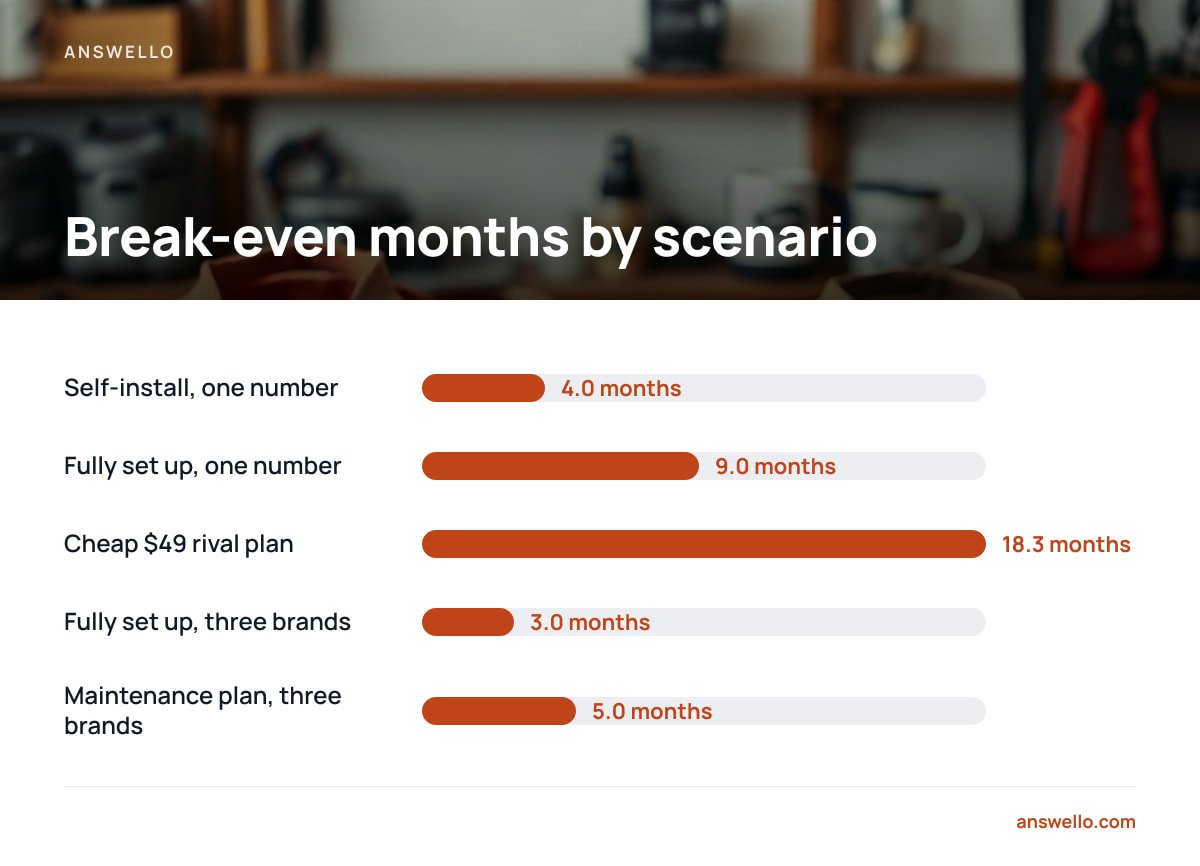
| Self-install, one number | $399 | $0 | $99 (one line) | 4.0 months |
| Fully set up, one number | $895 | $0 | $99 (one line) | 9.0 months |
| Fully set up, cheap rival plan | $895 | $0 | $49 (one line) | 18.3 months |
| Fully set up, three brands | $895 | $0 | $297 (3 × $99, per number) | 3.0 months |
| Set up + $119/mo maintenance, three brands | $895 | $119 | $297 | 5.0 months |
| Set up + $119/mo maintenance, one line | $895 | $119 | $99 | Never |
The last row matters most. If you buy software and then pay a permanent monthly plan that costs more than the subscription you replaced, you have paid for a subscription with an expensive entry fee. The purchase only wins if you drop the plan once the system is tuned, or if you are replacing several per-number subscriptions at once.
The multi-brand rows show the opposite case. Many subscriptions bill per site, per number or per seat, so a trades owner running three brands pays three times. A one-time purchase that covers every number turns the bottom of the fraction from $99 into $297, and break-even drops from nine months to three.
$895 against three $99-a-month lines breaks even in about 3 months. Against one $49 line, it takes over a year and a half.
What the Simple Formula Misses: Price Hikes, Lifespan, and the Cost of Money
The basic formula assumes prices never change and money today is worth the same as money in three years. Neither is quite true. Three adjustments change the answer in practice.
Subscription price increases
Subscription prices rarely stay flat for the life of a contract. Some business agreements tie annual increases to inflation measures such as the Consumer Price Index published by the U.S. Bureau of Labor Statistics. Others simply reserve the right to change pricing at renewal. Any increase makes the purchase look better, because the gap you divide by gets wider. For a payback under a year the effect is small. A 10% increase after month 12 moves the $895-versus-$49 example from 18.3 months to about 17.7. Over five years, those increases add up to real money.
The time value of money
A dollar spent today costs you more than a dollar spent in two years, because you could have used it in the meantime. Investopedia's explanation of net present value covers the method. For this decision, the effect depends on how long the payback is:
- Short paybacks barely move. At an 8% annual discount rate, the $895-versus-$99 example shifts from 9.0 months to about 9.3.
- Long paybacks stretch noticeably. The same $895 against a $25-a-month subscription goes from about 36 months undiscounted to about 41 months discounted.
Run the plain formula for anything that pays back within a year. If the answer is over two years, discount it, or pick a more conservative number.
Useful life
A purchase that breaks even in month 36 and becomes obsolete in month 36 earned you nothing. Before buying, estimate honestly how long the tool will keep working without a paid upgrade. Consider phone carrier changes, operating system updates and whether the vendor will still exist. Then compare that estimate to your break-even.
If break-even lands beyond half the tool's expected working life, the subscription is the safer bet.
Tax Treatment: Usually a Timing Difference, Not a Winner
In the U.S., subscription fees are generally deductible as ordinary business expenses in the year you pay them. Purchased off-the-shelf software can generally be expensed in the year you buy it under Section 179, as IRS Publication 946 explains. For most small businesses that means the tax difference is about when you take the deduction, not whether you get it. It rarely changes which option wins. Rules differ outside the U.S. and change over time, so confirm your position with your accountant before you count tax as a reason to buy.
Monthly or Yearly Billing, and How Each Moves Your Break-Even
Is it better to pay subscriptions yearly or monthly? Pay yearly only for tools you've already used for at least a few months and know you'll keep. Annual plans are usually discounted, and "two months free" is a common pattern. But you prepay the whole year and give up the ability to leave the month a better option appears.
Annual billing also changes your break-even math in two ways:
- It lowers the monthly figure. A $99 monthly plan offered at $990 a year works out to $82.50 a month. Use the lower figure, which pushes the purchase's break-even later. The $895 example moves from 9.0 months to about 10.8.
- It adds a lock-in cost. If you'd switch to a purchase in month four, the rest of a prepaid year is money you won't get back. Add that to the subscription side.
Our position: for a tool you are still evaluating, pay monthly and accept the higher rate. The flexibility is worth more than the discount until you're sure.
Cancellation Friction: The Hardest Subscriptions to Leave

What is the hardest subscription to cancel? The usual suspects are gym memberships, newspaper subscriptions and online services that run you through several "are you sure?" screens and retention offers before you can leave. Regulators have taken notice. In 2023 the Federal Trade Commission sued Amazon, alleging its Prime cancellation process was designed to discourage people from leaving.
For a business buyer, the hardest subscription to cancel is usually an annual software contract with an automatic renewal clause and a notice window. These often require written notice 30 to 60 days before the renewal date. Miss that window and you are committed for another year, which can cost more than the entire purchase price you were comparing against.
Pro Tip: Before you sign, ask the vendor for the renewal price, not the introductory price, and use the month-13 figure in your formula. Introductory discounts are usually set to last roughly as long as a typical break-even window, so they make subscriptions look cheapest exactly when you're doing the math. On signing day, put the cancellation-notice deadline in your calendar.
One-Time Purchases and Subscription Types, Defined Plainly
What is meant by a one-time purchase? You pay once and get the right to use the software indefinitely, usually called a perpetual license. You keep the version you bought, but that doesn't always mean free updates, hosting or support forever. Some of those may carry their own fees, and those fees go in the "monthly cost of owning" line of the formula.
What are the three types of subscriptions? In retail, the common split is:
- Replenishment. Recurring delivery of things you use up, such as razors or coffee.
- Curation. A box of selected items that changes each cycle.
- Access. Membership that unlocks content, discounts or a service.
Software is usually grouped by how you're billed instead:
- Flat-rate. One price for everything.
- Tiered. Price bands by features.
- Usage-based or per-seat. You pay per user, number, site or minute.
Per-seat and per-number pricing are the ones to watch if you run several brands, because the bill grows with every line you add. There is more on which recurring tools actually earn their fee in subscription business software: what you actually need to pay for.
A Decision Rule You Can Use in Five Minutes

A rule of thumb you'll see in forum threads on this question, Reddit included, is "buy it if it pays back within two years." That rule is reasonable, but it leaves out the two things that most often flip the answer: recurring costs on the purchased side and how long the tool will last. Here is a tighter version:
- Run the formula with renewal prices and every recurring fee on both sides.
- Buy if break-even is under 12 months and you expect to use the tool for three years or more.
- Subscribe if break-even is beyond half the tool's expected life, or if you're still testing whether you need it at all.
- Between those, decide on lock-in. If the subscription has an annual auto-renewal with a notice window, lean toward buying. If it's genuinely cancel-anytime, lean toward subscribing.
If the tool earns money rather than just saving it, add that to the comparison too. One recovered job a month can outweigh either price, which how to stop losing jobs to unanswered calls works through with real numbers.
Break Even on Call Answering in Months, Not Years
Answello is a one-time-purchase AI phone-answering system. It picks up the calls you miss while you're on a job, works out who's calling and what they need, and texts you their name, number and request along with a transcript. It covers multiple brands and numbers under one payment, so the per-number multiplier in the table above doesn't apply. The self-install package is $399 one-time. The fully set-up package with a custom script is $895 one-time. Every call is also saved to a recording and transcript dashboard.
The honest caveat is our own $119-a-month maintenance plan. It's optional and you can cancel anytime. But if you would keep it forever against a single cheap subscription line, the formula says our purchase never breaks even. Most owners use it for a few months while the script is tuned, then drop it. Run the formula on our numbers before you buy.
Frequently Asked Questions
How do I calculate the break-even point between buying software and subscribing?
Divide the upfront purchase price, plus any setup costs, by the monthly subscription cost minus whatever the purchased option still costs you each month. The result is the number of months before buying becomes cheaper. If the purchased option costs as much per month as the subscription, it never breaks even.
What is a good break-even period for buying software outright?
Under 12 months is a strong case for buying, provided you expect to use the tool for three years or more. If break-even lands beyond half the tool's expected useful life, the subscription is usually the safer choice. Between those points, contract lock-in should decide it.
Is it better to pay for software subscriptions yearly or monthly?
Pay yearly only for tools you've already used for a few months and are sure you'll keep, because annual plans lock in your money in exchange for a discount. While you're still evaluating a tool, monthly billing costs more but lets you leave the moment a better option appears. Remember that an annual discount lowers the subscription's monthly cost, which pushes a purchase's break-even point later.
Does the time value of money change the buy-versus-subscribe decision?
Only for long paybacks. At an 8% annual discount rate, a nine-month payback stretches by roughly a week, while a 36-month payback can stretch to around 41 months. Discount any break-even that runs past two years.
Why do per-number or per-seat subscriptions favor a one-time purchase?
Per-number pricing multiplies the monthly fee by every line or brand you run, which widens the monthly gap the purchase price is divided by. A purchase that covers all your numbers for one price can break even three times faster against three per-number subscriptions than against one.
Sources
- Break-Even Point | Investopedia
- Net Present Value (NPV) | Investopedia
- Publication 946, How To Depreciate Property | Internal Revenue Service
- Press Releases | Federal Trade Commission
- Consumer Price Index | U.S. Bureau of Labor Statistics
Leave a Reply