
How much money do missed calls cost a contractor comes down to three numbers you already have: your average job value, your close rate on inbound calls, and how many calls go to voicemail each week. Run those numbers for a contractor billing $450 jobs at a 35% close rate, and missing just three calls a day adds up to more than $115,000 in lost work over a year — not because the jobs disappeared, but because the caller hired whoever picked up next.
TL;DR:
- Missed calls cost a contractor real job revenue, not just goodwill — multiply job value × close rate × missed calls per week to see your number.
- A contractor averaging $450 jobs who misses three calls a day can lose well over $115,000 a year in work that went to someone else.
- Research tied to a well-known Harvard Business Review lead-response study shows how fast the odds of reaching a caller drop once a call goes unanswered.
- Most callers who hit voicemail don't leave a message — they call the next name on the list, often within minutes.
- Fixing the leak doesn't require hiring a receptionist or signing up for another monthly subscription; it requires something that answers every time the phone rings.
Table of Contents
- The Math Behind What Missed Calls Cost a Contractor
- Why the Calls Go Unanswered in the First Place
- The Five-Minute Window: Why Callback Speed Changes the Outcome
- What the Caller Does When You Don't Pick Up
- Running Multiple Brands or Numbers Multiplies the Problem
- How to Calculate Your Own Number in Ten Minutes
- Your Options, and What Each One Actually Costs
- Answer Every Call Without Adding a Monthly Bill
- Frequently Asked Questions
- Sources
The Math Behind What Missed Calls Cost a Contractor
Every missed call has a dollar value attached to it, even if nobody writes it down. That value is the product of three things: what an average job is worth to you, what share of callers you'd normally close, and how many calls simply don't get answered. Multiply those together across a year and the number is almost always bigger than contractors expect, because it compounds weekly and nobody tracks it the way they track material costs or fuel.
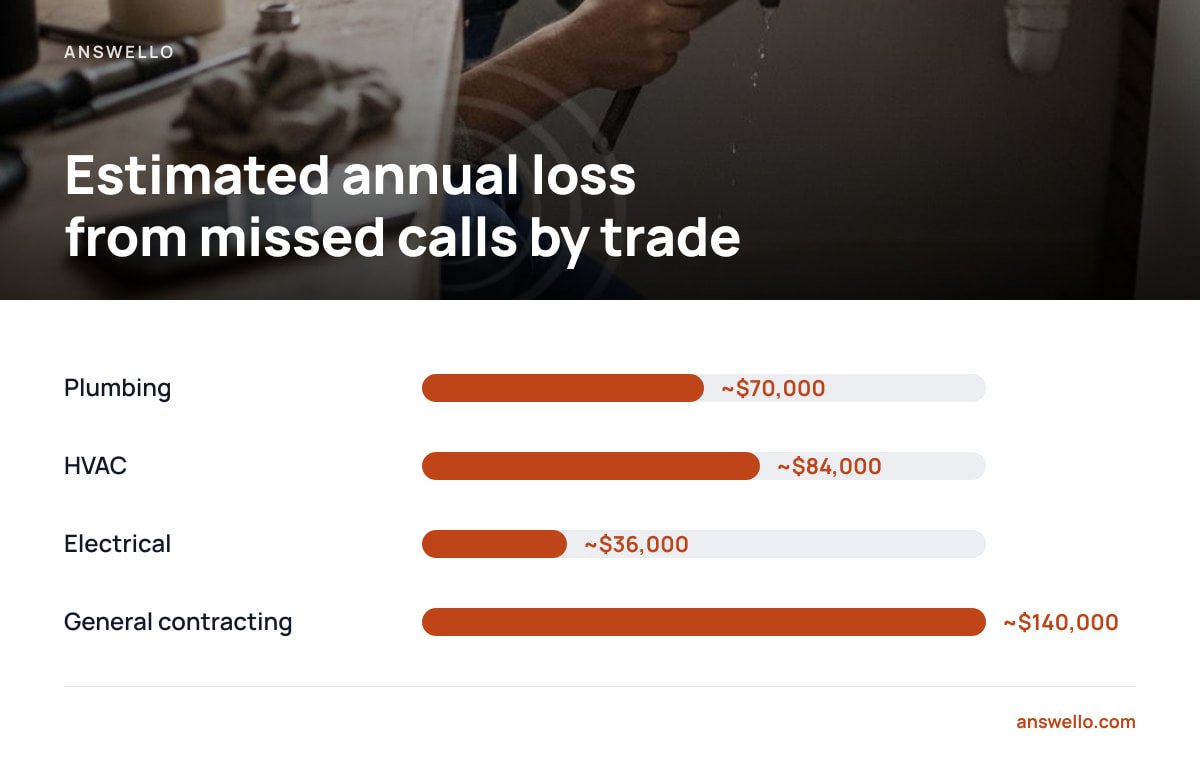
Here's what that math looks like across a few common trades, using a 250-working-day year and a conservative close rate on phone inquiries:
| Trade | Avg. job value | Close rate | Missed calls/week | Estimated annual loss |
|---|---|---|---|---|
| Plumbing | $350 | 40% | 10 | ~$70,000 |
| HVAC | $600 | 35% | 8 | ~$84,000 |
| Electrical | $400 | 30% | 6 | ~$36,000 |
| General contracting (larger jobs) | $3,500 | 20% | 4 | ~$140,000 |
These figures are illustrative, built from the same formula you can apply to your own books — they're not a claim about what every contractor loses, just what the math produces when you plug in typical numbers. Swap in your own job value and call volume and the picture gets sharper fast.
Why the Calls Go Unanswered in the First Place

Missed calls rarely happen because a contractor is ignoring the phone on purpose. They happen because the business is built around one person doing skilled work and fielding calls at the same time, and those two jobs can't both win.
- You're on a roof or under a sink. Hands-on work doesn't pause for a ringing phone, and by the time you're free, the caller has already dialed someone else.
- One phone, one person. Small shops often route every number to the owner's cell, so a call during a job site conversation or a drive is simply unreachable.
- No coverage after 5 p.m. or on weekends. A large share of service calls — burst pipes, no-heat emergencies, lockouts — happen exactly when the office is closed, as detailed in this breakdown of after-hours call coverage.
- Voicemail is the fallback, and voicemail doesn't sell. It collects information but does nothing to keep the caller from hanging up and trying the next listing.
If you want the fuller picture of what unanswered calls do to a service business beyond the dollar figure, this piece on what unanswered phone calls really cost covers the reputational side too.
The Five-Minute Window: Why Callback Speed Changes the Outcome
Speed matters more than most contractors assume, and it isn't a soft point about customer service — it's measurable. Research summarized in the Harvard Business Review found that the odds of successfully qualifying a lead fall off sharply once contact is delayed past the first few minutes, and keep falling the longer a callback is put off. A missed call isn't a paused conversation; it's a closing window.
The odds of reaching and qualifying a caller drop fastest in the first hour after the call — not the first day.
That's the uncomfortable part for contractors who call back at lunch or at the end of the day. By then, the caller has often already booked with the business that picked up live.
What the Caller Does When You Don't Pick Up

A missed call doesn't sit in the caller's queue waiting patiently for you to return it. The caller moves on, usually fast, and usually to a competitor who was simply available.
- Most callers don't leave a voicemail. They hang up and dial the next number on their search results page instead of recording a message they're not sure you'll hear in time.
- They often screen your callback. The FCC has documented the enormous volume of spam and robocalls hitting U.S. phones, and it has trained people to let unfamiliar numbers go to voicemail — including your callback.
- Phone leads convert at a premium. Invoca's research into home services calls has consistently found that callers who reach a live person convert to paying jobs at a notably higher rate than web form submissions, which makes every unanswered call a disproportionately expensive one to lose.
Pro Tip: Before you spend a dollar fixing this, track your actual missed-call rate for one full week using your phone's call log, not your memory — most contractors underestimate it by half because they only remember the calls they regret missing, not the ones they never noticed.
Running Multiple Brands or Numbers Multiplies the Problem

Contractors who operate under more than one brand, or run separate numbers for different service lines, often have no idea their missed-call rate is additive across every line. A plumbing company that also does drain cleaning under a second name, or a multi-truck operation with a dispatch number and a sales number, is really running two or three missed-call problems at once — and each one has its own job value and close rate.
If you've never run the math across every number you operate, this guide to calculating lost revenue from unanswered calls walks through doing it line by line instead of guessing at a combined figure. The total is almost always higher than the sum people expect, because the numbers that get the least attention — the second brand, the overflow line — tend to have the worst answer rates of all.
How to Calculate Your Own Number in Ten Minutes
You don't need software to find your own figure. You need your call log, your invoices, and ten minutes.
- Pull last month's call log from your phone or office line and count how many calls were missed, not just how many you answered.
- Estimate your close rate on calls you do answer — most contractors know this number roughly from memory or a quick scan of invoices against inquiries.
- Find your average job value by dividing last year's revenue by the number of jobs completed.
- Multiply missed calls per week by 50, then by your close rate, then by your average job value. That's your annual exposure.
Run it once and you'll likely stop thinking of missed calls as an annoyance and start thinking of them as a line item.
Your Options, and What Each One Actually Costs
Once you know the number, the next question is what to do about it — and the choices aren't all priced the same way.
| Option | Typical cost | Main drawback |
|---|---|---|
| Voicemail only | Free | Most callers won't leave a message, as covered above |
| Hiring part-time admin help | $15–$25/hour, plus payroll overhead | Doesn't cover nights, weekends, or sick days |
| Live answering service | $200–$1,000+/month, scales with call volume | Recurring cost for every number and every month, whether calls come in or not |
| AI call-answering system | One-time hardware/setup cost, sometimes an optional monthly add-on | Needs a clear script and occasional tuning to sound right for your trade |
Live answering services and virtual receptionists solve the coverage problem but add a recurring bill that grows with every number you add — this comparison of answering service costs and alternatives breaks down where that math stops making sense. AI-based systems built for trades, covered in more detail in this look at AI receptionists for plumbers and this overview of AI phone assistants for small business, aim to close the same gap without turning every missed call into a monthly subscription line.
Answer Every Call Without Adding a Monthly Bill
Answello was built for exactly the number this article is about: it answers calls you'd otherwise miss, figures out who's calling and what they need, and texts you the caller's name, number, and request along with a transcript, so you can call back the right job first instead of guessing. It runs under multiple brands or numbers from a single purchase, which matters if the table above made you realize your second number is the one actually bleeding money.
The self-install package is $399 one-time, and the fully configured version with a custom script built for your trade is $895 one-time — no monthly fee unless you want the optional $119/month plan for ongoing tuning and maintenance, which you can cancel anytime. The honest caveat: it answers and routes calls, it doesn't replace a dispatcher who schedules crews or quotes complex jobs on the spot, so check the spec sheet against what you actually need before you buy.
Frequently Asked Questions
How much does one missed call cost a contractor on average?
It depends entirely on your average job value and close rate, not a fixed industry number. A contractor with a $450 average job and a 35% close rate loses roughly $157 in expected value for every call that goes unanswered, since that's the job value multiplied by the odds it would have converted.
Do missed calls really cost more than the job itself?
Often yes, because a missed caller who hires a competitor may also become that competitor's repeat customer and referral source, compounding the loss beyond a single job. The immediate job value is just the floor of the real cost.
Is voicemail enough to catch missed calls for a small contracting business?
Usually not, because most callers in a hurry for service simply hang up rather than leave a message and call the next business instead. Voicemail captures intent only from the small share of callers patient enough to wait and talk to a machine.
What's the fastest way to calculate my own missed-call cost?
Pull last month's call log, count missed calls, estimate your close rate, and multiply by your average job value and 50 working weeks. Ten minutes of math usually produces a number far higher than contractors expect going in.
Does hiring a receptionist solve the problem better than an answering service or AI system?
It can, but it adds payroll, benefits, and gaps during nights, weekends, and sick days unless you hire multiple people to cover shifts. Many contractors find a live answering service or an AI-based system closes more of the gap per dollar spent.
Sources
- The Short Life of Online Sales Leads | Harvard Business Review
- Invoca | Invoca
- Robocalls | Federal Communications Commission
Leave a Reply