

To calculate lost revenue from unanswered phone calls, multiply the number of calls you miss in a given period by the percentage that would have converted to paying work, then multiply that by your average job value. The part most businesses get wrong isn't the math — it's treating every missed call as a missed sale, when a real chunk of them are robocalls, wrong numbers, or the same caller trying twice in ten minutes.
TL;DR:
- Lost revenue = missed calls × conversion rate × average job value, run monthly and then annualized.
- Not every missed call is a missed sale — filter out spam, wrong numbers, and repeat attempts before you multiply.
- Your phone bill rarely flags a call as "missed"; the real record lives in your phone system or carrier's call detail records.
- Missed-call percentage = (missed calls ÷ total incoming calls) × 100 — track it monthly, since raw counts mislead as call volume grows.
- Average job value swings wildly by trade, so a missed call for a roofer costs far more than one for a locksmith.
Table of Contents
- The Three Numbers Every Missed-Call Calculation Needs
- How to Calculate Lost Revenue From Unanswered Phone Calls
- How to Calculate Your Missed-Call Percentage
- Where to Actually Find Your Unanswered Calls
- Do Unanswered Phone Calls Show Up on Your Bill?
- Why Your Raw Missed-Call Count Is the Wrong Number to Trust
- What a Missed Call Is Actually Worth, by Trade
- Get Every Missed Call Answered Without Adding a Monthly Bill
- Frequently Asked Questions
- Sources
The Three Numbers Every Missed-Call Calculation Needs

Before you multiply anything, you need three real numbers, not estimates pulled from a gut feeling: how many calls you're missing, what share of answered calls become paying work, and what an average job is worth. Get any one of these wrong and the final figure is a guess wearing a decimal point.
Pull your missed-call count from your phone system's call log or your carrier's call detail records. Most VoIP systems and even basic mobile plans log every incoming call attempt, answered or not, with a timestamp and duration of zero for the ones that rang out. Your conversion rate — the share of answered calls that turn into booked work — should come from your own CRM or job-booking records, not an industry average, because a plumber taking emergency calls converts very differently than a contractor quoting kitchen remodels. Average job value is your total revenue divided by number of jobs over a representative stretch; three to six months smooths out seasonal noise better than a single busy week.
Pro Tip: Don't calculate your conversion rate from your best month. Use your three slowest months instead. That number is usually within 5 to 10 points of your true average, and it's the one you'll still believe — and act on — when business is slow, which is exactly when a missed-call problem hurts most.
How to Calculate Lost Revenue From Unanswered Phone Calls
The formula itself is short: Lost Revenue = Missed Calls × Conversion Rate × Average Job Value. Run it monthly, then multiply by twelve for an annual figure, and recheck it each quarter since call volume and job value both drift with the seasons.
| Input | Example Value |
|---|---|
| Missed calls per month | 40 |
| Conversion rate (answered calls → booked jobs) | 35% |
| Average job value | $450 |
| Lost revenue per month | 40 × 0.35 × $450 = $6,300 |
| Lost revenue per year | $75,600 |
That $75,600 figure isn't a worst-case scenario built to scare you into buying something — it's what a mid-sized trades business misses every year at a fairly ordinary missed-call rate. Research from Invoca, a call-tracking analytics firm, has consistently found that phone calls convert to paying customers at a notably higher rate than web form submissions, which is exactly why a missed call costs more than a missed contact-form fill: the person on the other end was already further along in deciding to hire someone.
40 missed calls a month, at a 35% conversion rate and a $450 average job, is $75,600 a year — more than most small trades businesses spend on advertising.
How to Calculate Your Missed-Call Percentage
Raw counts tell you something is wrong; percentages tell you how bad it actually is relative to your call volume. The formula is: Missed Call Percentage = (Missed Calls ÷ Total Incoming Calls) × 100.
If you received 300 calls last month and missed 40 of them, that's 40 ÷ 300 × 100 = 13.3%. On its own, that number means little — but tracked monthly, it tells you whether a growing business is simply getting more calls than one person can answer, or whether something specific (a busy install week, a broken forwarding rule, a technician who hates picking up mid-job) is driving the spike. A missed-call rate that climbs steadily as your business grows is a capacity problem, not a bad month, and it's the clearest early signal that you need a system change rather than a reminder to "answer faster."
Where to Actually Find Your Unanswered Calls

You can't calculate anything without the underlying data, and that data lives in a few specific places depending on your setup.
Your phone system's call log
Most cloud or VoIP phone systems keep a running log of every call attempt, including ones that rang through to voicemail or hung up unanswered. This is almost always the fastest source, since it's already organized by date, duration, and caller ID without needing to request anything from a carrier.
Your carrier's call detail records (CDRs)
If you're on a traditional mobile or landline plan, your carrier's itemized call detail records show every inbound call attempt, including the ones you never picked up. These are typically available through your online account portal going back several billing cycles, even if they don't appear on the printed or summary version of your bill.
Dedicated call tracking software
If you run multiple numbers, brands, or ad campaigns, standalone call tracking software can attribute each missed call to its source — a specific ad, a listing, a referral — which matters more once you're trying to decide where to fix the leak rather than just how big it is.
Do Unanswered Phone Calls Show Up on Your Bill?
Generally, no — not in a way that's obvious. Most consumer and business phone bills summarize charges rather than listing every call attempt, and an unanswered call typically generates no charge, so there's little incentive for carriers to print it on the bill you see each month. The Federal Communications Commission's guidance on billing requires clear, accurate itemization of charges, but itemization rules are built around what you're billed for, not around giving you a missed-opportunity report.
The call data still exists — it's just filed under call detail records (CDRs) rather than your bill. Every carrier and most VoIP providers make CDRs available through an online portal, and that's the record you want, not the PDF that arrives once a month. If you've never looked at your CDRs, that's usually the first sign nobody in the business has had a clear view of how many calls go unanswered.
Why Your Raw Missed-Call Count Is the Wrong Number to Trust
Here's where most of the calculators you'll find online go wrong: they treat every missed call as a missed sale. It isn't. A meaningful share of inbound calls to any business number are robocalls, scam attempts, or wrong numbers, and the Federal Trade Commission tracks unwanted call complaints in the tens of millions annually, which gives a sense of just how much junk traffic lands on ordinary phone lines.
Before you run the formula, strip out the noise:
- Duplicate attempts. A customer who calls twice in five minutes because the first call rang out is one missed opportunity, not two — count unique callers, not raw call attempts.
- Spam and robocalls. If your call log flags these or you recognize the pattern (short duration, no voicemail, repeat numbers from different area codes), exclude them entirely.
- Wrong numbers. These show up as short, confused-sounding voicemails or no voicemail at all, and they inflate your missed-call count without representing any lost revenue.
- After-hours calls from existing customers. A current client calling to reschedule isn't new revenue at risk the same way a first-time caller is, even though both show up identically in your call log.
Once you've filtered for genuine new-opportunity calls, your missed-call count usually drops by 20 to 40 percent — which means your lost-revenue figure does too, but what's left is a number you can actually act on with confidence. A related wrinkle: the Harvard Business Review's coverage of lead response research found that the odds of qualifying a lead drop sharply with even modest delays in response time, which means a "missed" call you call back within the hour may not be fully lost — but one you never call back almost certainly is.
What a Missed Call Is Actually Worth, by Trade

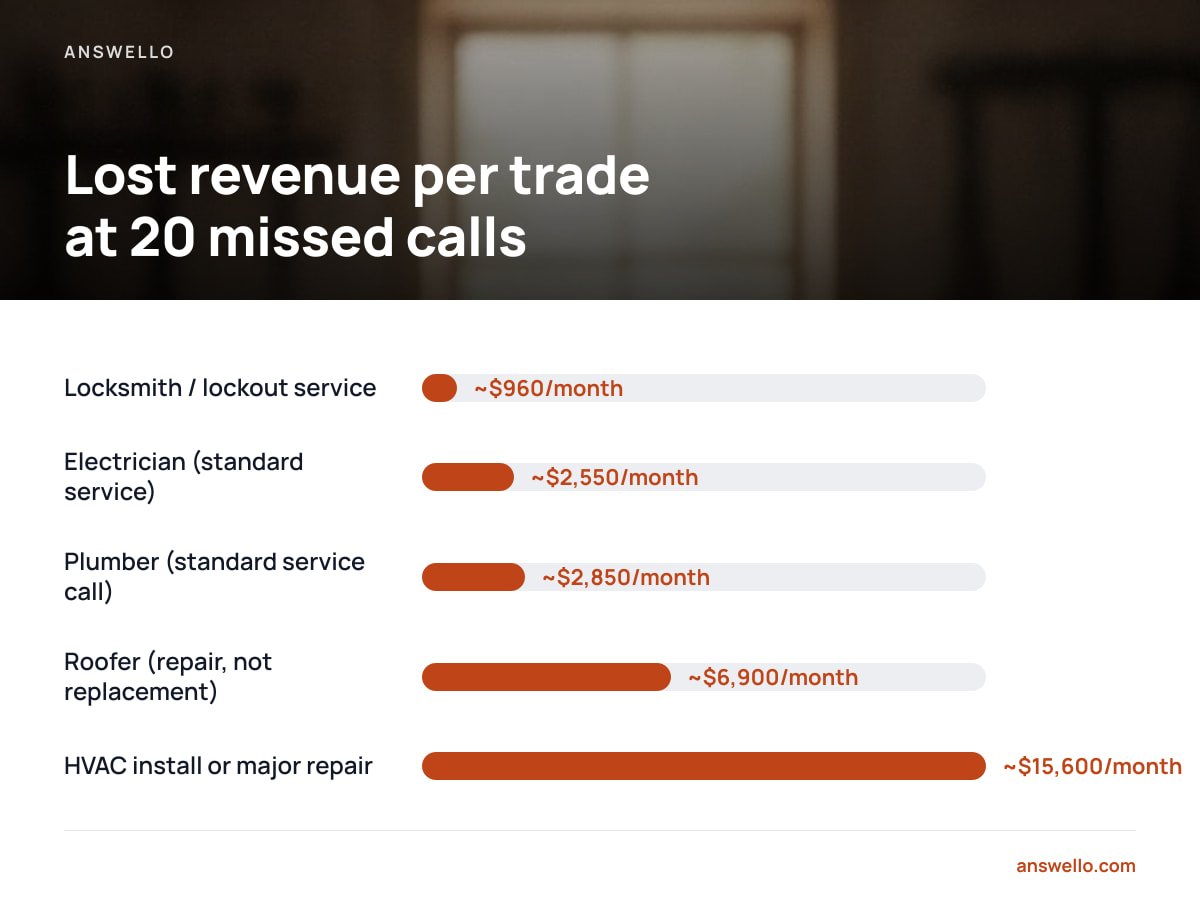
Average job value drives the whole calculation, and it varies enormously depending on what you do. Use your own numbers where you have them, but these ranges are a useful sanity check if you're estimating for the first time.
| Trade | Typical average job value | Lost revenue at 20 missed calls/month, 30% conversion |
|---|---|---|
| Locksmith / lockout service | $120–$200 | ~$960/month |
| Plumber (standard service call) | $350–$600 | ~$2,850/month |
| Roofer (repair, not full replacement) | $800–$1,500 | ~$6,900/month |
| HVAC install or major repair | $1,200–$4,000 | ~$15,600/month |
| Electrician (standard service) | $300–$550 | ~$2,550/month |
The spread here is the whole point: a roofer or HVAC contractor missing the same number of calls as a locksmith is losing six to fifteen times as much revenue, which is why generic "missed calls cost businesses thousands" claims are true but not useful. Your number is either specific to your trade and your average ticket, or it's not worth calculating at all.
Get Every Missed Call Answered Without Adding a Monthly Bill
If the math above landed somewhere uncomfortable, the fix isn't complicated — someone or something needs to pick up the phone when you can't, and that's the exact problem Answello was built around. It answers calls your business misses, asks the caller what they need, and texts you their name, number, and request so you can call back the moment you're free instead of guessing who phoned and why.
It's sold as a one-time purchase rather than a per-month subscription: $399 for a do-it-yourself setup, or $895 if you'd rather have it fully configured with a custom script for your business. There's an optional $119-a-month plan if you want ongoing tuning and maintenance, but it's cancel-anytime and not required to use the system. One honest limit: it answers and captures the call, it doesn't replace a live conversation for jobs that genuinely need a human to quote on the spot — check the spec sheet against how complex your typical first call actually is before you buy. If you run multiple brands or numbers, it's worth comparing against the answering service alternatives and AI phone assistant options covered elsewhere on this site, since not every business needs the same setup.
Frequently Asked Questions
What is the formula for calculating lost revenue from missed calls?
Lost Revenue = Missed Calls × Conversion Rate × Average Job Value. Run it per month using your actual call log, your own conversion rate from booked jobs, and your average job value over a three-to-six-month period, then multiply by twelve for an annual figure.
Do unanswered phone calls show up on your bill?
Not usually in a way you'd notice — most bills summarize charges rather than listing every call attempt, and missed calls typically generate no charge. The full record exists as call detail records (CDRs), available through your carrier or phone system's online portal, not on the printed bill.
How do you calculate the percentage of calls you're missing?
Missed Call Percentage = (Missed Calls ÷ Total Incoming Calls) × 100. Track it monthly rather than as a one-time snapshot, since a rising percentage as your call volume grows signals a capacity problem rather than a single bad week.
How do you find your unanswered calls?
Check your phone system's built-in call log first, since most VoIP and cloud systems record every call attempt including unanswered ones. If you're on a traditional carrier plan, log into your online account for itemized call detail records (CDRs), which go further back than what shows on your monthly bill.
Is every missed call actually a lost sale?
No. A meaningful share of missed calls are robocalls, wrong numbers, or duplicate attempts from the same caller, and filtering those out typically cuts your "real" missed opportunity count by 20 to 40 percent before you calculate lost revenue.
How many calls do small businesses typically miss?
It varies widely by call volume and staffing, which is why tracking your own missed-call percentage matters more than relying on an industry average. A business running lean on a single phone line during busy service windows commonly misses 10 to 20 percent of inbound calls without realizing it until they check the log.
Sources
- The Short Life of Online Sales Leads | Harvard Business Review
- Truth-in-Billing and Billing Format | Federal Communications Commission
- Phone Call Conversion Research | Invoca
Leave a Reply