
AI phone assistant emergency call detection works by scoring every call on three signals at once: what the caller says, how they say it, and what your business rules count as urgent. The distinction that matters is this. A life-safety emergency belongs with 911 or 112, not your assistant. A business emergency, like a burst pipe or a dead furnace, is something the assistant can flag and escalate to you in seconds.
TL;DR:
- An AI assistant transcribes the call, classifies the caller's intent, and scores urgency from word choice, vocal stress, and your own rules.
- Life-safety emergencies should go to 911, 112, or your local number. A good assistant tells the caller that and does not try to handle it.
- Your rules matter more than the model. A list of what counts as urgent for your trade beats any generic detection.
- Detection fails on vague callers, noisy lines, and sarcasm. Test it with recorded scenarios before you rely on it.
- Tune the threshold. Over-flagging costs you sleep, and under-flagging costs you the best jobs.
Table of Contents
- Two Kinds of Emergency, and Only One Is the Assistant's Job
- How AI Phone Assistant Emergency Call Detection Actually Works, Step by Step
- The Signals That Mark a Call Urgent, and the Ones That Fool It
- Why Rules You Write Beat a Model's Guess
- What Happens After a Call Is Flagged
- Where Detection Fails, and How to Test It Before You Trust It
- Tuning the Threshold So Alerts Stay Useful
- Get Urgent-Call Flagging Without Another Monthly Bill
- Frequently Asked Questions
- Sources
Two Kinds of Emergency, and Only One Is the Assistant's Job
Start with a boundary, because it shapes everything else. Your callers can have two very different kinds of emergency.
Life-safety emergencies
Someone is hurt, a fire is burning, or a gas leak is active. These calls belong with emergency services. In the EU, EENA describes 112 as the single European emergency number. In the US, the FCC maintains consumer guidance on 911. In the UK, Gas Safe Register tells anyone who smells gas to call the National Gas Emergency Service on 0800 111 999.
If you smell gas in the UK, the number is 0800 111 999, not your plumber's voicemail.
An assistant that answers your business line should never pretend to be a dispatcher. The right behavior is a short, firm instruction to hang up and call local emergency services, followed by an immediate alert to you.
Business emergencies
A water heater has failed in January, a basement is flooding, or an AC unit has died during a heat wave. These are urgent for the customer and valuable for you, but nobody's life is at stake. This is what the assistant is built to catch.
If you want the underlying mechanics of how calls become text, read our main guide to AI call transcription and summaries for business owners. The rest of this article covers only how the urgent call gets picked out.
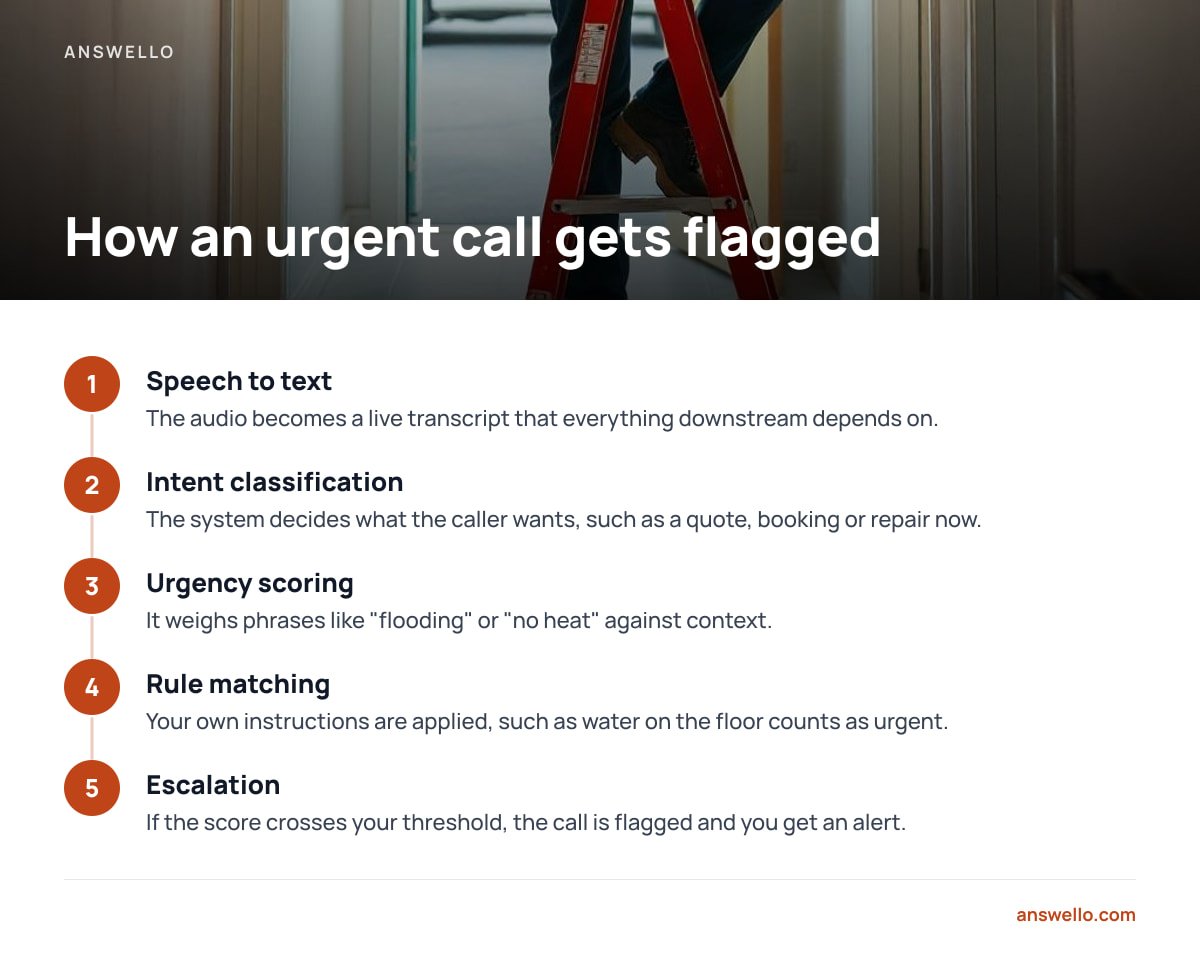
How AI Phone Assistant Emergency Call Detection Actually Works, Step by Step

There is no single "emergency detector." It is a short chain of checks, and each one can fail on its own.
- Speech to text. The audio is turned into a live transcript. Everything downstream depends on it, so a mangled transcript produces a mangled urgency score.
- Intent classification. The system decides what the caller wants: a quote, a booking, a billing question, a repair now. "Repair now" is the intent that usually carries urgency.
- Urgency scoring. The assistant looks for phrases like "flooding," "no heat," "sparks," or "right now." It weights them against context, so "I'm planning for when the heat goes out" scores lower than "the heat is out."
- Rule matching. Your own instructions are applied, such as "any call mentioning water on the floor is urgent" or "ignore sales calls."
- Escalation. If the score crosses your threshold, the call is flagged and you are alerted differently from a routine message.
The model does the first guess. Your rules decide what happens next. That ordering is the part most people get backward, and it's why the next two sections matter.
The Signals That Mark a Call Urgent, and the Ones That Fool It

Every signal is a hint, not a verdict. Here is how the common ones behave in practice.
| Signal | Example | Reliability | Where it misleads |
|---|---|---|---|
| Urgent keywords | "flooding," "no heat," "smoke" | High | "Smoke detector chirping" is not a fire |
| Time language | "right now," "tonight," "ASAP" | Medium | Callers say "ASAP" about everything |
| Vocal stress | Raised pitch, fast speech | Low to medium | Some people are just loud or fast talkers |
| Repeat calls | Same number three times in ten minutes | High | May be a customer who dialed the wrong brand line |
| Caller context | Known customer with an open job | High | Needs a customer list to work |
| Time of day | Call at 2 a.m. | Medium | Night owls and other time zones |
Keywords and repeat calls are the strongest, because they are concrete. Vocal stress is the weakest, because it is easy to misread. You should be skeptical of any vendor that sells emotion detection as the main event. A caller who is calm and says "there's water coming through the ceiling" is a better lead than one who is agitated about a quote.
Why Rules You Write Beat a Model's Guess
A generic model has never met your business. It doesn't know that for a roofer, "a few drips" after a storm is a same-day job, while for a landscaper, "a few drips" means nothing. So you write the list.
I would pick written rules over a "smart" setting every time, for three reasons:
- They are predictable. You can read the rules and know why a call was flagged. A black-box score gives you nothing to fix.
- They are trade-specific. "Sewage," "no hot water," "sparking outlet," and "tree on the roof" mean different things in different trades.
- They scale across brands. If you run several brands or numbers, each can have its own definition of urgent. A drain business and an HVAC business shouldn't share one list.
Write the rules in plain sentences, the way you would brief a new receptionist. Include what counts as urgent, what counts as routine, and what the assistant should say when it isn't sure.
What Happens After a Call Is Flagged
Detection is only useful if the alert reaches you fast. There are a few ways it can go, and they trade speed against interruption.
- Text summary with a priority label. You get the caller's name, number, and request, marked URGENT. This is the minimum, and it works well when you are on a job and can't talk.
- Immediate callback prompt. The alert tells you to call back now, with the number ready to tap.
- Live transfer. The assistant rings your cell while the caller waits. It's fastest, but it only works if you actually pick up.
- Backup contact. If you don't respond in a set time, the alert goes to a partner or on-call tech.
For most small trades, the first and second are enough. Live transfer sounds appealing, but if you miss it, the caller has been on hold for nothing. The point of the system is to make a missed call into a captured lead, as covered in our look at whether AI can answer phone calls and text a summary.
Where Detection Fails, and How to Test It Before You Trust It
Every detection system has blind spots. Know them before a real caller finds them.
- Vague callers. "Something's wrong with my unit" has no keyword to catch. A good assistant asks one follow-up question rather than guessing.
- Noisy lines. Wind, a job site, or a bad cell connection corrupts the transcript. The safest design routes low-confidence calls to you rather than dropping them.
- Accents and fast speech. Transcription accuracy varies. Read the transcripts from your first week.
- Understatement. Some people say "bit of a leak" about a ceiling collapse.
- Wrong-number urgency. A caller may be in real distress and not be a customer at all. The assistant should still tell them to contact emergency services.
Missing a true emergency costs you a job. Over-flagging costs you sleep. Decide which error you can live with before you set the threshold.
Pro Tip: Call your own line with ten scripted scenarios before going live: three clear emergencies, three clear routine requests, and four deliberately vague ones, such as "my thing isn't working." Pay attention to the vague four. That is where your threshold is actually set, and it's the cheapest hour of testing you will do.
Tuning the Threshold So Alerts Stay Useful
If every call is URGENT, none of them is. People stop reading alerts within a week.
Start strict. Flag only calls that match your explicit emergency rules, then loosen it if you find missed jobs in the transcript log. Review the dashboard weekly for the first month, looking at two lists: calls flagged urgent that weren't, and calls marked routine that should have been flagged. Each miss becomes a new line in your rules.
Cost matters here too. Tuning is ongoing work, and a vendor that charges per seat or per site punishes you for adding brands or numbers. We've laid out the math in our one-time purchase vs subscription break-even guide.
Get Urgent-Call Flagging Without Another Monthly Bill
Answello answers the calls you miss while you're under a sink or on a roof, identifies the caller and what they need, and texts you the name, number, request, and a transcript. You write the rules for what counts as urgent, and urgent calls get flagged ahead of routine ones. Multiple brands and numbers sit under one payment. The self-install package is $399 one time, and the fully configured package with a custom script is $895 one time. If you want someone to keep tuning your rules, the optional plan is $119/month and you can cancel anytime. The full breakdown is on the Answello system page.
The honest limit: it is not an emergency dispatcher and it does not call 911 for anyone. It tells callers in danger to contact emergency services, and it will misjudge some vague calls. Run the ten-scenario test above, and check the spec sheet, ours included, for what the flagging and alert options cover before you buy.
Frequently Asked Questions
Can an AI phone assistant call 911 for a caller?
In general, no, and you shouldn't want it to. A business assistant should tell a caller in danger to hang up and contact local emergency services, such as 911 or 112, and alert you separately. Check any product's spec sheet for what it does here.
How does an AI assistant know a call is urgent?
It combines the transcript's wording, the caller's apparent intent, context such as repeat calls or a known customer, and rules you write. Concrete keywords and repeat calls are the most reliable signals. Vocal stress is the least reliable.
Can the assistant tell a real emergency from a caller who just says "ASAP"?
Not perfectly. Time words like "ASAP" are weak signals because many callers use them for routine jobs. Pairing them with a specific problem, like "no heat" or "water on the floor," is far more reliable.
What happens if the assistant is unsure whether a call is urgent?
A well-configured system routes uncertain calls to you with a clear label rather than treating them as routine. You can also have it ask one clarifying question. Setting that fallback in your rules is worth the five minutes.
How do I test emergency detection before going live?
Call your own number with about ten scripted scenarios: clear emergencies, clear routine requests, and several vague ones. Read the transcripts and alerts afterward. Adjust your rules wherever the assistant guessed wrong.
Sources
- 9-1-1 and E9-1-1 Services | Federal Communications Commission
- European Emergency Number Association (112) | EENA
- Gas Safe Register: gas emergency advice | Gas Safe Register
Leave a Reply