
Virtual receptionist vs AI call answering comes down to one structural difference: a human service bills you per minute and an AI system bills you per install. That difference decides your cost in a busy month, how many calls get answered at once, and what happens at 2am. Humans still handle angry callers, price negotiation and messy judgment calls better. AI handles volume, after-hours coverage and clean intake, then texts you the details.
TL;DR:
- Per-minute billing is the entire cost difference. A service charging $1.50 a minute costs about $390 a month at 260 billed minutes, while software answers the tenth call at the same price as the first.
- AI answering wins on coverage and consistency. It picks up at 2am, on the third simultaneous call, and never changes its qualifying questions.
- Humans win on ambiguity. Complaints, negotiation and complicated scheduling still produce better outcomes when a person handles them.
- You do not have to choose one. Route every call to AI, then transfer on a spoken keyword when the caller says "emergency" or asks for a person.
- Check the rules before you switch. The EU AI Act requires disclosure that a caller is talking to AI, and recording consent laws vary by state and country.
Table of Contents
- Virtual Receptionist vs AI Call Answering: The Difference That Sets the Price
- Where the Money Goes: Per-Minute Billing vs a Fixed Price
- What Each Option Handles Badly
- When a Human Still Wins, and How to Keep One Reachable
- The Rules You Have to Follow, and the Ones People Skip
- Four Questions Buyers Keep Asking
- How to Decide in Ten Minutes: Run Three Numbers
- Get Missed Calls Answered Without Another Monthly Subscription
- Frequently Asked Questions
- Sources
Virtual Receptionist vs AI Call Answering: The Difference That Sets the Price
A virtual receptionist is a remote human who answers your business line using a script you approve. You are billed by the minute or by the call, usually with a monthly minimum attached. An AI call answering system is software that picks up the same call, asks the same qualifying questions, and sends you the caller's name, number and request.
The billing model decides the rest of the comparison. Every call a human handles has labor behind it, so your invoice rises with volume. Software has a fixed cost, so the tenth call of the day costs the same as the first.
| What you're comparing | Virtual receptionist (human) | AI call answering (software) |
|---|---|---|
| How you pay | Per minute or per call, plus a monthly minimum | One-time license, or a small flat monthly fee |
| Cost of call ten vs call one | The same per-minute rate, so volume drives the bill | The same, regardless of volume |
| Hours covered | Whatever you buy. Round-the-clock plans cost the most | Every hour, including weekends and holidays |
| Simultaneous calls | One per receptionist. Overflow queues or drops to voicemail | Several at once, on separate lines |
| Price negotiation | Possible | No |
| What you receive afterward | Typed call notes, with quality varying by who answered | Recording, transcript, caller name and request by text |
| Setup time | Days to weeks, plus an onboarding call | Often same day, once call forwarding is set |
One naming warning first. "Answering service" and "virtual receptionist" mean the same thing to most vendors: a human, in a call center, answering on your behalf. Several AI companies have started renting that phrase to describe software. When you request a quote, ask one question first: "Is a person picking up the phone, or is software?"
Where the Money Goes: Per-Minute Billing vs a Fixed Price

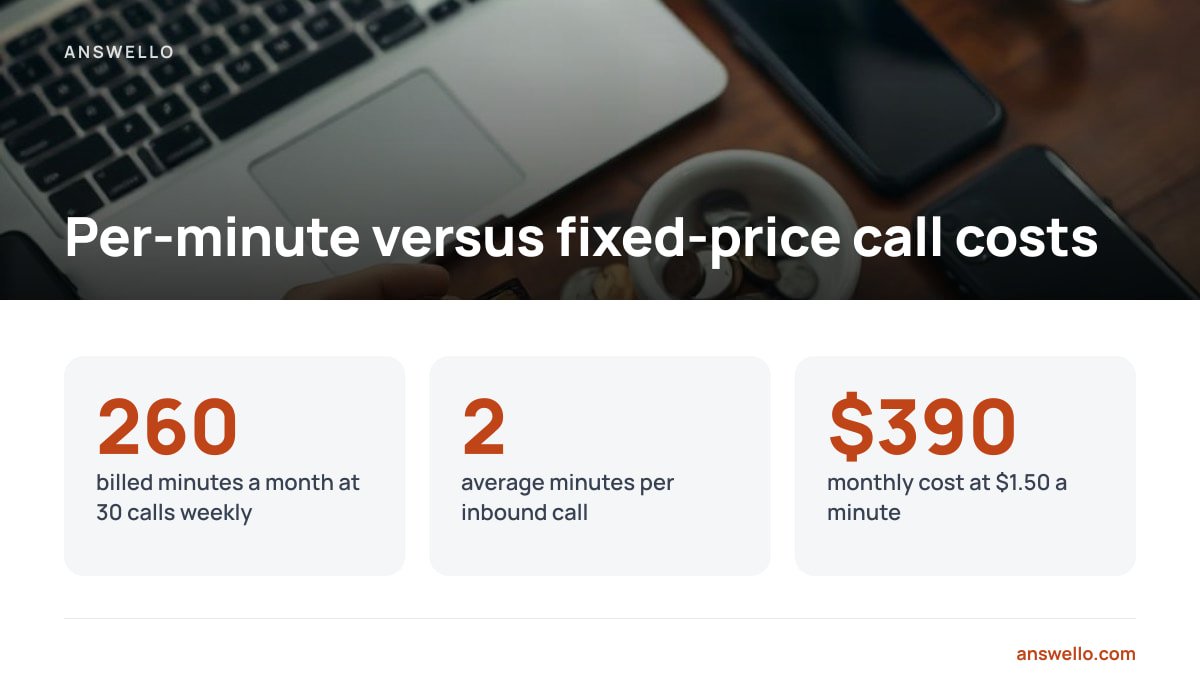
Run your own numbers before you sit through anyone's demo. Assume 30 inbound calls a week at an average of two minutes each. That is 60 billed minutes a week, or roughly 260 minutes a month.
At $1.50 a minute, you are at $390 a month. Per-minute services commonly bill in 30-second or full-minute increments, so a call that runs 70 seconds can bill as two full minutes. Most plans carry a monthly minimum, and unused minutes generally do not roll over. Confirm the rollover rule in writing before you sign, because it decides what your slow season costs. Spring and summer can double that call volume for trades, and the invoice doubles with it.
Thirty calls a week at two minutes each is 260 billed minutes a month. At $1.50 a minute that is $390, every month, indefinitely. A one-time install priced between $399 and $895 pays for itself inside three months at that volume.
An AI system inverts the curve. There is no hourly labor behind the tenth call, so a busy week costs what a quiet week costs. If your call volume swings hard between seasons, that inversion is worth more than any feature on a comparison chart. The one-time payment answering service model exists for this exact reason, and it carries its own trade-offs you should read before committing.
What Each Option Handles Badly
Neither option is a clean win. Both fail in predictable places, and knowing the failure points in advance is what keeps you from switching twice.
Where AI answering falls down
- Heavy accents and bad connections. Speech recognition degrades when a caller is standing next to a running excavator. Expect more transcription errors on outdoor calls, and ask for the recording so a human can recheck anything unclear.
- Interruptions and corrections. Callers change their minds mid-sentence, spell a street name twice, and contradict themselves. Scripted flows handle that worse than an experienced person does.
- Money conversations. Discount requests, scope changes and "can you do it for less if I pay cash" get a message taken, not an answer.
- Callers angry about your last job. An AI will collect the details accurately and still leave that customer angrier, because what they wanted was acknowledgment from someone with authority.
Where a human service falls down
- Billing punishes your best weeks. The month you land three large jobs is also the month with the most calls, which is also the largest invoice your answering provider will send you.
- Coverage stops when the shift stops. Genuine round-the-clock human coverage is the priciest plan on any rate card, and it still means one person handling one call at a time.
- Consistency drifts. Call notes read differently depending on who picked up, and the detail you needed most is often the one that got dropped.
- Onboarding takes days. Someone has to learn your services, your service area and your pricing rules before the first call gets answered well.
When a Human Still Wins, and How to Keep One Reachable
Four kinds of calls should reach a person on the same dial, every time. A caller reporting a gas smell or an active water leak. A customer who is already upset about a previous visit. A commercial inquiry worth more than a normal month of work. A caller whose language your AI handles poorly. Any of those sitting in a text summary for two hours is a lost job or a safety problem.
You can buy both. Route every inbound call to AI first, then have it transfer on a keyword the caller says out loud: "emergency", "gas", "flood", or "speak to someone". A system built to flag a true emergency call does one job well: sorting urgency before you ever see the transcript.
Warm transfers are not free. A human answering service still bills those transferred minutes at its per-minute rate, so cap how many transfers run in a month and read the overage fee. If you run a trade business with several numbers, answering AI for tradespeople covers how one system handles multiple brands without multiplying the bill.
The Rules You Have to Follow, and the Ones People Skip
Disclosure comes first. The EU AI Act requires that people be told when they are interacting with an AI system, unless it is obvious to a reasonable person. If any of your customers call from the EU, build that disclosure into your greeting. The obligations are being phased in over several years, so check the current timetable for the type of system you deploy.
Recording consent is the rule small businesses break most often. California's Penal Code section 632 makes it a crime to record a confidential phone call without the consent of all parties, and several other states work the same way. A recorded greeting saying "this call may be recorded" covers you in many jurisdictions. It does not cover you everywhere, so check your own state's rule before you switch recording on.
The FCC's rule on AI voices matters less than people assume for inbound calls. In February 2024, the FCC ruled that AI-generated voices count as "artificial" under the Telephone Consumer Protection Act. That targets outbound robocalling. Software answering calls your own customers dialed is a different activity.
The FCC treats AI-generated voices as "artificial" under the TCPA. Answering inbound calls with AI is not the regulated activity. Dialing out with it, without consent, is.
If your AI follows up by text, you need A2P 10DLC registration on the number sending the message. Registering for missed call texting is a paperwork problem with a hard rejection rate, and unregistered traffic gets filtered before it ever reaches the customer.
Four Questions Buyers Keep Asking
Can receptionists be replaced by AI?
Partly, and the split is predictable. Intake work (name, number, address, what is broken, when can you come) is being automated now and mostly works. Judgment work (is this caller about to cancel, is this a warranty claim we should handle carefully, is this the client who still owes us money) is not automated at small-business scale. Buyers who expect a full replacement tend to be disappointed by week four.
Is receptionist a low level job?
The pay is low. The skill is not. The U.S. Bureau of Labor Statistics puts median pay for receptionists and information clerks under $40,000 a year, with little or no employment change projected over the decade. The work itself is triage: deciding in ten seconds whether a caller is an emergency, a price shopper, or a commercial client who could carry the quarter. Businesses that file it as low-level make expensive routing mistakes.
Can I use AI to answer my calls?
Yes. In the United States you need no special license to have software answer your own business line, and there is no federal approval process for the software itself. Three things you do need: an honest answer when a caller asks whether they are talking to a person, consent before recording where your state requires it, and a working path to a human on the same call for anything urgent.
Are virtual assistants considered AI?
Usually not, in this industry. Most "virtual assistant" and "virtual receptionist" services are remote human workers, often offshore, and their labor is what you are buying. In software marketing, "virtual assistant" means a chatbot or a voice model. The words have been reused so heavily that the label tells you nothing. Ask whether a person answers, where that person sits, and whether calls get recorded, and get all three answers in writing.
How to Decide in Ten Minutes: Run Three Numbers
Pull three figures out of your own records.
- Missed calls per month. Every inbound call that hit voicemail, rang out, or dropped while you were on a roof.
- Average call length. Open your call log and measure it instead of guessing. Most service calls run under three minutes.
- Average value of one booked job. Your number, not an industry average.
Multiply the missed calls by the share that were real buyers, then by your job value. Forty missed calls a month, with a quarter of them turning into work at $600 a job, is $6,000 a month walking away, and both options on this page cost a fraction of that.
Pro Tip: Compare vendors on cost per booked job, not cost per minute. Take 90 days of call logs, count every call that never reached you, and multiply by the share that would have booked work. That figure is what your current setup already costs, and it is the only benchmark that matters when a sales rep quotes a per-minute rate. A cheap minute that never converts is the most expensive line item in the whole comparison.
Get Missed Calls Answered Without Another Monthly Subscription
Answello sells a one-time-purchase AI phone system for trades and small multi-brand businesses, built for the problem this article describes: calls arriving while you are on a job and nobody there to take them. It answers, identifies the caller and what they want, then texts you the name, number and request, with the recording and transcript stored in a dashboard. Multi-brand and multi-number setups run under a single payment, so adding a second brand does not double the cost.
Two packages, both one-time. Self-install is $399. Fully set up and configured with a custom script is $895. The honest limit: neither package includes ongoing tuning, so if your script changes every month or you want someone watching call quality, the optional maintenance plan is $119 a month and you can cancel it whenever. Check the spec sheet, including ours, for two things before you buy: whether your phone system supports the call forwarding the setup needs, and whether your state requires all-party consent for recording.
Frequently Asked Questions
Which is cheaper, a virtual receptionist or AI call answering?
It depends on volume. A per-minute human service costs more every month you get busier, while AI answering has a fixed cost, so AI wins as call volume rises and the human service only wins if you get very few calls. At 260 billed minutes a month, a $1.50 per-minute service runs about $390 monthly, which is more than a one-time AI install costs in total.
Can receptionists be replaced by AI?
The intake half of the job is being automated now and works reasonably well: capturing names, numbers, addresses and the reason for the call. The judgment half is not. Deciding whether a caller is about to cancel, whether a job is a warranty risk, or whether a commercial inquiry deserves same-day attention still needs a person who knows your business.
Is receptionist a low level job?
The pay is low, but the skill is not. The U.S. Bureau of Labor Statistics puts median pay for receptionists and information clerks under $40,000 a year. What the role actually does is triage: sorting an emergency from a price shopper from a commercial client within seconds of a call starting.
Can I use AI to answer my calls?
Yes, and in the United States you need no special license to have software answer your own business line. What you do need is an honest answer when a caller asks if they are speaking to a person, consent before recording where your state requires all parties to agree, and a working transfer path to a human for urgent calls.
Are virtual assistants considered AI?
Usually not in this industry. Most virtual assistant and virtual receptionist services are remote human workers, and you are paying for their labor by the minute. Software vendors have reused the same phrase for chatbots and voice models, so the label alone tells you nothing about what picks up the phone.
Do I have to tell callers they are talking to AI?
In the EU, yes. The AI Act requires that people be informed when they are interacting with an AI system, unless it is obvious to a reasonable person. There is no equivalent general federal rule for inbound business calls in the United States, but disclosing in your greeting still reduces hang-ups and complaints.
Sources
- Receptionists and Information Clerks | U.S. Bureau of Labor Statistics
- AI Act: regulatory framework for artificial intelligence | European Commission
- FCC makes AI-generated voices in robocalls illegal | Federal Communications Commission
- California Penal Code section 632 | California Legislative Information
Leave a Reply