
An AI answering service pricing script setup has two costs and one job. The costs are the build (a one-time configuration fee or a monthly seat-and-minutes plan) and the script itself, a rules document listing your call-out fee, travel bands, after-hours multiplier and the jobs your AI must never price. The job is quoting a number that survives contact with the real invoice. Get the fields wrong and your AI books work at last year's rates.
TL;DR:
- One-time build fees run about $399 to $895; monthly AI answering plans run roughly $49 to $300 plus per-minute or per-seat charges.
- The script is a rules document: fees, travel bands, multipliers, refusal list and an escalation ceiling.
- Quote a range with a named condition attached, never a single number you cannot honor on the invoice.
- Test 20 real call scenarios and 3 adversarial calls against what you would have said, then fix one field per revision.
- Hard-code a dollar ceiling and date-stamp every script version so stale prices cannot quote themselves.
Table of Contents
- AI Answering Service Pricing Script Setup Starts With Two Budgets
- Real Price Bands, and the Minute Trap Inside Them
- The Eight Fields Your Pricing Script Has To Carry
- Where AI Quotes Break, and the Guardrails That Hold
- Test It in 45 Minutes Before It Answers a Real Call
- One-Time or Monthly: Run the Two-Year Math Yourself
- Get the Script Built Once and Quoting Right This Week
- Frequently Asked Questions
- Sources
AI Answering Service Pricing Script Setup Starts With Two Budgets
Every quote you get bundles two purchases into one number. The first is the platform: the phone number, the voice engine, the minutes. The second is the script, the document that tells the AI your call-out fee, the areas you cover, what you charge at 11pm and which jobs it must never price. Treat them as one item and you end up paying $250 a month for a system that still answers "someone will get back to you."
The plumbing-specific cost model sits on the AI phone answering system for plumbers page. This article handles the part that decides whether the system pays for itself: the pricing script and how you train it.
Most trade owners ask about price first and script second. Reverse that order. A $49-a-month platform with an accurate script beats a $300-a-month platform whose AI tells every caller "prices start from $99" and then loses the job when the invoice lands at $480. The script is where the margin is won or lost, and it is the one part you build once and keep.
Real Price Bands, and the Minute Trap Inside Them
| Model | Typical range | What you get | Where it bites |
|---|---|---|---|
| Self-install, one-time | $399 one-time | Software and templates; you write and load the script | Your evenings, plus a first draft that quotes wrong for two weeks |
| Configured, one-time | $895 one-time | Build plus a custom script tested against your price list | Revisions after the included round cost extra or your time |
| Monthly per seat | $30 to $120 per user, per month | Human or hybrid answering with an AI assist layer | Every new number or user adds a line item |
| Monthly per minute | $49 to $300 base, plus $0.10 to $0.50 per minute | Metered AI call handling | Long scripts and rambling callers inflate the bill |
| Per call | $1 to $3 per handled call | You pay only for answered calls | Storm weeks and burst pipes spike volume |
| Tuning retainer | $99 to $199 per month | Ongoing script edits and monitoring | Easy to keep paying after you stop changing prices |
Read that table with two things in mind. The ranges are what small trade businesses report paying across the market, not any single vendor's list price. And the per-minute row hides a cost most buyers miss: your script's length controls the bill.
A script that spends 90 seconds gathering job details instead of 45 is charging you for 45 seconds of politeness on every single call. At 400 calls a month that is roughly 200 extra billable minutes. Flat-fee plans do not care. Metered plans do.
Talk time is billable time. At $0.15 a minute, 30 seconds of extra chatter on every call costs about $360 a year at 400 calls a month.
Write the script to collect four facts and stop: what the job is, where it is, when it is needed, and whether the caller owns or rents the property. Everything else can come from the transcript the owner reads later. If you are still choosing a model, AI call answering service: what it actually costs walks through the platform side in more detail.
Free tiers deserve one line. Google's Call Screen on Pixel phones screens calls for an individual, and it does not answer a business line or quote a price. Free tools handle personal calls; a priced script handles paying customers.
The Eight Fields Your Pricing Script Has To Carry
Split them into money fields and guardrail fields. The money fields set the number. The guardrails stop the AI from improvising when a caller pushes.
Money fields
Call-out fee. The amount you charge to show up, written as a sentence the AI can say out loud, plus what the fee includes. "A $120 call-out covers the first 30 minutes on site and travel inside 15 miles" gives the AI something to defend.
Travel bands. Two or three bands beat a formula. Band one is inside 15 miles at no charge, band two is 15 to 30 miles at $45, band three beyond 30 miles goes to a human because you might decline the job.
After-hours multiplier. Put the multiplier in numbers. Time and a half on weeknights after 6pm, double on weekends and public holidays. State the cut-off hour so the AI does not guess what "evening" means.
Diagnostic credit. If you charge $95 to diagnose a fault and credit it against the repair, the script has to say both halves. Callers hear "free quote" if you only mention the credit, then get angry when the $95 shows up on the invoice.
Guardrail fields
Range width and the condition. Give a range, never a single figure, unless the job is genuinely fixed-price. Keep the top within about 25% of the bottom and make the AI name what moves the number: access, age of the unit, removal and disposal, or distance.
The refusal list. Gas fitting, panel upgrades, asbestos, anything needing a permit or a site inspection. The AI says the job needs a licensed assessment and routes it to you. This list protects your license as much as your margin.
Escalation ceiling. Pick a dollar figure. Any estimate whose top crosses it goes to a human within a stated window. $1,200 is a workable starting point for most residential trades; set yours from the jobs you would want to see before quoting.
Deposit and cancellation. Say whether booking requires a card, what the deposit is, and how much notice a cancellation needs. The AI should read this wording, not paraphrase it.
A range without a condition attached is a guess. If the script cannot name the single thing that moves the price, the AI is guessing in your name.
Where AI Quotes Break, and the Guardrails That Hold
Four failure modes show up again and again once these systems go live.
Prices age silently. Your AI quotes from the document you loaded in March. By September your supplier has raised prices twice. Date-stamp every version in the first line of the script and set a quarterly review. The FTC's advertising guidance treats a price you advertise but cannot honor as bait advertising, and an undated script does that at scale without anyone noticing.
Callers push and the model folds. "The other guy said $200 less" is the most common pressure line in the trade. Train the AI to repeat the range once and then offer a callback from you. Two sentences maximum, then route. If it negotiates, you have given a discount bot a phone line.
Arithmetic drifts. Travel plus call-out plus after-hours is three additions. Models get two of them right most of the time, which is worse than getting all three wrong. Test the total against a calculator on every revision.
Regulated work gets priced by accident. A script that will quote "a bathroom extractor fan" may also quote "a gas hob install" because both sit in your category. The refusal list has to be literal, listing the exact phrases the AI must not price. If the system records calls or dials back to confirm a booking, guidance from the ICO requires you to tell people their call is recorded, and FCC rules on AI-generated voices put an automated callback under the TCPA's consent requirements. The ACCC's guidance on false or misleading claims covers the other end: a quoted price is a representation, and "from $99" when nothing has cost $99 since 2023 is a problem.
Test It in 45 Minutes Before It Answers a Real Call
Five steps, one sitting.
- Pull your last 20 invoices. Note the final amount, the job type and what pushed the price up. You now have 20 known-good outcomes to test against.
- Write 20 test calls. Five job types, four variants each: a straightforward one, one with access problems, one after hours, one outside your travel bands.
- Add three adversarial calls. "Can you do it cheaper for cash", "the other guy quoted $200 less", "just give me a number". These catch the failures that cost you margin.
- Score each answer against what you would have said. Not against "reasonable". Against your actual words on the phone.
- Fix one field per revision and date-stamp it. Change five fields at once and you learn nothing about which fix worked.
Pro Tip: Test the script against your invoice history, not your imagination. Take 50 completed jobs and check whether the final invoice landed inside the range the script would have quoted. If it misses more than one job in five, split the job category before you widen the number. "Blocked drain" and "camera survey" carry different price spreads. Widening the range hides the error; splitting the category fixes it.
One-Time or Monthly: Run the Two-Year Math Yourself

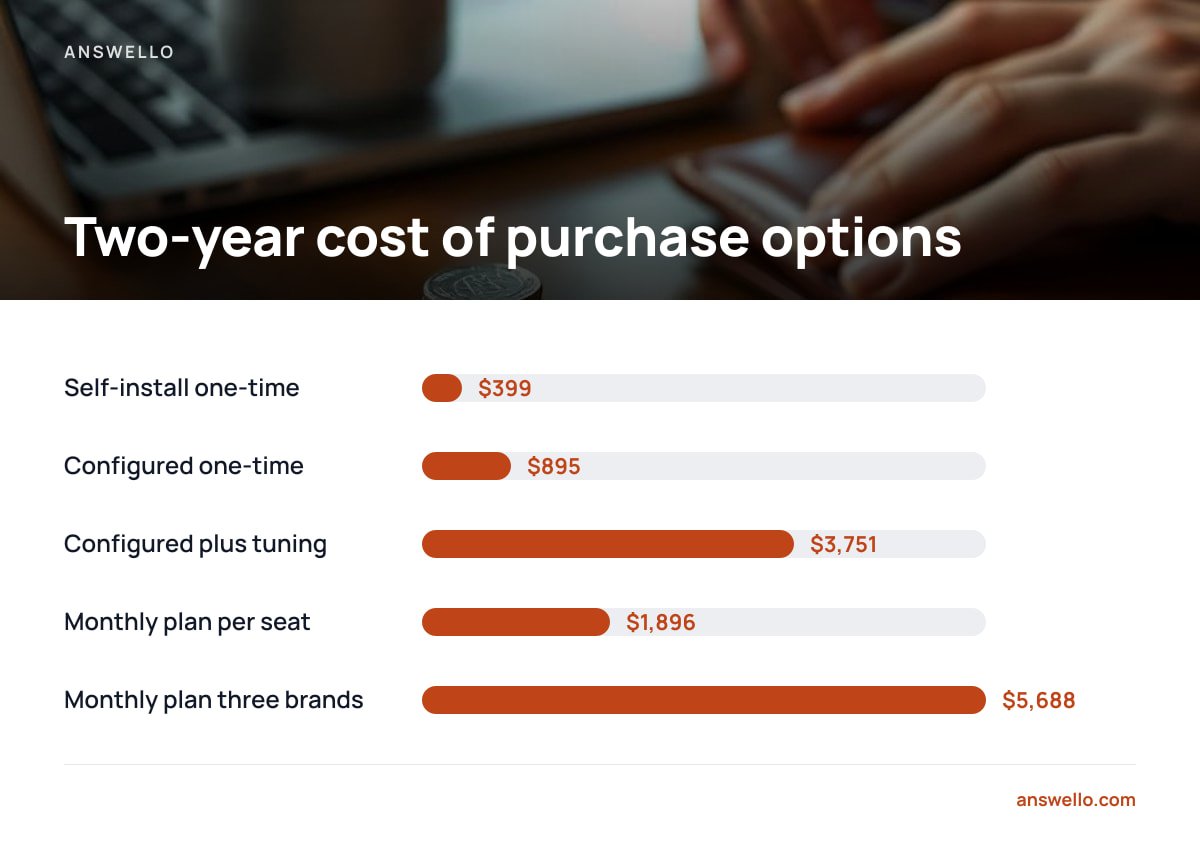
| Purchase | Two-year cost |
|---|---|
| Self-install one-time at $399 | $399 |
| Configured one-time at $895 | $895 |
| Configured plus $119 a month tuning | $3,751 |
| Monthly plan at $79 per seat | $1,896 |
| Monthly plan at $79, three brands | $5,688 |
The configured build plus tuning costs more over two years than a $79 monthly plan. That is the honest comparison, and it is why I would skip the retainer at the start. Buy the build, run it for a quarter, and add tuning only when you find yourself editing the script more than once every three months. A retainer you do not use is a subscription wearing a different name.
The math flips for multi-brand operators. Per-seat plans charge per number, so three brands at $79 each is $237 a month. Three brands on a one-time build cost less in two years than one year of seats. If you run HVAC or refrigeration, AI receptionist for HVAC companies covers emergency-versus-routine triage rules that change how the script should escalate. For the buy-or-subscribe decision from the owner's side, answering service for busy trade jobs is the longer version.
Get the Script Built Once and Quoting Right This Week
Answello sells a one-time purchase instead of a monthly seat. The $895 configured package includes a custom pricing script written against your fee schedule: call-out fee, travel bands, after-hours multipliers, refusal list and escalation ceiling, tested against your own numbers before it takes a live call. The $399 self-install version gives you the software and templates if you would rather write the script yourself. Multi-brand and multi-number setups sit under one payment instead of one seat per brand, and every call is recorded and transcribed to a dashboard you can review.
One honest limit. The configured package covers one round of revisions in the first 30 days. If your prices move more often than that, either budget for the $119 a month tuning plan or expect to edit the script yourself. And no script replaces a human above your ceiling: that rule stays yours to enforce, which is exactly why the ceiling belongs in the script from day one.
Frequently Asked Questions
How long does it take to build a pricing script for an AI answering system?
Most trade businesses can draft the fields in about two hours and finish testing in another 45 minutes. Drafting the words is quick. The slow part is pulling your last 20 invoices to see what actually pushed prices up. A configured build usually takes a few days because the supplier has to test the script against your numbers.
Can the AI quote an exact price instead of a range?
Only for genuinely fixed-price jobs, such as a standard call-out fee or a listed diagnostic charge. Everything that depends on what is on site should be quoted as a range with the condition named out loud. An AI that commits to an exact figure for unseen work gives away your margin on every awkward job.
What should the script do when a caller says a competitor quoted less?
Repeat your range once and offer a callback from the owner, then stop. Two sentences is the limit. An AI that keeps talking after that point starts negotiating, and a system that negotiates on price will lose money faster than a missed call ever did.
Do I have to tell callers the AI is recording them?
If you record or transcribe calls, yes. The ICO's guidance for organizations is explicit about telling people. Put the disclosure in the AI's opening line so every call says it. Automated callbacks also fall under robocall consent rules in the US.
Is a one-time AI answering system cheaper than a monthly plan?
Over two years, a $895 build beats a $79 monthly seat ($1,896), but only if you skip the tuning retainer at the start. Add $119 a month maintenance and the two-year total reaches $3,751. The one-time model wins hardest when you run several brands or numbers, because per-seat plans charge for each one.
Sources
- Guidance for organisations | ICO
- Robocalls and AI-generated voices | FCC
- False or misleading claims | ACCC
- Advertising FAQs: A Guide for Small Business | FTC
Leave a Reply