

How to switch answering service providers without losing calls comes down to one rule: keep the old service answering until the new one has passed live test calls, and cancel last. The step that decides your risk is who owns the phone number callers dial. If it is yours at your carrier, switching means changing a forwarding setting. If the provider owns it, you have to port it first, and that is where calls get lost.
TL;DR:
- Find out who owns the number callers dial before anything else. If you own it, switching is a forwarding change. If the provider owns it, you need a port.
- Run the old and new services in parallel for 7 to 14 days, and cancel the old one only after the new one has answered real test calls.
- Read your contract for the notice period and auto-renewal date, and export scripts, recordings and caller history before you give notice.
- A simple number port is due within one business day under FCC rules, but plan for a week because a mismatched account name or address gets requests rejected.
- Test after-hours, busy and no-answer paths, since each is a separate forwarding rule that can fail on its own.
Table of Contents
- How to Switch Answering Service Providers: Start by Finding Out Who Owns the Number
- What To Gather Before You Give Notice
- Three Ways To Cut Over, and the One I Would Pick
- A Two-Week Switch Plan, Step by Step
- Porting a Number Without a Gap
- Test Calls, Recording Consent, and the Handoff Rules
- Mistakes That Drop Calls During a Switch
- Switch To an Answering System You Own, Not Another Monthly Meter
- Frequently Asked Questions
- Sources
How to Switch Answering Service Providers: Start by Finding Out Who Owns the Number
Pull out a recent bill or log in to your phone carrier and look at the number customers actually dial. Two situations come up, and they need different plans.
You own the number
Your business number lives with your carrier, and the answering service receives calls only because you forward them. This is the common setup for small trades businesses. Switching means pointing your forwarding rule at the new provider's number. It takes minutes, and you can reverse it just as fast.
The provider owns the number
Some services hand you a number of their own, and you printed it on trucks, invoices and a Google listing. Cancel that service and the number can disappear. Before you do anything else, ask the provider in writing whether they will release it, and how long a port-out takes.
If pricing is why you are switching, our guide to flat rate phone answering service costs and trade-offs covers the cost comparison. This article stays on the mechanics of moving.
What To Gather Before You Give Notice
Giving notice first is the most common way to create a gap. Spend a day collecting what you need while the old service is still fully working.
- Contract terms. Find the notice period (often 30 days), the auto-renewal date and any early-termination fee. A 30-day notice window means you may pay for a month you are not using, so count that overlap as the cost of a safe switch.
- Your call script. Copy the greeting, the questions callers are asked, and the rules for emergencies. A new provider can only reproduce what you hand them.
- Recordings and message history. Export them now. Many providers delete recordings after a set retention window once you cancel.
- Account details for the number. If you will port, you need the exact account name, billing address, account number and PIN on file with the current carrier.
- Where messages go today. List every email address, text number or CRM that receives call summaries. If a CRM is involved, run through the virtual receptionist CRM integration checks so the new service's data lands where your jobs are tracked.
Three Ways To Cut Over, and the One I Would Pick
You have three realistic methods. The table shows how each one fails.
| Method | How it works | Risk of lost calls | Best for |
|---|---|---|---|
| Change the forwarding target | You edit the forwarding rule at your carrier to point at the new service | Low, and instantly reversible | You own the number |
| Port the number to the new provider | The number moves to the new provider's network | Medium, since the cutover moment can drop calls | The old provider owns the number |
| Parallel run with ring groups | New service answers on a secondary path while the old one stays primary | Lowest | Any business with steady call volume |
I would pick the parallel run whenever the carrier allows it. Send overflow or no-answer calls to the new service for a week while the old one still handles the main flow. You see real calls handled by the new provider before you commit, and you lose nothing if the script is wrong.
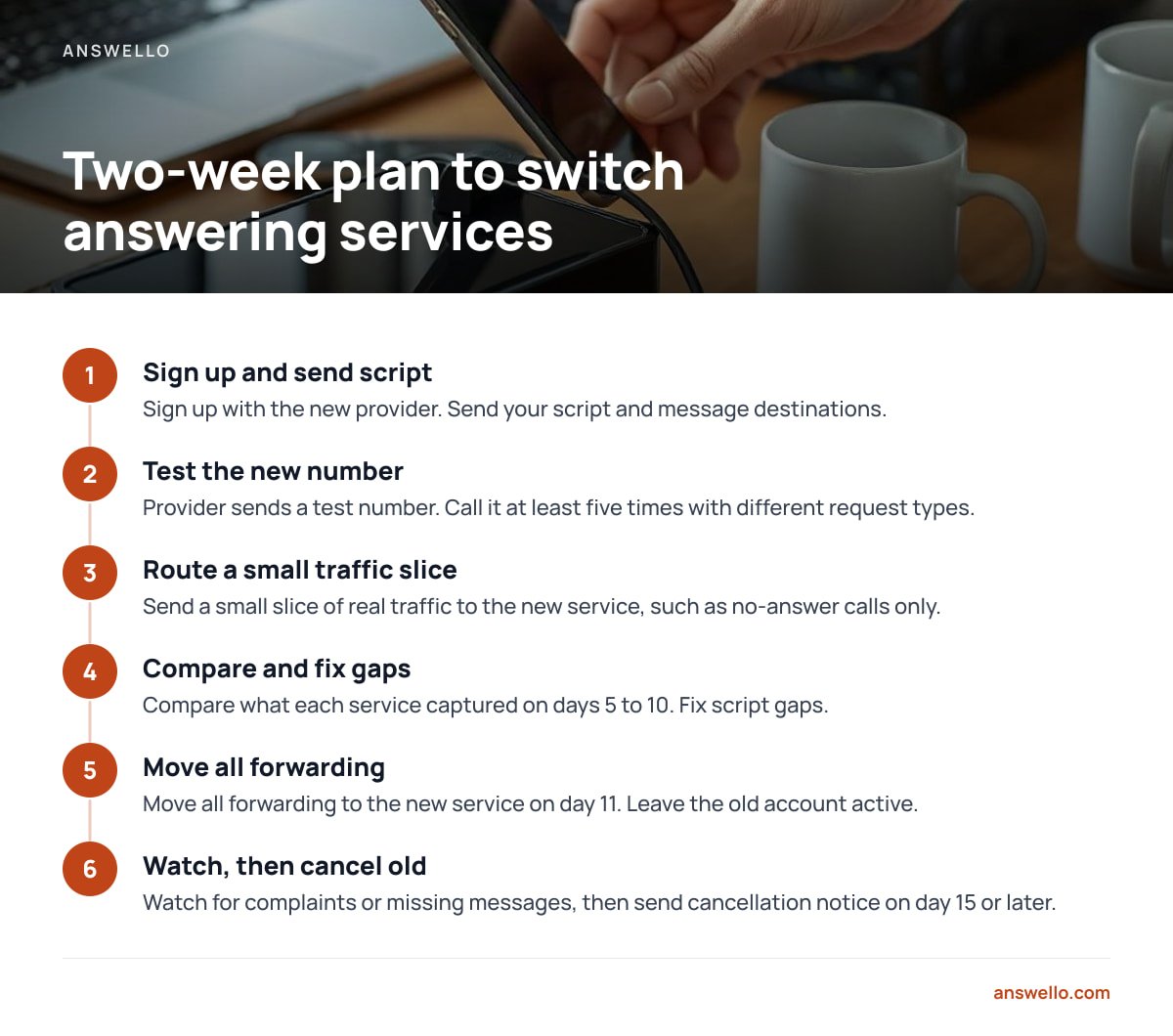
A Two-Week Switch Plan, Step by Step
This timeline assumes you own the number and your carrier supports conditional forwarding. Stretch it if you need to port.
| Day | Action |
|---|---|
| 1 | Sign up with the new provider. Send your script and message destinations. |
| 2 to 3 | Provider configures and sends you a test number. Call it yourself at least five times, with different request types. |
| 4 | Route a small slice of real traffic to the new service, such as no-answer calls only. |
| 5 to 10 | Compare what each service captured. Fix script gaps. |
| 11 | Move all forwarding to the new service. Leave the old account active. |
| 12 to 14 | Watch for complaints, wrong details or missing messages. |
| 15 or later | Send cancellation notice to the old provider, timed to your contract. |
The overlap costs you maybe two weeks of two subscriptions. A single missed emergency job is worth more than that for most trades businesses.
Cancel the old service last. Every lost-call story in a provider switch starts with someone ending the old line before the new one had answered a single test call.
Porting a Number Without a Gap
Porting is its own project. The Federal Communications Commission requires carriers in the U.S. to let customers keep their numbers when changing providers, and its standard for a simple port is one business day. A carrier also cannot refuse to release your number because you owe a balance or an early termination fee, though you still owe the money.
In practice, ports get rejected for small reasons: an account name that differs by a letter, an old billing address, a missing PIN. Plan for a week even though the rule says one day, and never cancel the losing service until the port completes. Canceling first can wipe the number from your account and leave nothing to port.
Other countries have their own porting rules and timelines, so check your national regulator if your numbers are outside the U.S. The sequence is the same: request the port from the new provider, let the old one release the number, and keep the old account open until the new route is confirmed.
If you run several brands or lines, move them one at a time, starting with the least busy. Our breakdown of an answering service for multiple business numbers explains how to structure that so one failed port does not take every brand offline.
Test Calls, Recording Consent, and the Handoff Rules
One daytime call is not enough. Each of these is a separate forwarding path, and each can break independently:
- Busy signal. Call while you are on another call.
- No answer. Let it ring past your carrier's ring limit.
- After hours. Call at night or on a weekend, when different rules may apply.
- Emergency keywords. Say the phrases your script treats as urgent and confirm you get a call or text immediately.
- Handoff to a human. If your script transfers certain calls to a person, verify the transfer works. The AI receptionist call routing setup guide shows how to decide which calls should hand off.
Recording rules matter during a switch because a new provider may record by default where the old one did not. U.S. federal law generally allows recording with one party's consent, but several states require every party to agree, according to the Reporters Committee for Freedom of the Press recording guide. If you serve customers in more than one state, make sure the new greeting announces recording. Where transcripts are stored is covered in our piece on AI phone answering service privacy risks.
Pro Tip: Before you switch, place a few calls to your own business from a landline and from a cell phone on a different carrier than yours. Forwarding rules and caller ID sometimes behave differently depending on where the call originates, and a test from your own cell often hides the problem that real customers hit.
Mistakes That Drop Calls During a Switch
Most failures are quiet. You find out when a customer mentions that they called twice and nobody picked up.
- Cancelling on the contract date. Auto-renewal dates and notice periods rarely line up with your cutover. Put both dates in your calendar before you start.
- Forgetting secondary numbers. Old Google listings, directory profiles and a second line from a former brand often still forward to the old provider. List every place your number appears.
- Skipping the ring-count check. If the carrier sends calls to the new service after 4 rings but you answer at ring 3, nothing breaks. If you set it to 8 and callers hang up at 5, you lose jobs without any error.
- Trusting the setup call only. One clean test shows the greeting plays. It does not show whether the message reaches the right phone at 9 p.m.
- Not measuring afterward. Pick numbers to track for the first month, such as answer rate and time to message delivery. After-hours answering service performance metrics lists the ones worth watching.
Switch To an Answering System You Own, Not Another Monthly Meter
If your switch is partly about escaping a recurring bill, Answello is built for that. It is an AI system that picks up calls you miss, identifies the caller and what they need, and texts you the name, number, request and a transcript. You pay once: $399 for the self-install package, or $895 if you want it set up and configured with a custom script for you. A single payment covers multiple brands and numbers, so you do not add a per-site fee each time you add a line.
There is one limit. Answello answers and captures the call, but it is not a live human, so if your business depends on a person talking customers through complications in real time, keep that path in your routing. If you want ongoing tuning, the looked-after plan is $119 a month and you can cancel anytime. Check the spec sheet for how your carrier's forwarding works with it before you buy, as you should with any provider.
Frequently Asked Questions
How long does it take to switch answering service providers?
If you own your number and only need to change forwarding, the switch itself takes minutes, but a safe plan runs about two weeks including testing. If you need to port a number, allow at least a week, even though simple ports are due within one business day under FCC rules.
Will I lose calls when I change answering services?
Not if you keep the old service active until the new one has answered test calls on every path: busy, no answer and after hours. Losses happen when someone cancels first or when a port is rejected and nobody notices.
Can I keep my phone number when I change providers?
If the number is registered with your carrier, yes, since you are only changing where it forwards. If your current answering service issued the number, ask in writing whether they will release it, because some providers can refuse or charge a fee.
Do I have to give notice before switching?
Check your contract. Many providers require 30 days' written notice, and some auto-renew for a full term if you miss the window. Give notice on the date that fits your overlap period, not the day you sign with the new provider.
What should I export from my old answering service?
Your call script, call recordings, message or transcript history, and the list of destinations that receive messages. Do this before you give notice, since some providers delete data soon after cancellation.
Sources
- Federal Communications Commission | FCC
- Reporter's Recording Guide | Reporters Committee for Freedom of the Press
Leave a Reply