

An answering service for multiple business numbers has to know which number the caller dialed before it says a word, so each brand gets its own greeting and its own labeled summary. That one capability separates a usable setup from a confusing one. After that, price decides it: some services bill per number every month, while others charge once.
TL;DR:
- The system must identify the dialed number before it answers. Without that, every brand gets the same generic greeting.
- Giving each brand its own destination line is more reliable than depending on the carrier to pass the original number along.
- Per-number monthly pricing multiplies fast. Four brands at an illustrative $60 each is $2,880 a year.
- Each brand needs its own script (services, service area, emergency rules), but the summaries should land in one inbox with the brand name on top.
- Test every number with a real call before you trust it, and check call recording consent rules where your callers live.
Table of Contents
- What an Answering Service for Multiple Business Numbers Has to Do, Starting With Knowing Which Number Rang
- How Calls Reach the System: Forwarding, Dedicated Lines and the Dialed-Number Problem
- Three Ways to Cover Several Numbers, Compared
- Per-Number Pricing Math: Where Subscriptions Get Expensive
- Scripts and Greetings for Each Brand, and When to Share One
- Summaries, Transcripts and Recordings Across Brands: Keep Them Separate and Legal
- A Rollout Checklist for Several Numbers: Test Before You Trust
- Get Multi-Brand Call Answering for One Payment
- Frequently Asked Questions
- Sources
What an Answering Service for Multiple Business Numbers Has to Do, Starting With Knowing Which Number Rang
If you run a plumbing company, a drain-cleaning brand and a water-heater installation site, you likely have three numbers and one pair of hands. A caller who dials the drain-cleaning line and hears "Thanks for calling Smith Plumbing" assumes they dialed wrong and hangs up. So the first job is simple to state and easy to get wrong: answer as the brand the caller actually dialed.
A workable setup does four things:
- Identifies the dialed number. The system must know which of your numbers was called, as well as who is calling.
- Greets by brand. The business name, the tone and the first question all change per number.
- Labels every summary. The text you receive should lead with the brand, then the caller name, number and request.
- Keeps one inbox. You should not log into four dashboards to find Tuesday's missed calls.
If anything on that list is missing, you will feel it at 6 p.m. when you are standing in a crawlspace and a text says only "new lead."
How Calls Reach the System: Forwarding, Dedicated Lines and the Dialed-Number Problem
Most small businesses do not move their numbers. They forward them. The catch is that a forwarded call can lose track of which number was originally dialed. The IETF's RFC 5806 describes the Diversion header, which lets a SIP call carry the originally called number after a redirect. Whether your carrier actually fills that field in is a separate question, and many small-business carriers do not.
That leaves two practical ways to build it:
Option 1: One destination line per brand
Each of your public numbers forwards to its own inbound number on the answering system. The system knows the brand because of the line the call lands on. This is the method I would pick every time. It does not depend on carrier headers, and you can see in a minute whether it works.
Option 2: One shared line plus header detection
All numbers forward to the same destination, and the system reads the redirect information to work out which brand was dialed. It works when the carrier cooperates. When it does not, every call gets the default greeting and you find out from an annoyed customer.
If one of your numbers is a landline you cannot port, forwarding is still the route. Our walkthrough on missed call text back for a landline number without porting covers that case.
A forwarded call is only as informative as the carrier makes it. If the original dialed number is not passed along, the system cannot tell your brands apart.
Three Ways to Cover Several Numbers, Compared
There are three common ways small businesses handle this. The table shows where each one pinches.
| Approach | How you pay | Brand-specific greeting | Where it breaks |
|---|---|---|---|
| Shared live receptionist pool | Monthly fee plus per-minute or per-call charges | Yes, if the agents read your notes | Agents juggle many clients' scripts, and cost climbs with call volume |
| AI answering on a per-line subscription | Monthly fee for each number or site | Yes | The bill grows with every brand you add |
| One-time-purchase AI system | Single payment, optional paid support | Yes | You own the setup work, or pay for it once |
The live pool suits you if callers need a human voice and your volume is low. We compare that route in detail in virtual receptionist vs AI call answering. For a trades business with two to six numbers and mostly routine requests (book a job, quote a repair, emergency or not), I would pick the one-time AI system. The calls are repetitive enough for a script to handle, and the money you do not spend monthly can go toward trucks and ads.
Per-Number Pricing Math: Where Subscriptions Get Expensive
Per-line pricing looks cheap when you have one number. It stops looking cheap at the third brand. Take an illustrative example, not a quote from any vendor: a service charging $60 per number per month, across four brands.
Four brands at $60 per number per month is $2,880 a year, or $8,640 over three years. A one-time $895 setup is paid once.
Three things push the real number higher than the sticker:
- Overage fees. Some plans cap minutes or calls per number, and a busy storm week blows through the cap.
- Add-on charges. Recording, transcripts and custom scripts are sometimes separate line items.
- Lock-in. After a year of call history and tuned scripts, switching is a chore, and vendors know it.
Ask any vendor for the total monthly cost with all your numbers, recording and transcripts on, in a busy month. If they cannot give you a single figure, assume it is higher than the one on the pricing page. For a deeper budget breakdown, see what to budget and build for an AI answering service.
Scripts and Greetings for Each Brand, and When to Share One

Every brand needs its own opening line. Beyond that, the question is how much of the script should differ.
What should differ per brand
- Business name and greeting. Exact wording, including how you say the name aloud.
- Services and exclusions. The drain brand does not install water heaters, so the script should say so.
- Service area. Different brands often cover different ZIP codes or counties.
- Emergency rules. A burst pipe line needs "is water actively flowing?" while a quote line does not.
What can be shared
- Information collected. Name, callback number, address, description, urgency.
- Escalation rules. What triggers an immediate text versus a daily digest.
- Tone. Keep it consistent so your brands sound like they live in the same shop.
Addresses and phone numbers are where transcription errors cost real jobs, so make the script read them back. Our piece on why mishearing addresses costs trades jobs explains why that single step matters.
Pro Tip: Set your carrier's forwarding to trigger after fewer rings than your carrier's own voicemail needs. If voicemail picks up at five rings and you forward after six, the call never reaches the answering system. Many people discover this only after weeks of "missed" calls that went to a full voicemail box. Make a test call from a second phone, let it ring, and count.
Summaries, Transcripts and Recordings Across Brands: Keep Them Separate and Legal
Once calls from several brands flow into one place, you want to filter them by brand, not scroll through a mixed list. A good dashboard tags each call with the number dialed, stores the recording and transcript, and lets you search by caller.
Recording brings legal duties that vary by location. In the United States, the Reporters Committee for Freedom of the Press recording guide summarizes state-by-state rules, and it lists states such as California and Florida as requiring consent from all parties to a call. In the EU and UK, a voice recording is personal data, so the General Data Protection Regulation requires you to have a lawful basis and to tell people what you are doing.
The simple fix is a one-line disclosure at the start of the call: "This call may be recorded to take your request accurately." Put it in every brand's script. It costs two seconds, and it covers you across jurisdictions. If you serve customers in several countries or states, confirm the rules with a local attorney instead of relying on a blog post, including this one.
A Rollout Checklist for Several Numbers: Test Before You Trust
Do this in order, one number at a time:
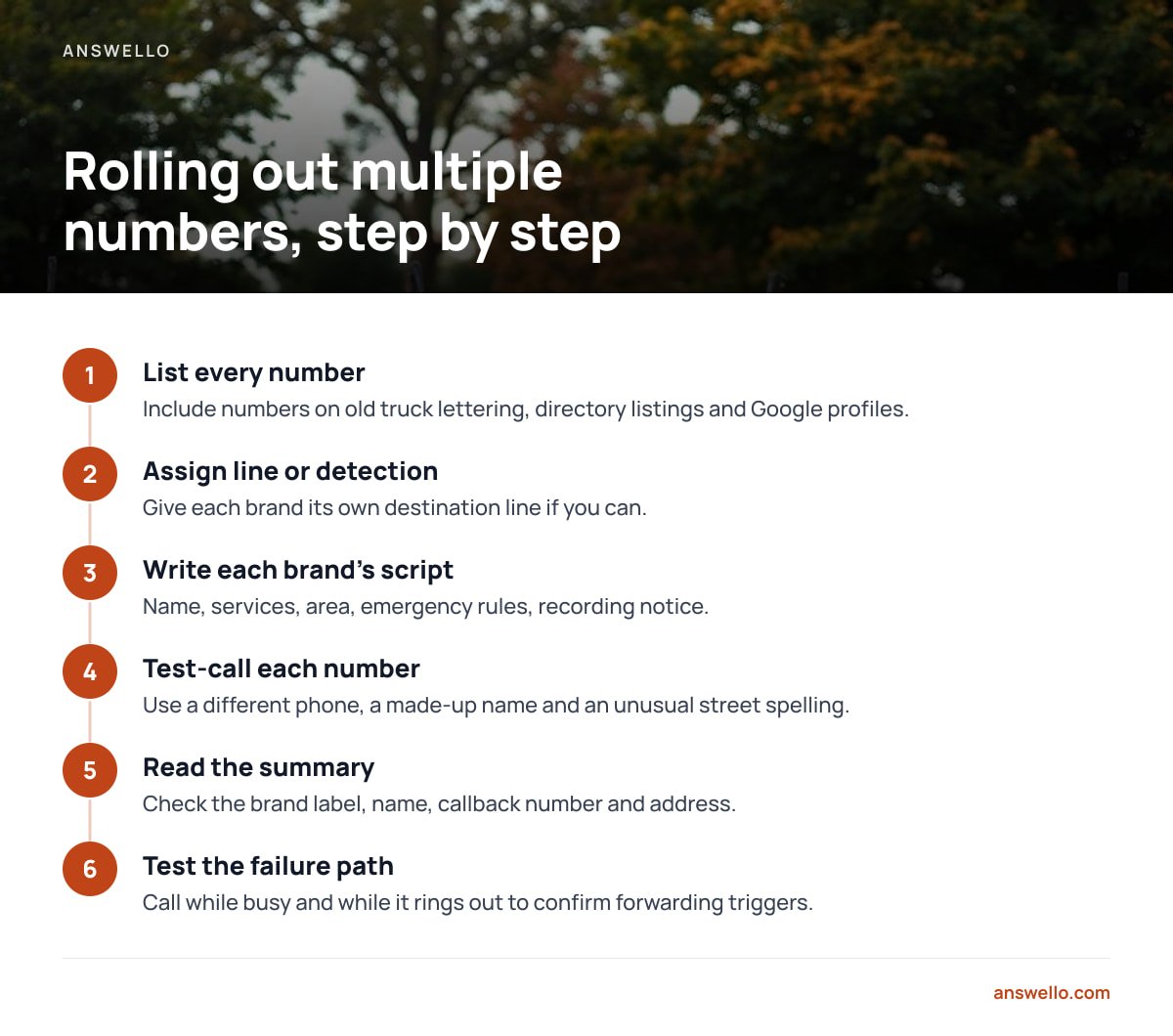
- List every number. Include the ones on old truck lettering, directory listings and Google profiles. Missed calls often come from numbers you forgot.
- Assign a destination line or detection method. One per brand if you can.
- Write the script per brand. Name, services, area, emergency rules, recording notice.
- Call each number from a different phone. Give a made-up name, an address with an unusual street spelling, and a request.
- Read the summary. Check the brand label, the name, the callback number and the address.
- Test the failure path. Call while your phone is busy and while it rings out, to confirm the forward triggers.
- Review the first week. Listen to a handful of recordings and fix script gaps.
Do not launch all brands on day one. Start with the number that loses you the most calls, fix what you find, then add the others.
Get Multi-Brand Call Answering for One Payment
If you are tired of paying per number, Answello is built for this. It answers calls you miss, identifies the caller and what they need, and texts you the name, number and request with a transcript. Multiple brands and numbers fall under a single one-time payment: $399 for the self-install package, or $895 for the fully configured version with a custom script written for your brands. A recording and transcript dashboard keeps every call in one place.
The caveat: the one-time price covers the system, and your phone carrier's charges for numbers and forwarding stay separate. Check the spec sheet for how many numbers your package covers before you buy. If you want someone watching the scripts after launch, an optional tuning plan runs $119 a month and you can cancel anytime. Most owners with two or three simple brands can run the self-install and skip it.
Frequently Asked Questions
Can one answering service handle several different business names?
Yes, if it can tell which number was dialed and attach a separate greeting and script to each one. Confirm this in a test call for every number before you rely on it, because a shared default greeting is the most common failure.
Do I need to port my numbers to use an answering service?
Usually not. Most small businesses forward their existing numbers to the service, which leaves the numbers with the current carrier. Forwarding fees from that carrier may still apply.
How do I stop my brands' calls from getting mixed up?
Give each brand its own destination line on the answering system, so the line itself identifies the brand. Relying on the carrier to pass along the original dialed number works only if the carrier supports it.
Is it legal to record calls for my answering service?
It depends on where you and your callers are. Some US states, including California and Florida, require consent from everyone on the call, and under GDPR a recording is personal data that needs a lawful basis and a notice. A short recording disclosure in every greeting covers most situations, but ask a local attorney about yours.
Is a one-time purchase cheaper than a monthly service for multiple numbers?
Usually, once you have more than one or two numbers. Per-number monthly fees multiply with each brand, while a one-time payment is spent once. Compare the total over three years, including overage and add-on charges.
Sources
- RFC 5806: Diversion Indication in SIP | Internet Engineering Task Force (IETF)
- Reporter's Recording Guide | Reporters Committee for Freedom of the Press
- Regulation (EU) 2016/679 (General Data Protection Regulation) | EUR-Lex, European Union
Leave a Reply