
An answering service contract checklist comes down to a handful of numbers and dates: the term length, the renewal notice window, how minutes are rounded, the overage rate, the cap on price increases, and the cancellation fee. Check those before you look at features, because they decide what you pay in year two. A low monthly price can end up a third higher once rounding and overages are applied.
TL;DR:
- Auto-renewal and the notice window cost more than any other clause. Miss a 60-day window on a 12-month term at $149 a month and you owe up to $1,788 more.
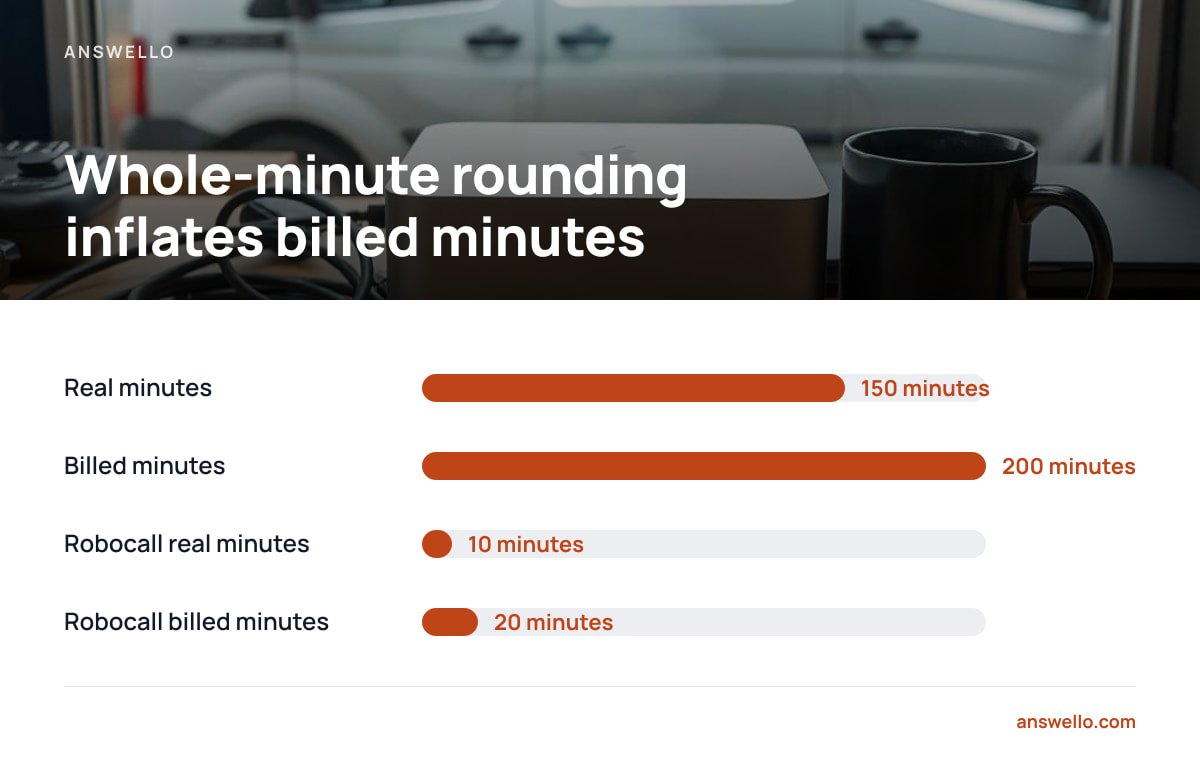
- Ask how minutes are rounded. Billing in 60-second increments turns 150 real minutes into 200 billed minutes when every call runs 90 seconds.
- Get a written cap on price increases, a stated overage rate, and a list of what counts as a billable call, including spam and wrong numbers.
- If the service records calls or touches health or EU personal data, the contract needs recording-consent language, a business associate agreement (HIPAA) or processor terms (GDPR).
- Get cancellation, data export and number handling in writing. You usually read these clauses only when you are already leaving.
Table of Contents
- The Answering Service Contract Checklist: Ten Items in One Table
- Term and Renewal: Where the Real Money Hides
- Minutes, Rounding, and Overages: Do the Math Before You Sign
- Service Levels You Can Actually Enforce
- Recording, Privacy, and Compliance Clauses
- Cancellation, Data Return, and Number Handling
- Price Changes, Fees, and Add-Ons
- When a Contract Checklist Is the Wrong Tool
- Skip the Renewal Clause: A One-Time Missed-Call Answerer for $399
- Frequently Asked Questions
- Sources
The Answering Service Contract Checklist: Ten Items in One Table
Print this table, then check each row against the draft you were sent. If a row is missing from the contract entirely, count it as a failed check, because anything left unstated defaults to the provider's standard terms.
This checklist covers the paperwork only. If you are still deciding whether a human-staffed service fits your business at all, the live answering service cost breakdown covers that question.
| # | Clause | What you want | Red flag |
|---|---|---|---|
| 1 | Initial term | Month-to-month, or 12 months with a stated discount | 24 or 36 months as the default |
| 2 | Renewal | Renews month-to-month, or needs your opt-in | Auto-renews for a full new term |
| 3 | Notice window | 30 days or less, by email | 60 to 90 days, certified mail only |
| 4 | Minute rounding | Per second, or 6-second increments | Whole-minute rounding up |
| 5 | Overage rate | Stated per-minute price in the contract | "Then-current rates" |
| 6 | Billable calls | Spam and wrong numbers excluded | Every ring-through counts |
| 7 | Price changes | Written cap, such as 5% a year | Change allowed on notice |
| 8 | Recording and data | Consent language, retention period, deletion on exit | Silent on all three |
| 9 | Service levels | Answer-time target with a credit if missed | "Commercially reasonable efforts" |
| 10 | Exit | No early-termination fee, data export, number stays yours | Fees equal to remaining months |
Term and Renewal: Where the Real Money Hides
Read the renewal clause first, because it decides how long you are committed. A 12-month agreement that auto-renews for another 12 months unless you cancel 60 days ahead is a 24-month agreement for anyone who forgets once.
Miss a 60-day notice window by one day on a 12-month auto-renewing contract at $149 a month, and you can owe another $1,788.
Many state auto-renewal laws are written to protect consumers, so a small business often gets less statutory help than it assumes. The contract text is your protection. Ask for three changes in writing:
- Renewal into month-to-month. At the end of the term, the agreement should convert to month-to-month, not restart a full term.
- A reminder. Ask for an email 30 to 45 days before the notice deadline. A provider who refuses has told you something.
- Email cancellation. If the contract demands certified mail or a phone call during business hours, your cancellation can fail on a technicality.
I would take month-to-month at 10 to 15% above the annual rate over a 12-month auto-renewing term. The premium is a known cost, while the renewal trap is an unknown one. The one annual deal I would sign has a written price cap and no auto-renewal. For more on what to push back on, see answering service contract terms to negotiate.
Minutes, Rounding, and Overages: Do the Math Before You Sign
Per-minute billing looks transparent until you ask how a minute is counted. Some providers round every call up to the next full minute. Others bill in 6-second increments or by the second.
Here is a worked example with made-up but realistic numbers. You get 100 answered calls a month, each lasting 90 seconds. That is 150 real minutes. With whole-minute rounding, each call bills as 2 minutes, so you pay for 200. On a plan that charges $1.25 per overage minute, that gap alone adds $62.50 a month if you are past your included minutes.
A 90-second call billed in 60-second increments is a 2-minute call. A hundred of them cost you 200 minutes for 150 minutes of talking.
Check these three numbers in the contract itself, not on the pricing page:
- Included minutes. Find out whether they roll over or vanish at month end. Most vanish.
- Overage rate. It should be a dollar figure in the agreement. "Then-current rates" lets the provider set the price after you have signed.
- Billable events. Ask whether robocalls, wrong numbers, hang-ups, and calls transferred to you count. If the contract does not exclude them, they do.
Pro Tip: Before you sign, pull 30 days of call durations from your carrier or phone system, then run them through the provider's rounding rule in a spreadsheet. Include the spam calls, since you will pay for those too. If your carrier log shows 20 robocalls a month at 30 seconds each, a whole-minute rule bills 20 minutes for 10 minutes of actual noise. How many minutes a small business really uses gives typical figures to compare against.
Service Levels You Can Actually Enforce
Contracts love phrases like "prompt answering" and "commercially reasonable efforts." Neither can be measured, so neither can be enforced. You want a number.
- Answer time. Look for a target such as "answered within 5 rings" or "within 20 seconds," measured monthly.
- A remedy. A target without a credit is a wish. Ask for a bill credit when the target is missed, even a small one, because it forces the provider to track the metric.
- Message delivery. The contract should say how fast a message reaches you (for example, within 2 minutes by text or email) and what happens if delivery fails.
- Script changes. Find out how many edits are included and how long they take. Some providers charge per change.
- Uptime. Ask for a stated availability figure and a reporting method, not a promise that the system is "reliable."
A provider that will not put any number in writing is telling you what its internal numbers look like.
Recording, Privacy, and Compliance Clauses
If the service records calls, the contract should say who stores the recordings, for how long, and what happens to them when you leave. It should also say how the caller is told about recording, because that duty sits with you as well as the provider.
Recording law varies. California's Penal Code section 632 bars recording a confidential communication without the consent of all parties, and several other states have similar all-party rules. If you serve callers in more than one state, assume the stricter rule and make sure the greeting includes a recording notice.
Two more clauses matter depending on your industry:
- Health information. Under HIPAA, HHS guidance on business associate contracts says a covered entity must have a written agreement with a vendor that handles protected health information on its behalf. If you take calls for a clinic or dental office, no business associate agreement means no deal.
- EU or UK callers. Article 28 of the GDPR requires a contract with any processor that handles personal data for you. That contract must cover, among other terms, deletion or return of the data when the service ends.
Trades businesses rarely handle health data, but almost every one records calls. Ask for the retention period in days, and ask whether recordings are used to train anything.
Cancellation, Data Return, and Number Handling
You usually read exit terms only when you are already unhappy, so read them first. Look for these specifics:
- Early-termination fee. The usual formula is the remaining months multiplied by your monthly fee. On an 18-month balance at $149, that is $2,682. Negotiate it down to zero or to a fixed amount before you sign.
- Data export. You should be able to download call recordings, transcripts and message history in a standard format, with a deadline for deletion afterward.
- Your phone number. Use call forwarding from a number you own, not a number the provider issues. If the provider owns the number, you may lose it, and every business card and truck decal with it.
- Final billing. The contract should say that service and billing stop on the same date, with no "final month" charge.
When you do leave, forward the number to the new service before you cancel the old one. How to switch answering service providers without dropped calls walks through the order of steps.
Price Changes, Fees, and Add-Ons
A price you can only see on day one is not a price. Four things inflate bills after signing:
- Annual increases. Ask for a written cap. 3 to 5% a year is reasonable. "Upon 30 days' notice" with no cap means any increase is allowed.
- Setup and script fees. A one-time fee is fine. A fee for every script revision is not.
- Add-on features. Texting, transcripts, call recording, and extra phone numbers are often priced separately. Get the full list with prices.
- Taxes and surcharges. Regulatory or "administrative" fees should be listed in the contract, not added later.
The headline rate of a cheap plan rarely survives contact with the invoice. What a low-cost answering service really costs over five years puts numbers on it.
When a Contract Checklist Is the Wrong Tool
Every item above exists because a recurring service is a recurring commitment. The vendor gets paid every month and has a reason to make leaving hard, so you check renewal dates, rounding rules, and escalation clauses.
For many small trades businesses, the better answer is to avoid the contract. If your goal is to catch the calls you miss while you are on a roof or under a sink, you may not need a human agent at all. A one-time-purchase system has no renewal date, no overage meter, and no exit fee, so most of this checklist does not apply. The trade-off is real: software cannot handle an upset customer or a complicated triage the way a trained person can. Pick the tool that matches the calls you actually get. For a broader comparison, see answering service alternatives and when not to pay monthly.
Skip the Renewal Clause: A One-Time Missed-Call Answerer for $399
Answello is an AI phone-answering system you buy once. It picks up the calls you miss, finds out who is calling and what they need, and texts you the caller's name, number, and request, along with a transcript. Calls are recorded to a dashboard you can search. One payment covers multiple brands and numbers, so there is no per-site fee to track. The self-install package is $399. The fully configured package, with a custom script, is $895. An optional "looked after" tuning plan is $119 a month and you can cancel it anytime.
Answello is software, not a person, so it will not talk an angry customer through a problem or dispatch a crew. It also does not remove your own recording-consent duties: you still need a notice in your greeting, and if you handle health data you should confirm compliance terms with us before buying. Check the spec sheet for what the system does and does not do. For a typical trades owner, it replaces the clause-by-clause worry with a single receipt.
Frequently Asked Questions
What is the most important clause in an answering service contract?
The renewal and cancellation clause, because it determines how long you are locked in and how much a missed deadline costs. After that, check how minutes are rounded and whether overage rates are stated in dollars. Those two terms drive most billing surprises.
Is month-to-month always better than an annual answering service contract?
Not always. Month-to-month costs more per month, but it has no renewal trap. An annual contract can win if it has a written price cap, no auto-renewal, and a discount larger than your risk of forgetting a notice date.
Do I need a business associate agreement with an answering service?
If you are a HIPAA covered entity and the service handles protected health information for you, yes. HHS guidance says a written agreement with the vendor is required. Most trades businesses do not handle health data and can skip this item.
Can I negotiate an answering service contract?
Yes, especially the renewal terms, notice period, early-termination fee, and price cap. Providers rarely move on per-minute rates for small accounts, but they often agree to month-to-month conversion or email cancellation. Ask in writing and get the change in the signed agreement.
How do I check what an answering service will really bill me?
Pull 30 days of call durations from your carrier, apply the provider's rounding rule in a spreadsheet, and add the overage rate for anything above your included minutes. Include spam and wrong-number calls unless the contract excludes them.
Sources
- Sample Business Associate Agreement Provisions | U.S. Department of Health and Human Services
- Regulation (EU) 2016/679 (General Data Protection Regulation) | EUR-Lex, European Union
- California Penal Code section 632 | California Legislative Information
Leave a Reply