

A low-cost answering service is one with a low five-year cost, which is not the same as a low monthly price. A $99 plan multiplied across every number or brand you run, plus per-minute overages, can pass $17,000 before you notice. For most small trades businesses, the real choice is between two options. You can pay a live or AI service every month indefinitely, or you can buy an AI answering system once and then decide whether you need ongoing help at all.
TL;DR:
- Judge any answering service by its five-year cost per number. The monthly sticker price hides overages and per-location billing.
- Free voicemail costs nothing up front but catches only the callers willing to leave a message, so it is often the most expensive option in lost jobs.
- Live answering services still exist and still work best for complex calls, but starter plans rarely include enough minutes for a busy trade.
- A monthly AI receptionist can be the cheapest pick for a single number when you want hands-off upkeep. One-time systems win once you run multiple brands or lines.
- Before you buy anything, set up conditional call forwarding and check the call-recording consent rules in your state.
Table of Contents
- The Real Price of a Low-Cost Answering Service Over Five Years
- Four Cheap Ways to Answer Your Phone, and What Each One Misses
- Do Answering Services Still Exist? Yes, but the Cheap Tier Has Changed
- Which AI Receptionist Is Best for a Small Business? Pick by Call Type, Not Features
- The Best Telephone System for a Small Business Is Simpler Than You Think
- Restaurants, Home Businesses, and Other Cases Where the Cheap Pick Changes
- How to Use AI to Answer Phone Calls, in One Afternoon
- Stop Paying Monthly Rent on Every Number You Own
- Frequently Asked Questions
- Sources
The Real Price of a Low-Cost Answering Service Over Five Years
Answering services advertise monthly prices because monthly prices look small. The number that matters is what you pay over the life of the business, multiplied by every phone number you need covered. A plumber running one brand and an owner running three brands under one roof can see the same "$99 a month" ad and end up paying wildly different amounts.
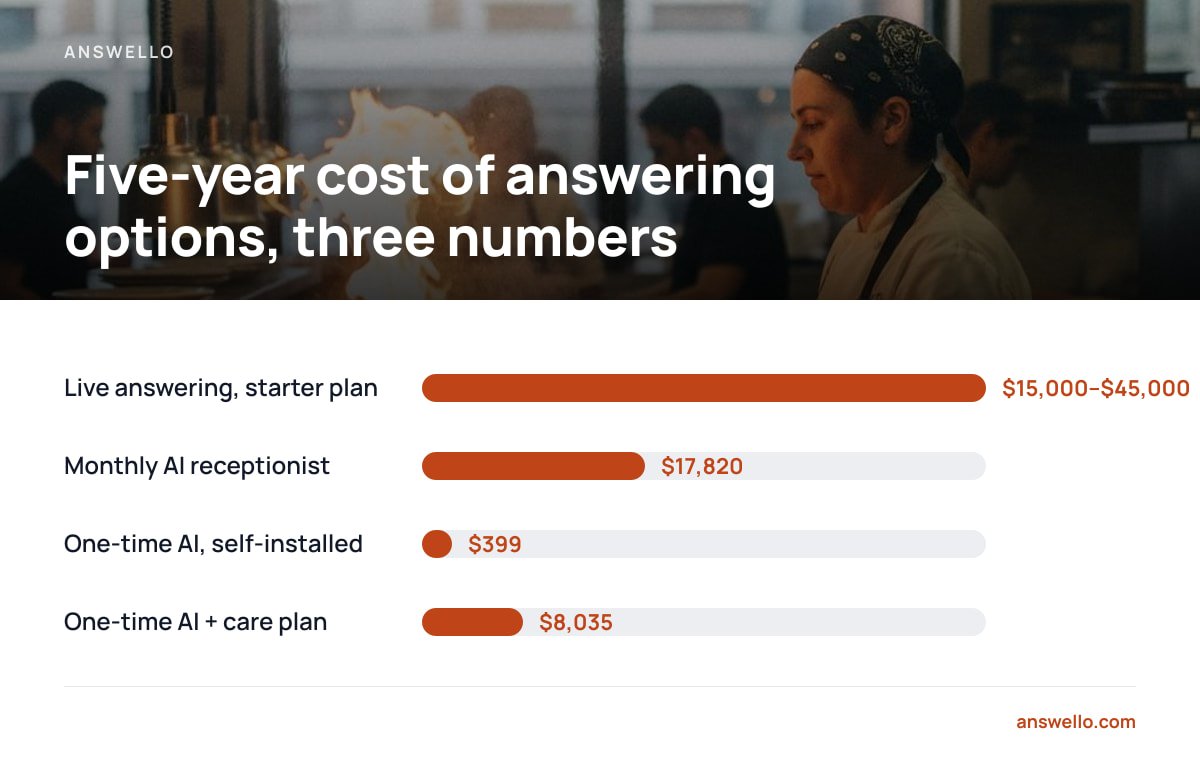
The table below uses common price points you will see on answering-service pricing pages. Treat them as illustrations, and get current quotes before you decide. The last two rows are our own pricing.
| Option | Typical sticker price | 1 number, 5 years | 3 numbers or brands, 5 years | What it actually catches |
|---|---|---|---|---|
| Carrier voicemail | $0 | $0 | $0 | Only callers willing to leave a message |
| Live answering, starter plan | ~$250/month, limited minutes | ~$15,000 | $15,000–$45,000, depending on per-account billing | Most calls, until minutes run out |
| Monthly AI receptionist | ~$99/month per number | $5,940 | $17,820 | Every call, 24/7 |
| One-time AI system, self-installed | $399 once | $399 | $399 | Every missed call, 24/7 |
| One-time AI system, set up + monthly care plan | $895 + $119/month | $8,035 | $8,035 | Every missed call, 24/7, tuned for you |
Three brands on a $99-a-month AI plan cost $17,820 over five years. One self-installed system covering all three costs $399.
One honest caveat about that table: one-time pricing is not automatically cheaper. If you run a single number and want someone to maintain and tune your system every month forever, the $99 monthly AI plan comes out about $2,000 cheaper over five years than a one-time setup plus a permanent care plan. The one-time model wins when you have several numbers, or when you are comfortable dropping the care plan once your script is working. For a full breakdown of the monthly models, see answering service costs and alternatives.
Four Cheap Ways to Answer Your Phone, and What Each One Misses
Each budget option fails in a different way. The right pick depends on which failure you can live with.
Free Voicemail and Auto-Reply Texts
Is there a free automated call service available? Yes. Your carrier's voicemail is free, most smartphones now transcribe voicemail automatically, and many phones and business apps can auto-text a caller you didn't pick up. Several internet calling apps also offer free tiers with basic voicemail.
The catch. Free tools wait for the caller to do the work. Someone with a flooded basement who hits a voicemail greeting usually doesn't leave a message. They call the next number on the search results page. An auto-reply text helps, but only if the caller reads it and answers. We cover the limits in detail in what a text back app actually does.
Live Answering on a Starter Plan
Who it suits. Businesses whose calls need judgment, such as medical triage, legal intake, or property-management emergencies, still get the most from a trained human.
The catch. Starter plans are built around a minute allowance. A busy season of long "how much to replace a water heater" calls burns through it fast, and overage minutes are where the low price stops being low. You can see the full cost picture in our guide to live answering service costs.
Monthly AI Receptionist
Who it suits. A single-location business that wants every call answered, whether or not anyone is busy, and wants the vendor to handle all upkeep.
The catch. You pay per number, per month, indefinitely. If you add a second brand, the bill doubles.
One-Time AI Answering System
Who it suits. Trades owners who answer most calls themselves but miss the ones that come in while they are under a sink or up a ladder. It also suits anyone running multiple brands or numbers.
The catch. You own the setup, so changes to your script are either your job or a paid add-on.
Do Answering Services Still Exist? Yes, but the Cheap Tier Has Changed
Answering services absolutely still exist. Live call centers with human receptionists still operate around the clock, and plenty of medical offices, law firms, and property managers rely on them. What has changed is the bottom of the market. The low-cost tier used to mean a human with a short script and a tight minute cap. Now it mostly means AI voice systems that pick up, ask the caller what they need, and send you the details.
That shift matters for price because AI does not bill by the minute in the same way. A human receptionist's time is the product. The Bureau of Labor Statistics' Occupational Outlook Handbook puts median receptionist pay well above $30,000 a year, before payroll taxes. A shared live service divides that cost across many clients. An AI system doesn't have that cost to pass on, which is why the cheap end of the market moved to AI.
Which AI Receptionist Is Best for a Small Business? Pick by Call Type, Not Features
Which AI receptionist service is best for small businesses? It depends on what happens after the call, not on how many features the vendor lists. Ask yourself one question first: when you miss a call, can you call the person back within an hour or so?
If yes, you need capture, not a full receptionist. You need something that answers, gets the caller's name, number, and what they want, and texts it to you right away. Booking engines, calendar sync, and payment collection are extra cost you won't use. This is the profile of most one- to five-person trades businesses, and it is the option we would pick for them.
If no, you need a system that resolves the call. That might mean booking appointments directly, quoting standard prices, or routing emergencies to an on-call tech. Here a monthly service with deeper integrations, or a live service, earns its fee.
If you run several brands, check how each one bills. Ask any vendor directly whether a second number means a second subscription. That single answer often decides the five-year cost more than anything else on the pricing page.
To size the stakes, run your own numbers. Say you miss eight calls a week, a quarter of those callers would have booked, and your average job is $350. That works out to roughly $700 a week walking to a competitor. Our guides on what missed calls cost a contractor and calculating lost revenue from unanswered calls walk through the math with your own figures.
The Best Telephone System for a Small Business Is Simpler Than You Think
What is the best telephone system for a small business? For most trades businesses with fewer than ten people, it is a mobile phone plus a cloud business number that supports conditional call forwarding. You don't need desk phones or an on-site phone system. Conditional forwarding sends a call somewhere else only when you don't answer, so you still take the calls you can, and the overflow goes to your answering service or AI.
You should move up to a full cloud phone system (VoIP, meaning calls run over the internet) when several people need to ring at once, when you run multiple numbers that need different greetings, or when you want call routing by time of day. Even then, conditional forwarding stays at the center of the setup.
Pro Tip: Most carriers let you change how long your phone rings before forwarding, but the default is often around 20 to 30 seconds. Cut it to roughly 15 seconds. You can almost never get to the phone in time if you're mid-job, and every extra ring is a chance for the caller to hang up before your answering system picks up. Codes and settings vary by carrier, so ask yours how to adjust the "no answer" timer.
If you run more than one brand, give each brand its own forwarding number and its own greeting. A caller who dialed your drain company and hears your HVAC company's name assumes they called the wrong business.
Restaurants, Home Businesses, and Other Cases Where the Cheap Pick Changes

Phone answering service for restaurants. Restaurants have a different problem than trades businesses. Calls spike during service, and many of them are orders or reservations that need an immediate answer. A message-taking system is the wrong tool for live order-taking. Look instead for a system connected to your reservation or ordering software. Message capture still works well for catering inquiries and after-hours calls.
Low-cost answering service for home. For a personal home line, don't pay for anything. Carrier voicemail and your phone's built-in call screening are enough. For a home-based business, the same rules as any small business apply: start with conditional forwarding and add an answering layer only once missed calls start costing you work.
Low-cost answering service for free. As covered above, free options exist but rely on the caller leaving a message. They work for businesses where callers are patient, such as accountants outside tax season. They fail for urgent, high-value calls.
Voice answering service vs. AI answering assistant. The terms overlap. "Voice answering service" can mean a human service or an automated phone menu. "AI answering assistant" usually means software that holds a natural conversation. When comparing options, ask the vendor whether a person or software answers, and what you receive afterward: a recording, a transcript, a summary, or all three.
How to Use AI to Answer Phone Calls, in One Afternoon

- Decide which calls the AI handles. Overflow only (calls you miss) or every call. For most trades, overflow is the right starting point.
- Write a short script. Include your business name, one sentence on what you do, and three questions: name, callback number, and what they need. Keep it short, because callers tune out long greetings.
- Set up conditional forwarding from each business number to the AI, and shorten the no-answer timer.
- Add a recording notice to the greeting. Federal law, under 18 U.S.C. § 2511, allows recording when one party consents. However, some states, including California, require every party's consent. The Reporters Committee for Freedom of the Press keeps a state-by-state guide. A one-line "this call may be recorded" covers you almost everywhere. Outside the U.S., data protection rules generally expect you to tell callers too.
- Test it from a phone that isn't yours, for each number and brand, before going live.
- Be careful with automated callbacks. In 2024 the FCC ruled that AI-generated voices count as "artificial" voices under the Telephone Consumer Protection Act. That ruling covers calls you place, not calls you answer. If your system dials people back on its own, check the consent rules first.
Answering a call with AI is broadly allowed. Calling people back with an AI voice is where the FCC's 2024 ruling starts to apply.
Stop Paying Monthly Rent on Every Number You Own

Answello is built for the exact problem this article describes: calls you miss while you're working. It answers when you don't, finds out who's calling and what they need, and texts you their name, number, and request, with the full recording and transcript in a dashboard. One payment covers every brand and number you run. The self-install package is $399 once. The fully set-up version, with a custom script for each brand, is $895 once.
Here is the honest part. If you want ongoing tuning, the optional care plan is $119 a month, and for a single number a cheap monthly AI service may cost less over time if you keep the plan forever. Most owners won't need it once their script is right, and you can cancel it anytime. Answello also captures and summarizes calls rather than taking payments, so check the spec sheet against what your calls actually need, and do the same for anything else you're comparing. For more on which recurring charges are worth keeping, see our guide to subscription business software.
Frequently Asked Questions
How much does a low-cost answering service cost per month?
Monthly AI receptionists commonly start around $30 to $100 per number, and live services often start in the low hundreds for a limited block of minutes. The better comparison is five-year cost per number, because overages and per-brand billing can multiply the sticker price. One-time AI systems avoid the monthly charge entirely.
Is free voicemail good enough for a small business?
Only if your callers are patient and willing to leave messages. For urgent, high-value calls like plumbing or electrical emergencies, many callers hang up and try the next business instead. Voicemail costs nothing up front but can cost the most in lost jobs.
Is it legal to record calls answered by an AI system?
U.S. federal law allows recording with one party's consent, but some states, including California, require consent from everyone on the call. Adding "this call may be recorded" to your greeting covers you in almost every state. Outside the U.S., check your local data protection rules.
Can one answering system handle several business brands?
Yes, as long as each brand has its own number and greeting so callers hear the name they dialed. The pricing question is the one to ask: many monthly services charge per number, so a second brand can double the bill. One-time systems that cover multiple numbers avoid that problem.
Do I need a new phone system to use an AI answering service?
Usually not. Most setups only need conditional call forwarding, which sends calls you don't pick up to the answering system. Most mobile carriers and cloud business numbers support it, though the setup steps vary by carrier.
Sources
- Occupational Outlook Handbook: Receptionists | U.S. Bureau of Labor Statistics
- 18 U.S. Code § 2511 – Interception and disclosure of wire, oral, or electronic communications | Legal Information Institute, Cornell Law School
- Reporters Recording Guide | Reporters Committee for Freedom of the Press
- FCC Makes AI-Generated Voices in Robocalls Illegal | Federal Communications Commission
Leave a Reply