

A missed call lost job calculator multiplies your missed calls by your close rate and average job value. Most online versions skip the step that matters most, which is removing the calls that were never jobs. Count only unique new-customer numbers that never reached you another way. Multiply those by your real close rate, then by profit rather than invoice value. The result is usually a fraction of the generic figure, and it is the only number worth spending money against.
TL;DR:
- Most missed-call calculators multiply every missed call by your close rate, which overstates losses by counting spam, repeat dials, and existing customers as new jobs.
- Use five filters: unique numbers, known contacts removed, spam removed, callers who reached you anyway removed, then apply your real close rate.
- In the worked example below, a generic calculator shows $10,800 a month in lost revenue, while the filtered figure is $2,700 in revenue and $1,080 in profit.
- The filtered number can also understate your loss if you ignore repeat customers, referrals, and higher-value after-hours emergency calls, so adjust for those separately.
- Speed matters as much as answering: Harvard Business Review found leads contacted within an hour were nearly seven times as likely to qualify as those contacted an hour later.
Table of Contents
- The Missed Call Lost Job Calculator Formula, Step by Step
- Where Online Calculators Go Wrong, and Why It Matters for Your Decision
- Getting Your Real Numbers: A 30-Minute Call Log Audit
- A Worked Example: $10,800 on Paper, $1,080 in Profit
- When the Real Loss Is Bigger: Repeat Customers, Referrals, and Emergencies
- Speed Decides the Job, Not Just Whether You Called Back
- What to Do With Your Number: Break-Even on Every Fix
- Turn Your Missed-Call Number Into Jobs for a One-Time $399
- Frequently Asked Questions
- Sources
The Missed Call Lost Job Calculator Formula, Step by Step
The honest version of a missed-call calculator has six inputs, not three. Generic tools ask for missed calls, close rate, and average job value, then multiply them together. That skips the filtering that separates a real lead from a robocall, a supplier, or the same customer ringing four times in three minutes.
Here is the formula worth using:
- Missed calls in a month. Take this from your carrier or phone system call log, not from memory.
- Unique numbers. Collapse repeat dials from the same number into one caller.
- Minus known contacts. Remove existing customers, suppliers, staff, and family. They matter, but they are not new jobs.
- Minus spam. Remove robocalls and unknown numbers that left no voicemail and never called again.
- Minus callers who reached you anyway. Remove anyone who left a voicemail you returned, texted you, or called back and got through.
- Times your close rate, times your profit per job. Use the close rate on calls you actually answer. Use gross profit, not the invoice total.
What remains is the number of jobs you lost, and the money you would have kept from them. If you want a deeper treatment of each input, our guide on how to calculate lost revenue from unanswered calls works through them one at a time.
Where Online Calculators Go Wrong, and Why It Matters for Your Decision
Generic missed-call calculators are built to produce a big, alarming number, because a big number sells whatever sits below the calculator. That is not always dishonest, but it does lead to bad decisions. You end up either overspending on a fix or dismissing the whole problem because the figure feels absurd.
Errors that inflate the number
- Counting rings, not people. A worried homeowner with a leaking pipe will often dial two to four times in a row. A raw call log counts that as several missed calls. It is one lead.
- Treating every caller as a new customer. A large share of missed calls in most trades businesses come from people already in your book: existing clients, suppliers, the parts counter. Those calls cost you time, but they are not lost jobs.
- Ignoring spam. The Federal Communications Commission lists unwanted robocalls among the top consumer complaints it receives. A business number listed publicly attracts its share of them, and every one inflates a raw missed-call count.
- Using revenue instead of profit. A $450 job does not put $450 in your pocket. Materials, fuel, and labor come out first.
Errors that shrink the number
- Ignoring lifetime value. A customer who calls about a dripping tap might be the one who calls next year about a full bathroom.
- Averaging away emergencies. After-hours and weekend calls are disproportionately urgent, and urgent jobs usually carry a higher ticket. Blending them into one average job value hides that.
The fix for both problems is the same. Filter first, then adjust upward for value that a single average misses.
Getting Your Real Numbers: A 30-Minute Call Log Audit
You can get every input for the formula above from one month of call history and a spreadsheet. Most carriers and VoIP systems let you export a call log as a CSV. If yours doesn't, the itemized bill usually lists every inbound call.
Work through the log in this order:
- Sort by number, then by time. Repeat dials within a few minutes of each other become one row.
- Match against your contacts. Anything in your phone book or job management system gets tagged as a known contact.
- Flag likely spam. Unknown numbers with no voicemail, no repeat attempt, and no follow-up text are mostly noise. Your phone's built-in spam labeling helps here.
- Check for recovery. For each remaining number, look for a later answered call, a returned voicemail, or a text thread. If any of these happened, that lead wasn't lost.
- Note the time of day. Split what remains into working hours and after hours. The two groups usually behave differently.
Pro Tip: Calculate the close rate you plug in from calls you answered live, not from all inquiries. Callers who reached voicemail and were called back hours later convert at a lower rate. Using a blended figure quietly understates how much a live answer is worth. If you run more than one brand or number, audit each separately. A drain-clearing line and a renovation line will have very different job values and close rates, and averaging them produces a number that is true for neither.
A Worked Example: $10,800 on Paper, $1,080 in Profit
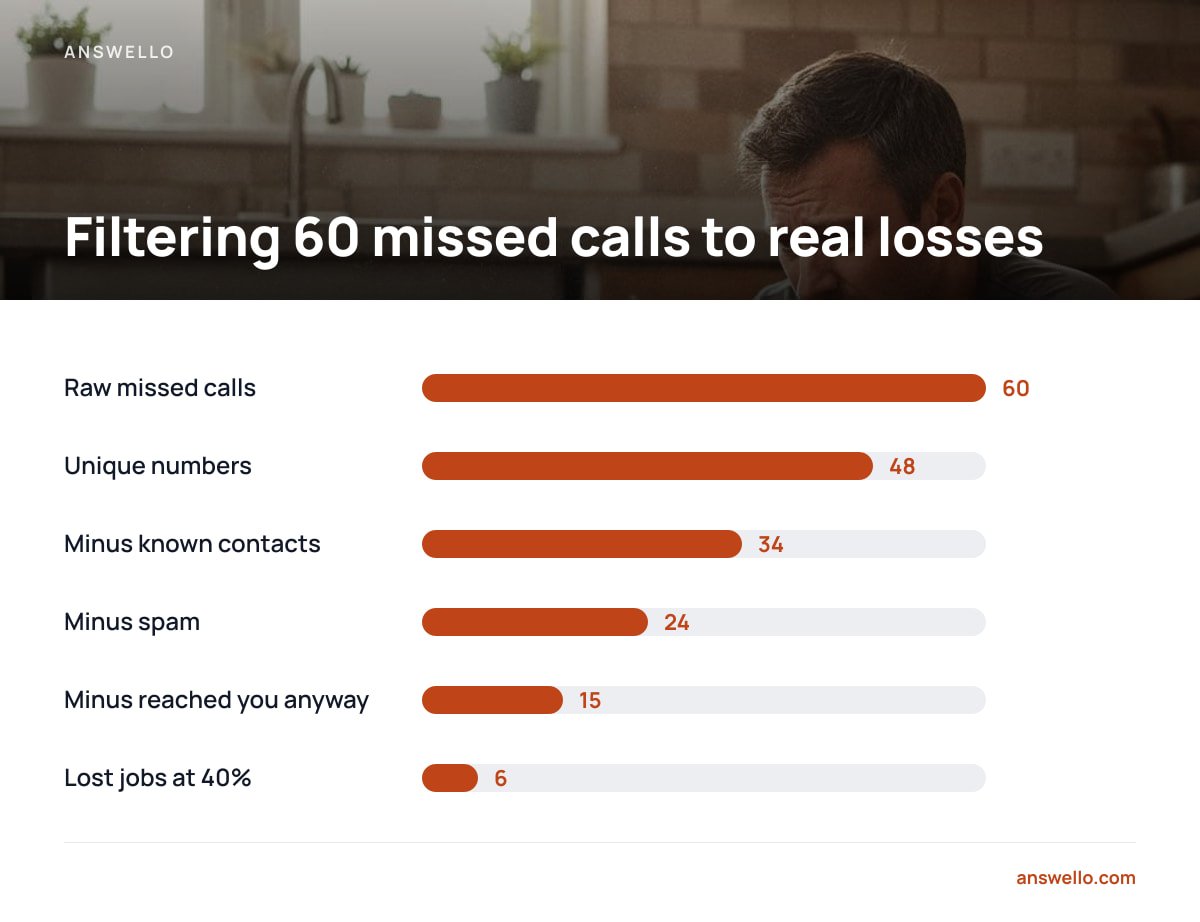
Take a plumber who sees 60 missed calls in a month, closes 40% of new inquiries answered live, and averages $450 per job at a 40% gross margin. A generic calculator multiplies 60 × 40% × $450 and reports $10,800 in lost revenue. Here is what the filtered audit looks like for the same month. The filtering figures are illustrative, so substitute your own from the audit above.
| Step | Calls remaining | What was removed |
|---|---|---|
| Raw missed calls | 60 | — |
| Unique numbers | 48 | 12 repeat dials |
| Minus known contacts | 34 | 14 existing customers, suppliers, family |
| Minus spam | 24 | 10 robocalls and one-ring unknowns |
| Minus callers who reached you anyway | 15 | 9 returned voicemails, texts, call-backs |
| Lost jobs at 40% close rate | 6 | — |
| Lost revenue at $450 per job | $2,700 | — |
| Lost gross profit at 40% margin | $1,080 | — |
A generic calculator says this business loses $10,800 a month. The filtered audit says $2,700 in revenue and $1,080 in profit. Both point to the same problem, but they lead to very different decisions about what to spend fixing it.
The smaller number is not a reason to relax. Over a year, $1,080 a month is nearly $13,000 in gross profit walking to a competitor who picked up. It does mean you should be wary of any fix whose annual cost approaches that figure. For a trade-by-trade view of these numbers, see how much money missed calls cost a contractor.
When the Real Loss Is Bigger: Repeat Customers, Referrals, and Emergencies

The filtered calculation captures the first job only. For most trades businesses, the first job is not where the money is. A customer who has a good experience calls back for the next problem and gives your number to a neighbor.
Research summarized in Harvard Business Review puts the cost of acquiring a new customer at 5 to 25 times the cost of retaining an existing one. It also cites Bain & Company's finding that a 5% increase in customer retention can lift profits by 25% to 95%. A missed first call doesn't just lose one invoice. It loses the cheapest future revenue you would ever have earned.
To adjust your number without guessing wildly:
- Lifetime jobs per customer. Count how many jobs your existing customers from three years ago have booked since. If the average is 2.5, multiply your lost first-job profit by roughly that much to see the long-run cost.
- After-hours premium. Run the formula separately for calls that came in outside working hours, using your emergency or call-out rates. These are often the highest-value calls you miss. Our piece on what an out-of-hours call service actually answers covers the options for that window.
- Referral rate. If you track how new customers found you, apply your referral share as a modest multiplier rather than an invented one.
Speed Decides the Job, Not Just Whether You Called Back

Calling a missed lead back eventually is not the same as winning it. In The Short Life of Online Sales Leads, Harvard Business Review reported on research into how fast companies followed up inquiries. Firms that contacted a lead within an hour were nearly seven times as likely to qualify it as firms that waited even one more hour. They were more than 60 times as likely as firms that waited 24 hours or longer.
Within one hour: nearly 7 times as likely to qualify the lead. Wait a day: more than 60 times less likely. A missed call returned tomorrow is, for most purposes, a lost job.
That research looked at online leads rather than phone calls, but the pattern fits trades work even more tightly. Someone with water coming through the ceiling calls the next plumber on the list within minutes, not hours. This is why the "minus callers who reached you anyway" step should only count recoveries that happened quickly. A voicemail returned the next morning often finds the job already booked elsewhere.
It is also why a simple automated text reply only solves part of the problem. A text tells the caller you exist. It doesn't tell you who they are or how urgent the job is. We break down that gap in what a text back app actually does and doesn't do. In the US, automated texting also falls under the Telephone Consumer Protection Act, which the FCC enforces. Replying to someone who just called you is a different situation from marketing, but check your setup before you switch it on.
What to Do With Your Number: Break-Even on Every Fix

Once you have a filtered monthly profit figure, every fix becomes a payback question. Take the worked example's $1,080 a month and compare the options honestly.
| Fix | What the caller gets | What you get | Cost structure | Main weakness |
|---|---|---|---|---|
| Voicemail only | A beep | A message, sometimes | Free | Many callers hang up rather than leave one |
| Auto text-back | A text saying you'll call | A number, no context | Usually monthly | You still don't know who or why |
| Human answering service | A person taking a message | Name, number, notes | Monthly, often per minute or per call | Ongoing cost scales with call volume |
| AI call answering | A conversation that captures details | Name, number, request, transcript | One-time or monthly, depending on vendor | Still needs you to call back and close |
| Hiring an office person | A full conversation and booking | Bookings, not just messages | Salary | Costs more than most small trades lose |
The rule we'd use is simple. Add up the cost of any fix over 24 months, then divide by your filtered monthly profit loss. If the answer is more than about 12, meaning a year of recovered profit just to break even, the fix is too expensive for your volume. If you recover even half your lost jobs, a fix that costs under one month of filtered profit pays for itself almost immediately.
For the worked example, recovering half the lost jobs is worth about $540 a month in gross profit. Any monthly subscription above a few hundred dollars eats most of that gain. A one-time cost in the high hundreds pays back inside two months. That trade-off is the reason we'd pick a one-time purchase over a subscription for most small operators, especially anyone running several brands or numbers, where per-line monthly fees multiply fast.
Turn Your Missed-Call Number Into Jobs for a One-Time $399
Answello answers the calls you can't, asks the caller who they are and what they need, and texts you their name, number, and request within moments. That keeps you inside the one-hour window where leads are still winnable. Every call is recorded and transcribed in a dashboard, so you can rerun the audit above with real data instead of guesses. One payment covers multiple brands and numbers.
The self-install package is $399 one-time, or $895 one-time fully set up with a custom script. An optional maintenance and tuning plan costs $119 a month, and you can cancel it anytime. The honest limit is that it captures and summarizes leads but doesn't close them. If you don't call back quickly, the jobs still go elsewhere. Run your filtered number first. If you lose fewer than one job a month, you may not need us at all.
Frequently Asked Questions
How do I calculate how many jobs I lose from missed calls?
Start with one month of missed calls from your call log, then reduce it to unique numbers. Remove known contacts, spam, and callers who reached you another way, and multiply what remains by your live-answer close rate. That gives you lost jobs, and multiplying by your gross profit per job gives you the money at stake.
Why do online missed-call calculators give such big numbers?
Most of them multiply every missed call by your close rate and average invoice. That counts repeat dials, spam, and existing customers as new jobs, and it uses revenue instead of profit. The result can overstate the real loss several times over.
Should I use revenue or profit when calculating the cost of missed calls?
Use gross profit if you are deciding how much to spend on a fix, because that is the money you actually keep. Revenue is useful for understanding scale, but comparing a subscription cost against lost revenue makes almost any fix look cheaper than it really is.
Does a missed call returned the next day still count as recovered?
Usually not. Harvard Business Review reported that leads contacted within an hour were nearly seven times as likely to qualify as those contacted an hour later, and more than 60 times as likely as those contacted after 24 hours. For urgent trades work, a next-day callback often finds the job already taken.
How do I factor in repeat customers when calculating missed-call losses?
Check how many jobs your customers from about three years ago have booked since their first one. Multiply your lost first-job profit by that average to estimate the long-run cost. This keeps the adjustment grounded in your own records rather than an industry guess.
Is an auto text-back enough to stop losing jobs from missed calls?
It helps, because the caller knows you got their call. It doesn't tell you who they are or what they need, so you can't prioritize the urgent or valuable jobs. A system that captures the caller's request gives you far more to act on.
Sources
- The Short Life of Online Sales Leads | Harvard Business Review
- The Value of Keeping the Right Customers | Harvard Business Review
- Stop Unwanted Robocalls and Texts | Federal Communications Commission
- Telemarketing and Robocalls | Federal Communications Commission
Leave a Reply