
An AI receptionist for HVAC companies picks up the calls you miss while you're on a roof or in a crawlspace. It records who called and what's broken, then gets that information to you fast enough to win the job. The difference that matters most is triage: a good one can separate a "no heat, elderly parent at home" call from a "quote on a new system next spring" call. The second question is whether you pay for it every month on every number, or once.
TL;DR:
- HVAC calls bunch up in heat waves and cold snaps, and a caller with no cooling usually phones the next company within minutes instead of leaving a voicemail.
- The script matters more than the AI. It has to flag emergencies, send gas or carbon monoxide callers to 911 or the utility, and capture equipment details for quotes.
- For most small shops, a fast text summary that you act on beats automatic booking, because job overruns make AI-booked calendars unreliable.
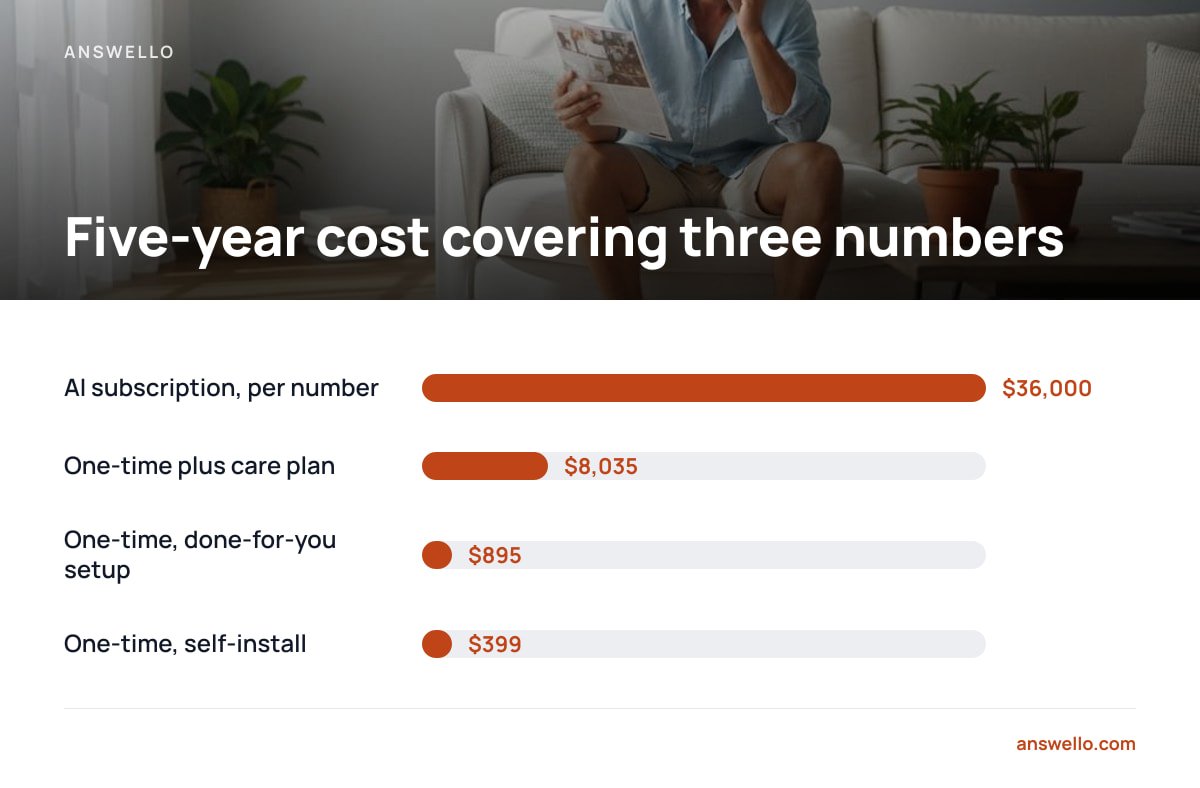
- At an illustrative $200 per number per month, a three-brand subscription costs $36,000 over five years. A one-time system costs $399 to $895 total.
- Check your state's call-recording consent rules and test the system with real emergency scenarios before peak season.
Table of Contents
- Why HVAC Calls Are Different: Seasonal Spikes and Callers Who Won't Wait
- What an AI Receptionist for HVAC Companies Actually Has to Handle
- Message, Book, or Escalate: Choosing How Much the AI Should Do
- The Cost Math: Monthly Subscription vs One-Time Purchase Over Five Years
- Running Multiple Brands or Numbers Without Paying Per Line
- Recording, Consent and Scripts: The Setup Details That Bite Later
- How to Test an AI Receptionist Before Peak Season, Not During It
- Catch the July No-Cooling Call Without Paying Every Month for It
- Frequently Asked Questions
- Sources
Why HVAC Calls Are Different: Seasonal Spikes and Callers Who Won't Wait

Calls to an HVAC business don't arrive evenly. They pile up in the first hot week of summer and the first hard freeze of winter, and those are exactly the weeks when you and your techs are busiest on job sites. The U.S. Bureau of Labor Statistics notes that HVAC mechanics often work in cramped spaces like attics and crawlspaces and may work overtime during peak heating and cooling seasons. That is the profile of someone who can't answer a phone.
A homeowner whose AC quit at 4 p.m. in July is not shopping around carefully. They want someone to say "we'll call you back in 20 minutes," and if your voicemail doesn't say it, the next company on the search results page will. Missed calls in HVAC cost more than calls missed by a landscaper or a painter, because the caller is under pressure and goes with whoever answers first.
Heat and cold also make some calls urgent for safety reasons. The CDC's heat and health guidance identifies older adults, young children, and people with chronic medical conditions as being at higher risk of heat-related illness. A "no cooling" call from a house with an 85-year-old in it is a different call from one at an empty rental, and your phone system should be able to tell you which is which.
What an AI Receptionist for HVAC Companies Actually Has to Handle
General-purpose AI answering is built for dentists and law offices. HVAC needs a script that understands four kinds of call, and each kind needs different information captured.
No-heat and no-cooling emergencies
These calls pay the bills in peak season. The AI should collect the address, a callback number, whether anyone vulnerable is in the home, and what the thermostat shows. Then it should mark the message as urgent so it reaches you as a priority text rather than sitting in a queue.
Gas smells and carbon monoxide alarms
These are not service calls, and a well-built script will never treat one as a booking. The CDC's carbon monoxide guidance describes CO as colorless and odorless and advises anyone who suspects poisoning to get outside to fresh air and call 911. Your AI should tell the caller exactly that, plus to call the gas utility from outside for a suspected leak, before it does anything else.
If a caller mentions a gas smell or a CO alarm, the first sentence your AI says should be "leave the house and call 911 from outside," not "let me get your address."
Routine repairs and tune-ups
These include a noisy blower, a unit short-cycling, or a spring AC check. The AI needs the caller's name, the address, the problem in their own words, and a rough sense of how flexible they are on timing. None of these is urgent, but each one is real revenue.
Replacement and new-install quotes
These are your biggest tickets and the easiest calls to lose, because the caller is getting three quotes. Capture the equipment type, its approximate age, the square footage if they know it, and whether they're replacing something broken or planning ahead. A homeowner whose 18-year-old furnace just died is a very different sale from one researching heat pumps for next year.
Pro Tip: Have your script ask "what does the thermostat screen show right now?" on every no-cooling call. A blank thermostat in summer often points to a tripped breaker, a blown low-voltage fuse, or a tripped condensate overflow switch. You'll know before you call back whether you're looking at a quick visit or a compressor conversation. It also tells you which tech and which parts to send.
Message, Book, or Escalate: Choosing How Much the AI Should Do
AI receptionists for trades fall into three rough tiers, and the most capable one is not automatically the right one for you.
- Message-taking with instant text summaries. The AI answers, captures the caller's details and need, and texts you a summary and transcript within moments. You decide what happens next. This is the simplest option and the hardest to get wrong.
- Direct calendar booking. The AI checks your schedule and books appointments itself. It sounds ideal, but HVAC jobs overrun all the time. A "two-hour" install turns into six when the line set is undersized. An AI booking against a calendar that doesn't reflect reality will double-book you, and you'll make the angry phone calls yourself.
- Live transfer or escalation. The AI tries to put urgent calls through to an on-call tech. This is useful for shops with a real on-call rotation, but it only works if someone actually picks up.
For an owner-operator or a shop with fewer than ten techs, pick message-taking with fast, well-structured text summaries. You keep control of the schedule, emergencies reach you right away, and nothing gets booked that you can't deliver. If that's your setup, a plain AI phone assistant that does one job reliably will serve you better than an elaborate one that does five jobs halfway.
The Cost Math: Monthly Subscription vs One-Time Purchase Over Five Years

Most AI answering is sold as a monthly subscription, often priced per number or per location. That's fine if you run one number. It gets expensive quickly if you run a residential brand, a commercial brand, and a separate number for a company you bought out.
The table below uses an illustrative $200 per number per month for a subscription. Swap in the actual quotes you've received.
| Option | Upfront | Monthly | 5-year cost, 1 number | 5-year cost, 3 numbers |
|---|---|---|---|---|
| Voicemail only | $0 | $0 | $0 (plus every job you lose) | $0 (plus every job you lose) |
| AI subscription, per number (illustrative) | $0 | $200 per number | $12,000 | $36,000 |
| One-time AI, self-install | $399 | $0 | $399 | $399 |
| One-time AI, done-for-you setup | $895 | $0 | $895 | $895 |
| One-time setup plus optional care plan | $895 | $119 | $8,035 | $8,035 |
$36,000 versus $895. That's the five-year gap between paying $200 a month on each of three numbers and paying once for a system that covers all three.
The subscription column isn't a scare figure. It's simple multiplication, and most owners never do it because the monthly charge is small enough to ignore. We've worked through the same arithmetic for what AI call answering actually costs and for a low-cost answering service over five years. The pattern holds both times: the recurring line is what hurts.
Pro Tip: Price the system against one job, not against the monthly fee. If an average no-cooling repair is worth $350 to you, a one-time system pays for itself the first time it saves you two or three calls in a heat wave. Any subscription has to keep earning that back every month, including December, when your AC line is quiet.
Running Multiple Brands or Numbers Without Paying Per Line
Plenty of HVAC owners run more than one brand. You might keep the name of a shop you acquired because its customers trust it, or you might separate commercial refrigeration from residential comfort work. Each brand has its own phone number, and per-number pricing turns that sensible business decision into a monthly penalty.
When you evaluate any system, ask these questions directly:
- Is pricing per number, per location, or per account? Get it in writing. "Unlimited" sometimes means unlimited minutes on one number.
- Can each number have its own greeting and script? Callers to your commercial line shouldn't hear your residential brand's name.
- Do the text summaries say which brand was called? You need to know before you call back, so you answer "Northside Heating," not the wrong company name.
- Can you add a number later without a new contract? Acquisitions happen, and your phone system shouldn't need renegotiating when one does.
This is where one-time purchasing makes the most sense. The more numbers you run, the bigger the gap gets, as we covered in more detail on which subscription business software you actually need to pay for.
Recording, Consent and Scripts: The Setup Details That Bite Later
Call recording and transcripts are some of the most useful features you'll get. You can reread exactly what a customer said about their furnace, settle a dispute about what was quoted, and spot weak points in your script. But recording laws vary by state.
The Reporters Committee for Freedom of the Press recording guide lays out state-by-state rules. Most states allow recording with one party's consent, but a minority, including California, require consent from everyone on the call. The safe and simple fix is a short disclosure in your greeting, such as "this call may be recorded so we can get your details right." Put it in on day one, whatever state you're in.
A few other script details save trouble later:
- Never let the AI diagnose or quote prices. "It's probably your capacitor, about $150" becomes a promise you have to keep. The AI collects symptoms, and you or your tech decide what they mean.
- Say when you'll call back, and make it true. "Someone will call you back within 30 minutes" works only if it's true at 9 p.m. in January. If it isn't, say "first thing tomorrow morning."
- Match your service area. Have the AI confirm the caller's town or zip code, so you don't drive 50 minutes to a job you'd have turned down.
The same principles apply to every trade. Our guide to AI receptionists for plumbers covers the burst-pipe version of the emergency script.
How to Test an AI Receptionist Before Peak Season, Not During It

Don't go live in the first heat wave of the year. Set the system up in a shoulder month like April or October, when a mistake costs you a tune-up rather than a $9,000 replacement.
Run at least these five test calls from a phone that isn't yours:
- The panicked no-cooling call. Talk fast, mention your elderly mother is in the house, and give the address out of order. Check whether the summary flags the call as urgent and gets the details right.
- The gas smell. Confirm that the AI tells you to leave and call 911 or the utility before it asks for anything else.
- The replacement shopper. Ask vague questions about heat pumps and see whether it captures your equipment age and timeline without trying to quote you.
- The wrong-brand caller. Call your second number and check that the greeting and the summary both name the right brand.
- The mumbler. Call from a noisy truck or a windy yard. If the transcript turns out unusable, your callback number capture needs a confirm-back step.
Then set your carrier's conditional call forwarding so unanswered calls roll to the AI after three or four rings. Six rings is long enough for an anxious homeowner to hang up and dial someone else.
Catch the July No-Cooling Call Without Paying Every Month for It
Answello picks up the calls you miss while you're up in an attic, works out who's calling and what they need, and texts you their name, number, and request along with a transcript, so the urgent no-cooling call reaches you in seconds. It covers multiple brands and numbers under one payment. The self-install package is $399 one-time, or $895 one-time if you want it fully set up with a custom HVAC script that handles gas and CO callers correctly. If you'd like someone to keep tuning it, there's an optional $119/month plan you can cancel anytime. You also get a dashboard for call recordings and transcripts.
The honest limit: Answello takes the message and gets it to you fast. It doesn't book jobs into your calendar or dispatch a tech. If no one calls the customer back, you'll still lose the job. Read the spec sheet, ours included, and run the five test calls above before July.
Frequently Asked Questions
What does an AI receptionist for an HVAC company actually do?
It answers calls you miss, collects the caller's name, number, address, and problem, and sends you a summary, usually by text, so you can call back quickly. Better systems also flag urgent calls like no heat or no cooling. They also tell anyone reporting a gas smell or carbon monoxide alarm to leave the house and call 911.
Should an AI receptionist book HVAC appointments automatically?
For most small HVAC shops, no. Jobs regularly run over, so an AI booking against your calendar can double-book you. Message-taking with fast text summaries keeps you in control of the schedule while still catching the call.
How much does an AI receptionist for HVAC cost?
Subscriptions are usually billed monthly, often per number, so the cost multiplies if you run several brands. One-time systems cost a fixed amount up front, for example $399 to $895, with optional maintenance plans. Work out the five-year total for every number you run before you compare.
Is it legal to record calls with an AI receptionist?
Usually yes, but it depends on your state. Most U.S. states allow recording with one party's consent, while a minority, including California, require everyone on the call to consent. A short "this call may be recorded" line in your greeting covers you in every state.
Can one AI receptionist handle multiple HVAC brands?
Some can, with a separate greeting and script for each number. Check whether pricing is per number or per account, and confirm that the text summaries tell you which brand the caller dialed so you answer with the right company name.
Sources
- Heating, Air Conditioning, and Refrigeration Mechanics and Installers, Occupational Outlook Handbook | U.S. Bureau of Labor Statistics
- Heat and Health | Centers for Disease Control and Prevention
- Carbon Monoxide Poisoning | Centers for Disease Control and Prevention
- Reporter's Recording Guide | Reporters Committee for Freedom of the Press
Leave a Reply