
The best AI answering service for electricians is the one that can tell a sparking panel from a quote request in the first minute and texts you that difference. A natural-sounding voice matters less. Most of these tools sound fine. They differ in three places: how they triage urgent calls, how they handle more than one business number, and whether you pay once or every month for as long as you're in business.
TL;DR:
- Judge an AI answering service on triage first. It should separate "burning smell at the panel" from "need a quote for recessed lights" and flag the urgent one.
- Any safety-related call should get a scripted instruction to leave the area and call 911 or the utility before the system takes a message.
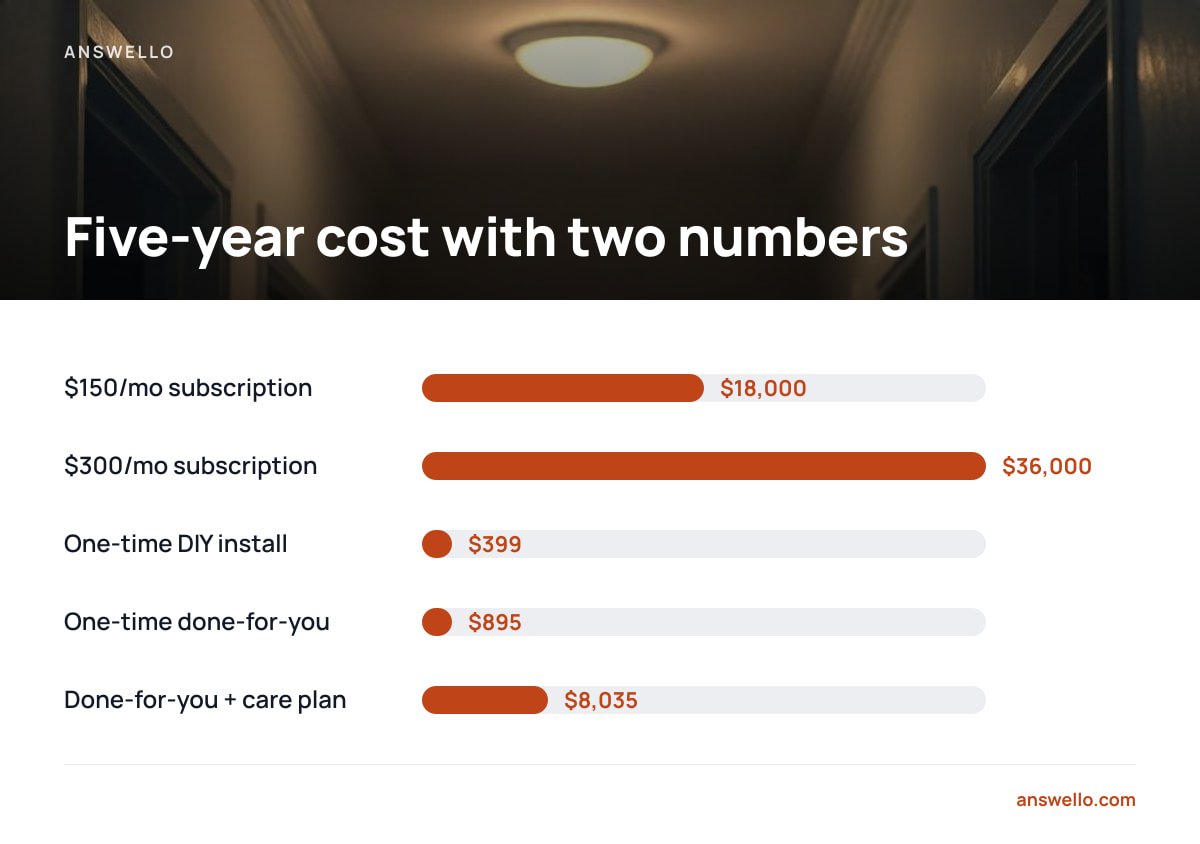
- Monthly per-number plans look cheap until you multiply them. $150 a month for two numbers is $18,000 over five years.
- If you run more than one brand or phone number, confirm coverage is included in one price, not billed per line.
- Your script should announce call recording, because several US states require every party to consent.
Table of Contents
- What the Best AI Answering Service for Electricians Actually Has to Handle
- Emergencies vs. Quote Requests: Why Triage Beats Voice Quality
- The Feature Checklist, and Which Ones Actually Matter
- Subscription vs. One-Time Purchase: The Five-Year Math
- Running Two Brands or a Second Number Without Paying Twice
- Recording, Consent, and What Your Script Should Say
- Which Option We'd Pick, and When We Wouldn't
- Stop Losing Panel Jobs to Voicemail, for a One-Time $399
- Frequently Asked Questions
- Sources
What the Best AI Answering Service for Electricians Actually Has to Handle

Electricians miss calls for a reason most other businesses don't have. When you're inside a live panel or up a ladder pulling wire, answering the phone is a safety problem. OSHA lists electrocution among the leading hazards in construction work. No reasonable person expects you to take your hands off a job to answer a ringing phone. Every call you physically can't take, though, is a customer who may dial the next electrician on the list.
The Bureau of Labor Statistics occupational profile for electricians notes that the work often runs into evenings and weekends, with overtime common. That matches what most shop owners already know: calls arrive whenever homeowners notice a problem, not when you're sitting at a desk.
An answering system for an electrical business has three jobs:
- Pick up every call you can't. This includes calls that come while you're on another line, under a house, or driving between jobs.
- Work out what the caller needs. It should tell apart an emergency, a booked-job question, a quote request, a supplier, and a sales pitch.
- Get that to you fast, in writing. You want a text with the name, number, and request, so you can decide in five seconds whether to call back now or after the job.
A system that does all three well is worth paying for. One that only does the first is a voicemail box with better manners.
Emergencies vs. Quote Requests: Why Triage Beats Voice Quality

Most buyers judge AI answering on how human it sounds. For electricians, that's the wrong test. The caller who matters most is the one with a hazard, and a pleasant voice doesn't help them.
The Electrical Safety Foundation International (ESFI) publishes homeowner guidance that treats several things as warning signs: burning smells, outlets or switch plates that are warm to the touch, flickering lights, and breakers that trip repeatedly. When a caller describes any of these, your system should do two things before it takes a message:
- Give a scripted safety instruction. For example: "If you smell burning or see sparks or smoke, leave the area and call 911. If wires are down outside, stay away and call your utility."
- Flag the message as urgent. It should go to you with an unmistakable marker, not land in the same pile as a ceiling fan quote.
A burning smell at the panel is not a lead. Your answering system's first job on that call is to say "leave the area and call 911," not "can I get your address?"
The AI is not diagnosing anything, and it shouldn't try. It is following a script you approved, and the script is what protects the caller and you.
Pro Tip: Add one question to your script for "my power's out" calls: "Are your neighbors out too?" If they are, it's almost always a utility outage, not your job. You save a callback and a wasted truck roll. You also look like the electrician who knew what to ask.
The Feature Checklist, and Which Ones Actually Matter

Vendors list dozens of features. Here's how they rank for a small electrical shop.
Must-haves
- Custom script with urgency rules. You set which words or situations count as urgent, such as burning, sparks, smoke, no power, or tripping breaker. A generic receptionist script won't know these.
- Text summaries to your phone. You need caller name, number, and request in one message. An email or app notification is easier to miss when your hands are full.
- Full transcript and recording. The summary tells you what to do. The transcript settles what was actually said when a customer later remembers it differently.
- Coverage for every number you advertise. That means your main line, your Google Business number, and any second brand.
Nice-to-haves
- Calendar booking. This is useful if your schedule is predictable. Many electricians would rather confirm times personally, because a "quick outlet swap" can turn into a panel upgrade.
- Multilingual answering. It's worth having in some markets and irrelevant in others.
Skip or ignore
- "Sales conversion" upsell features. An AI that tries to push service plans on someone reporting a burning smell is a liability.
For a broader look at what these systems do well and badly across industries, see our breakdown of what actually works in an AI phone assistant.
Subscription vs. One-Time Purchase: The Five-Year Math
Most AI answering services charge monthly, often per number or per location, and sometimes with per-minute overages on top. A monthly fee feels small. The total doesn't stay small.
| Setup | Upfront | Monthly | 5-year total (1 number) | 5-year total (2 numbers) |
|---|---|---|---|---|
| Typical subscription at $150/mo per number (illustrative) | $0 | $150 | $9,000 | $18,000 |
| Typical subscription at $300/mo per number (illustrative) | $0 | $300 | $18,000 | $36,000 |
| One-time DIY install | $399 | $0 | $399 | $399 (multi-number included) |
| One-time done-for-you setup | $895 | $0 | $895 | $895 (multi-number included) |
| Done-for-you + ongoing care plan | $895 | $119 | $8,035 | $8,035 |
The subscription rows are illustrative price points, not quotes from any specific vendor. Plug in the real number from any plan you're considering.
$150 a month per number is $9,000 over five years. Run two brands and it's $18,000 for the same job a one-time system does for $895.
Look at the last row. If you pay for ongoing tuning, a one-time system with a care plan costs roughly what a single-number subscription does over five years. The care plan is optional and cancellable, though. You can pay for help during the first few months while the script settles, then stop. Subscriptions don't give you that exit, because the service shuts off when you stop paying.
We run the full long-term comparison in what a low-cost answering service really costs over five years. For the pricing models in this category, see what an AI call answering service actually costs.
Running Two Brands or a Second Number Without Paying Twice
Plenty of electrical shops run more than one identity. You might have a residential brand and a commercial one. You might have kept a business you acquired under its old name, or you might advertise a separate EV-charger installation line. Each has its own phone number, and per-number pricing charges you for each.
When you compare options, ask these questions directly:
- Is each additional number billed separately? If yes, multiply the monthly price by your number count before you compare anything.
- Can each number have its own greeting? A caller to your commercial line shouldn't hear your residential brand name.
- Do summaries show which line was called? You need to know whether the caller dialed "Smith Electric" or "Coastal EV Installs" before you call back.
If a vendor can't answer the first question cleanly, assume the answer is yes.
Recording, Consent, and What Your Script Should Say
Call recordings and transcripts are among the most useful parts of an AI answering system. They're also where you need to be careful. The Reporters Committee for Freedom of the Press recording guide summarizes state laws. Most states allow recording with one party's consent, but a number of states, including California, require all parties to consent.
The simple fix works everywhere: start your greeting with a short line such as "This call may be recorded so we can get your details right." It costs you two seconds, and it covers you whichever state your callers are in.
Outside the US, rules differ again. In the UK and EU, recordings count as personal data, and you should check local guidance before you keep them. Whatever system you buy, find out where recordings are stored and how long they're kept.
Which Option We'd Pick, and When We Wouldn't
For a typical one-to-five-person electrical shop, we'd pick a one-time purchase with a custom script. Here's why:
- Your call patterns don't change much. Emergencies, quotes, scheduling, and suppliers make up the same mix year after year. Once the script is right, you don't need a vendor touching it monthly.
- You probably have more than one number. Per-number pricing penalizes exactly the shops that are growing.
- You keep the system if you stop paying for help. That's the real difference from a subscription.
We'd take a subscription instead in two cases. The first is if you need a live human to pick up overnight emergency calls and dispatch a tech, because that requires staff, and staff cost money every month. The second is if you only want the service for a single three-month busy season. Most shops are in neither situation.
Plumbers face nearly identical trade-offs. Our AI receptionist guide for plumbers goes through the same decision from their side.
Stop Losing Panel Jobs to Voicemail, for a One-Time $399
Answello picks up the calls you can't take while you're in a panel or on a ladder. It works out who's calling and what they need, then texts you their name, number, and request, with the full recording and transcript in a dashboard. You can include safety instructions and urgency flags for burning smells and outages in your script, so a hazard call reaches you marked as one. Multiple brands and numbers are covered under a single payment.
The self-install package is $399 one-time. The fully configured package with a custom script written for your trade is $895 one-time. If you want someone tuning it as call patterns shift, the optional care plan is $119 a month and you can cancel anytime. One honest limit: it takes messages and flags urgency, but it doesn't dispatch a technician or replace a 24/7 human on-call service. If you promise customers a live person at 2 a.m., you'll still need that person.
Frequently Asked Questions
What is the best AI answering service for electricians?
The best option triages calls by urgency, tells hazard callers to leave the area and call 911, and texts you a clear summary. It should cover every business number you advertise without charging per line. For most small shops, a one-time purchase with a custom script beats a monthly subscription over any period longer than a few months.
Can an AI answering service handle electrical emergency calls?
It can recognize them and respond with a scripted safety instruction, such as "leave the area and call 911" for burning smells or sparks. It can also flag the message as urgent when it texts you. It should not attempt to diagnose the problem or replace emergency services.
How much does an AI answering service cost for an electrician?
Subscription services typically charge monthly, often per number, so the cost grows every year you use them. A one-time system costs a fixed amount upfront, for example $399 to self-install or $895 fully set up. Compare five-year totals, not monthly prices.
Is it legal for an AI system to record customer calls?
Usually yes, but consent rules vary by state. Most US states require only one party's consent, while several, including California, require everyone on the call to agree. Announcing the recording at the start of the call is the simplest way to stay compliant everywhere.
Do I need a separate AI answering service for each business number?
Not necessarily. Some services bill per number, while others cover multiple brands and numbers under one price. Ask the vendor directly and multiply any per-number monthly fee by your total line count before comparing.
Sources
- Electrical Safety | Occupational Safety and Health Administration (OSHA)
- Occupational Outlook Handbook: Electricians | U.S. Bureau of Labor Statistics
- Home Electrical Safety Resources | Electrical Safety Foundation International
- Reporters Recording Guide | Reporters Committee for Freedom of the Press
Leave a Reply