To stop losing jobs to unanswered calls, you need something that captures each caller's name, number and job within seconds of the missed ring, and a habit of calling back inside an hour. Voicemail alone fails because many callers hang up and dial the next contractor without leaving a message. The goal is not to answer every call yourself. The goal is that no caller leaves without being heard, logged and put in front of you.
TL;DR:
- Most homeowners who hit voicemail call the next contractor instead of leaving a message. Recruiters and vendors leave voicemails. Customers mostly don't.
- Harvard Business Review found leads contacted within an hour were nearly 7 times as likely to qualify as leads contacted later. Speed of callback matters as much as capture.
- Price the problem first. Six missed calls a week at a $400 average ticket can cost about $24,000 a year.
- Answering every call yourself is the wrong fix. It's dangerous while driving and produces bad quotes when you're on a ladder.
- The best setup for most trades is conditional call forwarding to an answering system plus a firm one-hour callback rule.
Table of Contents
- What Happens If You Miss a Call From a Job, and Why Voicemail Rarely Saves It
- Put a Dollar Figure on Your Missed Calls Before You Fix Anything
- Why You Keep Getting Calls, and Which Ones Are Worth Returning
- How to Stop Losing Jobs to Unanswered Calls: Five Fixes Compared
- The Obvious Fix That Backfires: Picking Up Everywhere, Plus How to Get Off the Phone
- Set Up Missed-Call Coverage This Week: The Order That Matters
- Catch Every Missed Caller's Name, Number and Job, With No Monthly Bill Required
- Frequently Asked Questions
- Sources
What Happens If You Miss a Call From a Job, and Why Voicemail Rarely Saves It
When a homeowner calls a contractor and nobody answers, the most common next move is the next listing in the search results, not a voicemail. Someone with a leaking water heater or a dead furnace is not shopping for the best value. They are shopping for the first person who picks up. Your missed call becomes a competitor's booked job, often within minutes.
The research on lead response explains why this happens so fast. A study published in Harvard Business Review on the short life of online sales leads found that firms contacting a lead within an hour were nearly seven times as likely to qualify it as firms that waited longer. Firms that waited 24 hours or more were over 60 times less likely. That study measured web inquiries, not phone calls. But a phone caller has already picked the fastest channel available, so their patience is likely shorter, not longer.
Contact inside one hour: nearly 7 times as likely to qualify the lead. Wait a day or more: over 60 times less likely.
Recruiters, suppliers and sales reps usually do leave voicemails, because calling back is part of their job. Customers mostly don't, because they have other numbers to try. A voicemail box full of messages is not proof that voicemail works. Look at who left those messages. If they're mostly vendors and recruiters, the people who would have paid you are the ones who hung up.
Put a Dollar Figure on Your Missed Calls Before You Fix Anything

You can't judge whether a fix is worth paying for until you know what the problem costs. Count missed calls from your carrier's call log, not from your voicemail count. Voicemail only shows the callers who stayed, and those are the minority you'd probably have kept anyway.
Here is a worked example using conservative inputs. Swap in your own numbers.
| Input | Example value | Where to find yours |
|---|---|---|
| Missed calls per week | 6 | Carrier call log or phone's recent calls |
| Share that are real job inquiries | 50% | Spot-check two weeks of missed numbers |
| Close rate on inquiries you actually reach | 40% | Your quotes vs. jobs won |
| Average job value | $400 | Last quarter's invoices |
| Lost revenue per week | $480 | 6 × 0.5 × 0.4 × $400 |
| Lost revenue per year (50 weeks) | $24,000 |
Six missed calls a week, half of them real, at a $400 ticket: roughly $24,000 a year walking to someone else.
Use that figure as a test for any fix. If a solution costs less than one recovered job per month, it pays for itself. Watch for pricing that scales per number or per location, though. If you run two or three brands, a monthly fee charged per line can quietly eat most of what you recover.
Pro Tip: When you audit your call log, sort missed calls into two piles: numbers you've never seen before, and numbers that called more than once in a day. Repeat callers on the same day are almost always real, urgent jobs. If those are going unanswered, start your fix there.
Why You Keep Getting Calls, and Which Ones Are Worth Returning
If your phone rings constantly but jobs aren't growing, the noise is part of the problem. A trades business with a listed number attracts four kinds of callers:
- Real customers. People who found you on a map listing, a truck wrap or a referral. These are the calls you're trying to protect.
- Lead resellers and marketing pitches. Your number is public, so it gets scraped into sales lists. Expect a steady stream of calls about ads, reviews and "exclusive leads."
- Robocalls. Automated calls hit business lines just like personal ones. The FCC's guidance on unwanted robocalls advises people not to answer calls from unknown numbers. That advice is impossible to follow when every new customer is an unknown number.
- Recruiters and job-board follow-ups. If you've ever posted a hiring ad, your number may circulate among staffing firms for months.
Registering a business line won't stop most of this. The FTC's National Do Not Call Registry is built for personal numbers, and business-to-business calls are largely exempt from the Do Not Call rules. Carrier spam-labeling tools help at the margins, but they also misfire. Never auto-block unknown callers on a line customers use.
The practical answer is triage, not blocking. Return calls in this order:
- Same-day repeat callers. These are likely urgent jobs.
- New local numbers.
- Everything else, if there's time.
A system that asks each caller what they need sorts the pile for you. The person with the burst pipe says so. The ad salesperson either hangs up or says why they called, and you skip them.
How to Stop Losing Jobs to Unanswered Calls: Five Fixes Compared
Every competing approach falls into one of five buckets. Here is how they compare on what matters to a tradesperson who can't stop working to take a call.
| Fix | What the caller gets | What you get | Ongoing cost model | Where it breaks |
|---|---|---|---|---|
| Voicemail | A beep | A message, if they leave one | Free | Most new customers hang up |
| Callback loop (check phone every 15 min) | Nothing until you call | A missed-call list | Free, costs your attention | Fails on long jobs, crawlspaces, driving |
| Automatic text-back | A text saying you'll call back | A missed-call list | Usually monthly | Landline callers never see the text |
| Live answering service | A human operator | A message or booking | Monthly fee or per-minute | Cost climbs with volume and with each extra number |
| AI call answering | A voice that takes details | Name, number, job, transcript | Varies: monthly or one-time | Can't make judgment calls on complex quotes |
Voicemail: keep it, but don't rely on it
Voicemail is the fallback, not the plan. If you keep it, rewrite the greeting to say when you'll call back ("within the hour, 7 a.m. to 6 p.m."). A promise of a specific time keeps more callers on the line than "leave a message."
The 15-minute callback loop: good discipline, fragile system
Checking your phone between tasks is a sound habit, and you should keep it. But it depends entirely on you being able to stop. On a two-hour panel swap or in an attic, the loop stretches to two hours, and the caller has already booked someone else.
Automatic text-back: cheap, with a blind spot
A text sent to every missed caller buys time. It also does nothing for callers on landlines, which still include many older homeowners and most commercial property offices. Those are often the highest-value customers.
Live answering services: right for true emergency dispatch
A human operator is the right pick if you need someone to make judgment calls at 2 a.m., such as deciding whether a gas smell means dispatching you now. For most other trades, the per-minute or per-line billing is hard to justify. Our breakdown of answering services for busy trade jobs goes through when that cost is worth it.
AI call answering: our pick for most trades
For a small trades business, the best pick is AI answering on missed calls, paired with a one-hour callback rule. Every caller is greeted, asked their name and what they need, and you get the details in a text you can read between tasks. The trade-off is that it takes details and doesn't negotiate or quote. That's fine, because you want to do the quoting yourself. See our guide on what AI call answering actually costs before comparing pricing models.
The Obvious Fix That Backfires: Picking Up Everywhere, Plus How to Get Off the Phone

The most common advice on contractor forums is "just answer your phone." In practice that's the wrong answer for a lot of the day.
The NHTSA's distracted driving guidance treats phone use behind the wheel as a major crash risk. Your van is where you spend the gaps between jobs, which is exactly when calls stack up. A call answered on a ladder or with your hands in a live panel is also a call you handle badly. You half-hear the address, guess at the scope, and give a number you later regret.
If you do pick up mid-job, you don't need an excuse to get off the phone. You need an honest exit with a specific time attached. Lines that work:
- The specific callback. "I'm on a job and can't write this down properly. Can I call you back at 3:15?"
- The safety line. "I'm up a ladder right now. Text me your address and I'll call you within the hour."
- The capture-first line. "Give me your name and the best number, and I'll ring you back in twenty minutes with a proper answer."
Callers accept being put off when they're given a time. They don't accept being left with nothing, and they don't trust a vague "I'll get back to you."
Set Up Missed-Call Coverage This Week: The Order That Matters

Most owners can get basic coverage running in an afternoon. The order matters more than the tool you choose.
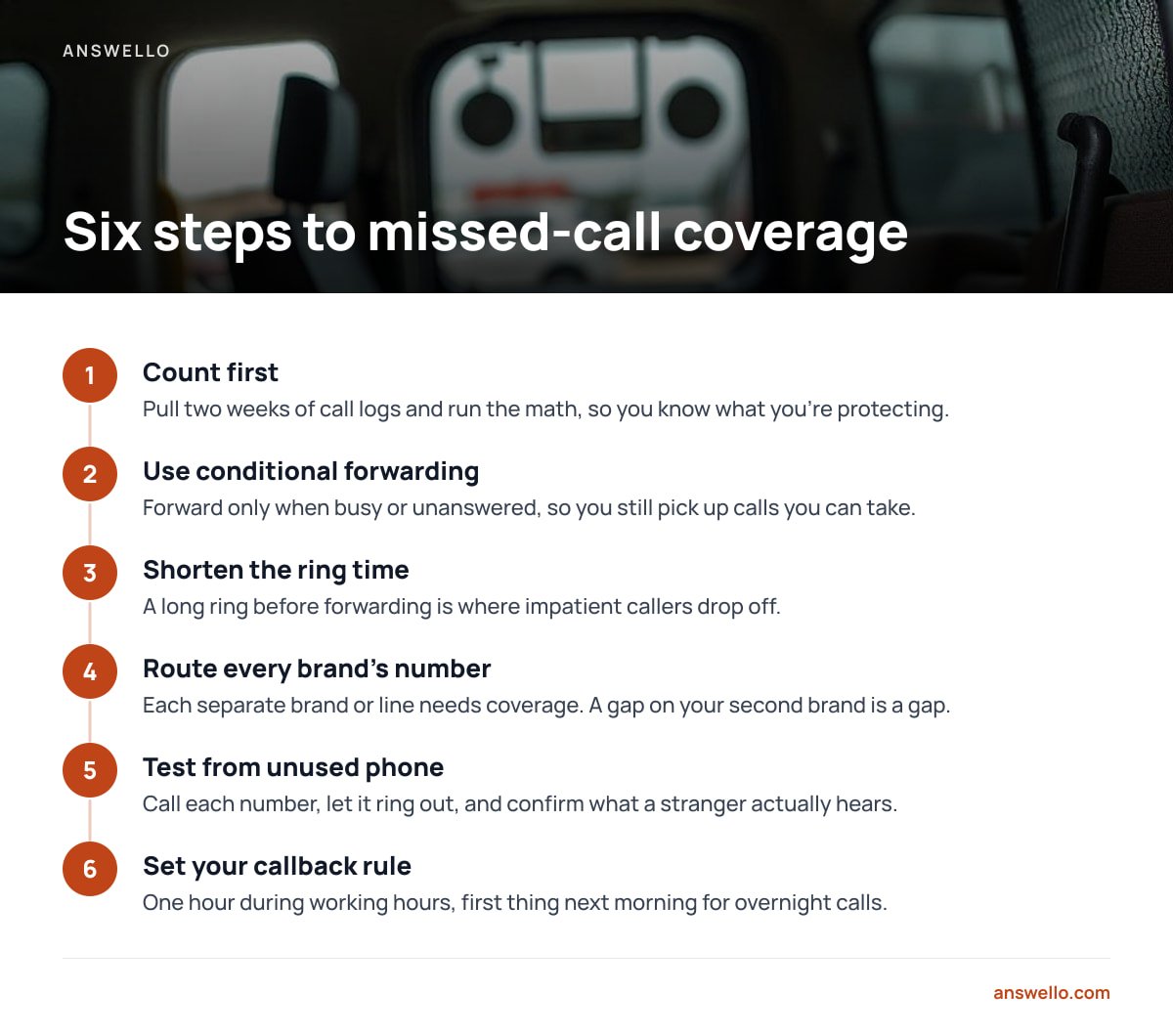
- Count first. Pull two weeks of call logs and run the math from the table above, so you know what you're protecting.
- Use conditional forwarding, not full forwarding. Forward only when you're busy or don't answer, so you still pick up the calls you can take. Your carrier sets the codes and settings, so check its support page.
- Shorten the ring time if your carrier allows it. A long ring before forwarding is where impatient callers drop off.
- Route every brand's number. If you run separate brands or lines, each one needs coverage. A gap on your second brand is a gap all the same.
- Test from a phone you've never used. Call each number, let it ring out, and confirm what a stranger actually hears.
- Set your callback rule and keep to it. One hour during working hours, first thing the next morning for overnight calls.
Our step-by-step guide to forwarding missed calls to AI answering in about an hour covers the carrier settings in detail. If your problem is mostly Saturdays, start with weekend call answering options.
Pro Tip: If you run more than one brand, make sure every message you receive shows which number the customer dialed. Calling back a customer as "Smith Plumbing" when they rang "Northside Drains" makes a bad first impression in under five seconds.
Catch Every Missed Caller's Name, Number and Job, With No Monthly Bill Required
Answello picks up the calls you can't. It asks who's calling and what they need, then texts you their name, number and request along with a full transcript. Calls are recorded and viewable in a dashboard, so you can check exactly what was said before you call back. It covers multiple brands and numbers under one payment. The self-install package is $399 one-time. The fully set-up version with a custom script is $895 one-time. If you want ongoing tuning, there's an optional $119/month maintenance plan you can cancel anytime.
The honest limit is that Answello is a message-taker, not a dispatcher. It won't quote, book or make a judgment call on an emergency. You still have to make the callback, and make it fast. Also confirm your carrier supports conditional call forwarding on each line before you buy.
Frequently Asked Questions
What happens if I miss a call from a potential customer?
In most cases the caller tries the next contractor on their list rather than leaving a voicemail, especially for urgent jobs. Research on lead response shows interest drops sharply after the first hour. A missed call with no follow-up is usually a lost job.
Do customers leave voicemails when they call a contractor?
Many don't. Recruiters, suppliers and sales reps usually leave messages because calling back is their job. Homeowners with a problem tend to keep dialing until someone answers, so a voicemail box is a poor measure of how many real jobs you're missing.
Why does my business phone get so many unwanted calls?
A publicly listed business number gets scraped into marketing lists, robocall databases and recruiter files. Business-to-business calls are largely exempt from Do Not Call rules, so registering the line does little. Screening each caller's reason for calling is more effective than blocking unknown numbers.
How quickly should I return a missed call from a customer?
Within one hour during working hours, and first thing the next morning for overnight calls. Harvard Business Review research found leads contacted within an hour were nearly seven times as likely to qualify as those contacted later.
Is an automatic text-back enough to stop losing jobs?
It helps, but it misses anyone calling from a landline, which includes many older homeowners and commercial offices. It also captures nothing about the job itself. Pair it with a system that records the caller's name and request, or replace it with one.
Should I answer calls while driving between jobs?
No. NHTSA treats phone use while driving as a serious crash risk, and you can't take down an address safely at the wheel. Forward missed calls to a system that captures details, and call back once you've parked.
Sources
- The Short Life of Online Sales Leads | Harvard Business Review
- Stop Unwanted Robocalls and Texts | Federal Communications Commission
- National Do Not Call Registry | Federal Trade Commission
- Distracted Driving | National Highway Traffic Safety Administration
Leave a Reply