A weekend call answering service for small business has two jobs. It has to catch every Saturday and Sunday call, and it has to tell you which ones can't wait until Monday. The real choice is not human versus AI. It is whether you pay every month for coverage you only use two days a week, or pay once for a system that sorts weekend calls and texts you a summary. For most trades owners, paying once wins on cost.
TL;DR:
- Weekend callers are usually more urgent than weekday callers, and many hang up on voicemail and call the next business on the list.
- Most paid answering options bill monthly or per minute, which means you pay for weekday capacity you don't need.
- A good weekend setup records the caller's name, number and problem, flags emergencies, and texts you within seconds.
- If you pay staff to sit by the phone on weekends, U.S. wage rules may count that whole shift as paid working time.
- Call recording is legal almost everywhere if you announce it at the start of the call, so put that line in your greeting.
Table of Contents
- Why Weekend Calls Are Worth More Than Weekday Ones
- Your Four Weekend Options, and What Each One Really Costs
- What a Weekend Call Answering Service for Small Business Must Do on a Saturday
- Paying Someone to Cover the Phone: The On-Call Math
- Recording Weekend Calls Legally, in the U.S. and Abroad
- Setting Up Weekend Coverage Before Friday Afternoon
- Which Option We'd Pick, by Type of Business
- Catch Every Saturday Job Without Adding Another Monthly Bill
- Frequently Asked Questions
- Sources
Why Weekend Calls Are Worth More Than Weekday Ones
A Tuesday caller is often shopping around. A Saturday caller usually has a problem right now: a tripped main breaker, a furnace that quit overnight, water coming through a ceiling. People who call a trade on a weekend have often already decided to pay someone. What they haven't decided is who.
That changes what a missed call costs you. When a weekday caller hits your voicemail, they might wait for a callback. When a weekend caller hits voicemail, they go back to the search results and dial the next listing. You won't see that call in any report. It just turns into a quiet Monday.
Here is a simple way to estimate your own weekend leak. You don't need industry averages for this, only your own phone log:
- Count missed weekend calls. Check your carrier's call history for the last four weekends. Count unique numbers, not repeat attempts.
- Estimate how many would have booked. Be conservative. If you normally convert half of the callers you actually speak to, assume a third of these.
- Multiply by your average weekend ticket. Weekend and emergency work often carries a premium rate, so use that figure, not your weekday average.
Say you miss six calls a weekend, two would have booked, and your average weekend job is $400. That is $800 a weekend, or more than $40,000 a year, walking to someone else.
Your Four Weekend Options, and What Each One Really Costs
Every option below works on some level. They differ in who picks up, whether anyone sorts the urgent calls from the routine ones, and how the bill is structured.
| Option | Who answers | Sorts urgent calls? | How you pay | Main weakness |
|---|---|---|---|---|
| Voicemail | Nobody | No | Free | Many weekend callers hang up without leaving a message |
| You answer everything | You, on a job or at a family event | Yes, when you pick up | Your weekend | Burnout, and calls still get missed while your hands are full |
| Live human answering service | Agents at a call center | Usually, if you write the script | Monthly plan or per-minute rate | You pay all month for coverage you need two days a week |
| AI answering, subscription | Software | Yes | Monthly fee, often charged per number or per site | The cost multiplies if you run several brands or numbers |
| AI answering, one-time purchase | Software | Yes | One upfront payment | You handle setup yourself, or pay once to have it done |
The table shows a structural problem. Weekend coverage is a part-time need, but most answering products are sold as full-time subscriptions. If your weekdays are already covered by you, a dispatcher or a spouse, you are paying for five days of capacity just to use two.
Run the five-year numbers before you sign anything. Our breakdown of what a low-cost answering service really costs over five years walks through that math. A plan that looks cheap at signup can end up costing more than a truck payment once you add per-number fees and overage minutes.
What a Weekend Call Answering Service for Small Business Must Do on a Saturday
Whatever you buy, test it against what actually happens on your weekend. Here is the minimum it should handle:
- Capture the basics every time. Caller name, callback number, address or area, and the problem in their own words. If any of these is missing, you end up phoning back just to ask questions.
- Separate emergencies from errands. "No heat and there's a newborn in the house" and "Can I get a quote on a panel upgrade?" should never land in your phone the same way. The system should ask the triage questions you would ask.
- Text you, not just log it. A dashboard you check Sunday night is useless for a burst pipe. You want a text summary within seconds of the call ending.
- Handle every number you run. Many trades operators run two or three brands, or keep a separate number for a plumbing side business or a second town. Each line should be covered without paying for each line separately.
- Keep a record. A recording and transcript settle disputes about what was promised. They also show you which calls you are losing and why.
- Never commit you to anything. The answering system should collect information and set expectations, such as "the owner will call you back within 30 minutes." It should not quote prices or book a slot you can't fill.
If you want to see how these features compare across products and pricing models, our guide to AI call answering service costs goes through them line by line.
Paying Someone to Cover the Phone: The On-Call Math
The traditional fix is to put an employee or family member "on the phone" for the weekend. Before you do that, understand how U.S. wage law treats it.
The U.S. Department of Labor's Fact Sheet #22 on hours worked draws a clear line. An employee who is required to stay on call at your premises, or so close by that they can't use the time for their own purposes, is working. Someone who only has to leave word where they can be reached is generally not working while they wait.
If the person covering your phone has to stay at the shop to take calls, the Department of Labor treats that entire shift as hours worked, not just the minutes spent talking.
For a small shop, that means a staffed Saturday phone can easily cost you a full day's wages, plus overtime if that person already worked 40 hours that week. A looser on-call arrangement is cheaper. But a person carrying a phone at a barbecue still misses calls, and you still get nothing in writing about what each caller needed.
Rules outside the U.S. differ, so check your local employment standards before you set up any on-call roster.
Recording Weekend Calls Legally, in the U.S. and Abroad
Recordings and transcripts are among the most useful parts of any answering setup. They are also the part most likely to cause trouble if you skip one sentence in your greeting.
In the United States, consent rules are set state by state. The Reporters Committee for Freedom of the Press keeps a state-by-state recording guide. It shows that most states require only one party to consent, but a minority, including California, Florida and Pennsylvania, require every party to agree. Because a caller from a strict state can reach your number from anywhere, the safe default is to treat every call as an all-party-consent call.
In the UK, the Information Commissioner's Office expects businesses that record calls to tell callers they are being recorded and to have a lawful basis for keeping the recording. Other jurisdictions have their own versions of the same rule.
The fix is the same everywhere. Open with something like: "This call is recorded so we can get your details right." It takes four seconds and covers you in almost every jurisdiction your callers are likely to be in.
Setting Up Weekend Coverage Before Friday Afternoon
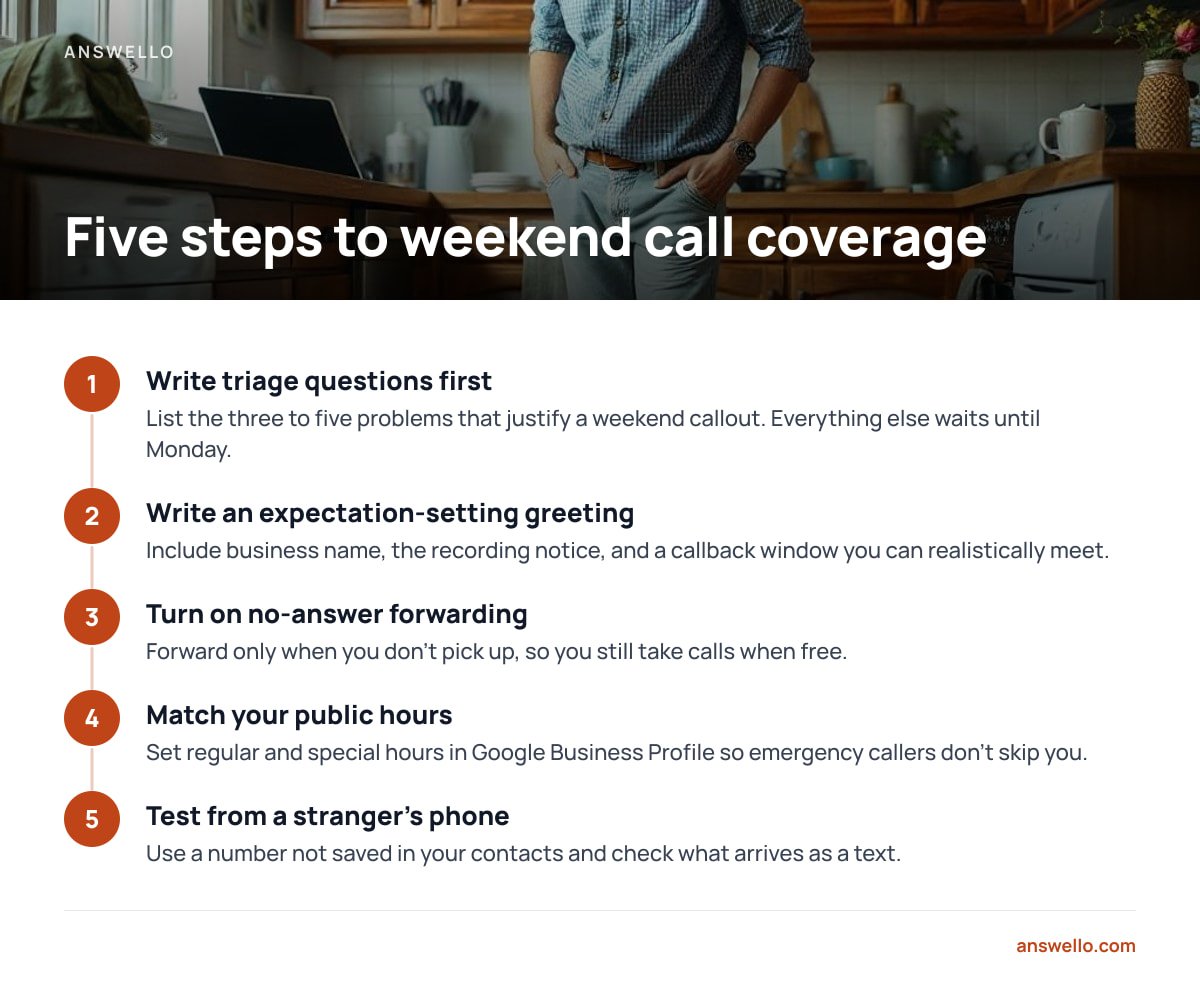
Most setups use conditional call forwarding. Your number rings as usual, and if nobody answers, the call moves to the answering system. Your carrier controls this, and most business lines support it. Here is the order to do it in:
- Write the triage questions first. List the three to five problems that justify a weekend callout in your trade. Everything else becomes "we'll call you Monday."
- Write a greeting that sets expectations. Include your business name, the recording notice, and the callback window you can realistically meet.
- Turn on no-answer forwarding. Forward only when you don't pick up, so you still take calls yourself when you're free.
- Match your public hours. Google Business Profile lets you set regular and special hours. If your listing says "Closed" on Saturday, many emergency callers will skip you before they ever dial.
- Test from a stranger's phone. Use a number that isn't saved in your contacts, and check what actually arrives as a text.
Our step-by-step guide to forwarding missed calls to an AI answering system in about an hour covers the carrier codes and the testing process in detail.
Pro Tip: Put your weekend callout fee in the greeting itself, for example: "Weekend emergency visits start at $195." It feels like it would scare callers off. In practice it filters out people who were only after a free quote, and the callers who stay on the line have already accepted the price. Your Saturday callbacks become bookings instead of negotiations.
15 to 20 seconds is roughly three to four rings. Set your no-answer forwarding delay there.
A shorter delay means you can't reach your phone in time. A longer one means the caller has already hung up.
Which Option We'd Pick, by Type of Business
Here is our recommendation for each common setup, with the reasoning:
- Solo electrician or plumber. Use one-time AI answering with emergency triage. You can't afford a live service's monthly minimum for two days of coverage, and voicemail loses exactly the high-value callers you want. Our breakdown of the best AI answering service for electricians covers trade-specific triage questions.
- HVAC with seasonal spikes. Use AI answering, with the triage tuned so "no heat" or "no cooling" goes to the top of the list. A live service charges the most during a cold snap, which is exactly when you need it. See our guide to AI receptionists for HVAC companies for sample scripts.
- Multi-brand operator. Pay once for a system that covers every number. Per-number subscriptions punish you for growing.
- Shop with a full-time dispatcher on weekdays. Keep the dispatcher and use AI only for overflow and weekends. Don't pay for full-week coverage to fill a two-day gap.
The only case where we'd pick a live human service is a business where every weekend call needs a judgment call on the spot, such as a property manager handling tenant emergencies with complicated escalation rules. For most trades, a clear set of triage questions does the job.
Catch Every Saturday Job Without Adding Another Monthly Bill
Answello picks up the weekend calls you can't take. It asks your triage questions, records the call, and texts you the caller's name, number and what they need, usually before you've put your tools down. One payment covers every brand and number you run. The do-it-yourself package is $399 one-time. The done-for-you package, with a custom script written around your emergency rules, is $895 one-time. If you'd like someone to keep tuning the scripts as your business changes, there is an optional $119/month maintenance plan you can cancel anytime. You don't need it for the system to work.
One honest limit: Answello takes the message and sorts the urgent calls, but it doesn't send a tech out. A no-heat call at 9 p.m. Saturday still needs you or someone on your team to call back. Before you buy, confirm that your carrier supports no-answer call forwarding, and check our spec sheet against your phone setup, the same way you would with any other product.
Frequently Asked Questions
Is a weekend call answering service worth it for a one-person business?
Usually, yes, if you miss more than a couple of weekend calls a month. Weekend callers tend to have urgent problems and go straight to the next listing if you don't answer. One booked emergency job often covers the cost of a one-time AI setup.
Can AI really tell an emergency call from a routine one?
It can if you give it the right questions. You define the problems that justify a weekend callout, such as no heat, active leaks or power loss, and the system asks about them and flags matching calls in the text it sends you. It sorts calls by your rules rather than making independent judgments.
Do I need to tell callers their weekend call is being recorded?
Yes, that is the safe approach. Several U.S. states, including California, Florida and Pennsylvania, require all parties to consent to a recording, and UK guidance expects callers to be told. A short recording notice in your greeting covers you in nearly every jurisdiction.
Will forwarding weekend calls stop my phone from ringing?
Not if you use no-answer forwarding. Your phone rings first, and the call only moves to the answering system if you don't pick up within the delay you set, typically 15 to 20 seconds. You can still take any call you're free to answer.
What's the cheapest way to cover weekend calls for multiple business numbers?
A one-time-purchase system that covers every number under a single payment is usually cheapest over a few years. Subscription services often charge per number or per site, so costs rise every time you add a brand. Compare the five-year total, not the monthly price.
Sources
- Fact Sheet #22: Hours Worked Under the Fair Labor Standards Act | U.S. Department of Labor, Wage and Hour Division
- Reporters Recording Guide | Reporters Committee for Freedom of the Press
- Guidance on data protection and call recording | Information Commissioner's Office
- Google Business Profile Help | Google
Recommended
- DIY AI Phone Answering Setup: Forward Missed Calls in an Hour
- Best AI Answering Service for Electricians: What to Buy and Why
- AI Receptionist for HVAC Companies: Costs, Triage and Setup
- AI Call Answering Service: What It Actually Costs
- After-Hours Voicemail Greeting for Contractors: Scripts That Work
Leave a Reply